



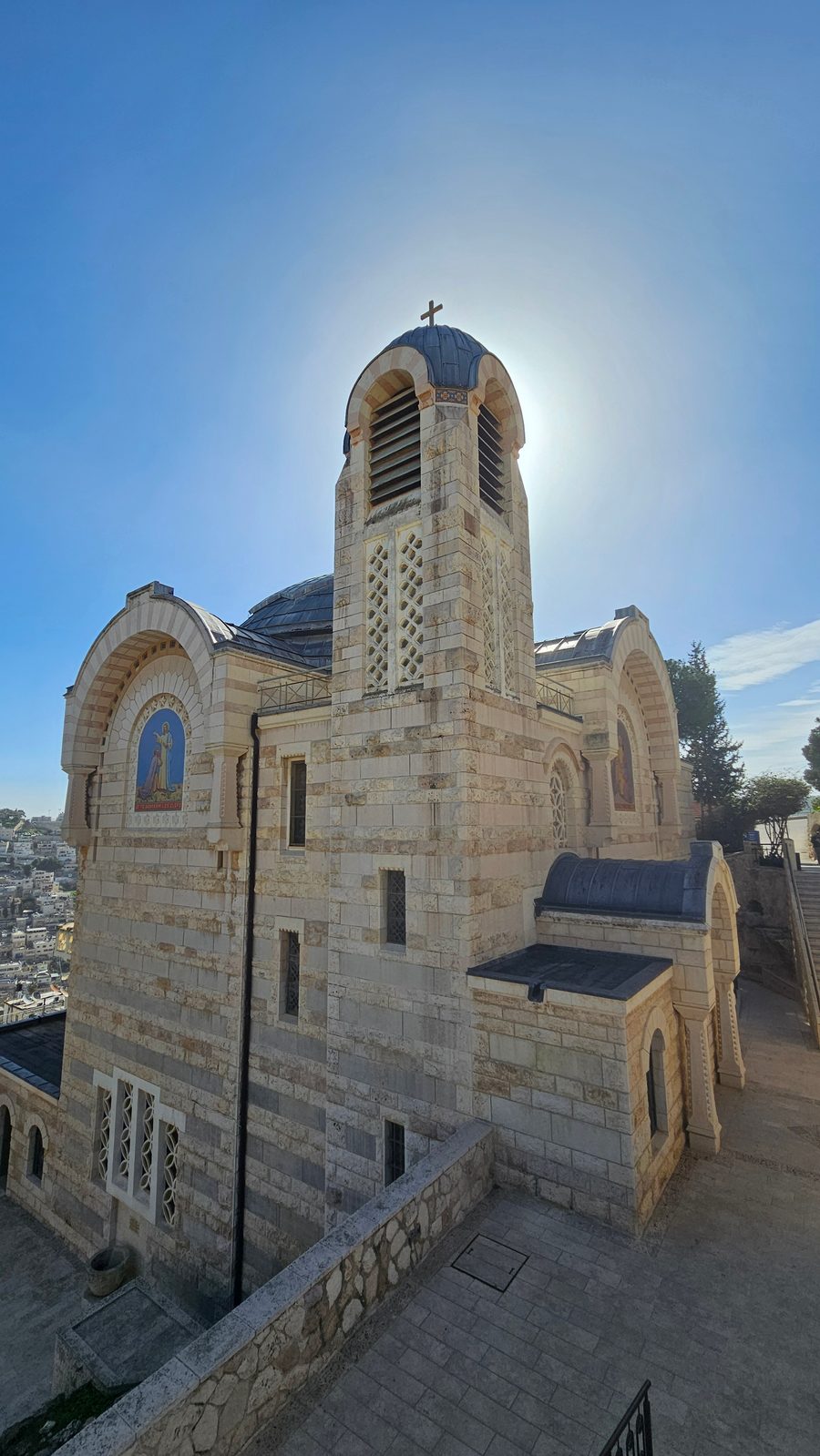
The Church of St. Peter in Gallicantu Jerusalem Israel (Latin for “at the cock’s crow”) stands on the eastern slope of Mount Zion marking the traditional site of the palace of the High Priest Caiaphas, where tradition holds Jesus was held overnight after his arrest and where tradition holds that Peter denied him three times before the rooster crowed.
Peter’s Denial
The story is told in all four Gospels. After Jesus was arrested in Gethsemane he was brought to the house of the High Priest for an informal trial. Peter followed at a distance and waited in the courtyard. Three times, people recognized him as one of Jesus’ followers. Three times, tradition holds that Peter denied it: “I don’t know the man!” (Matthew 26:72). Then the rooster crowed, and Peter remembered Jesus’ prediction: “Before the rooster crows, you will disown me three times” (Matthew 26:34). Peter went outside and wept bitterly.
The church’s name, Gallicantu, preserves this moment in stone. The rooster that crowed in the predawn darkness of that night gave the hill its name, and the church built here ensures that the sound of that crow echoes through every visit.
The St. Peter in Gallicantu
The church belongs to the Assumptionist Fathers, a French Catholic order, and was built in 1931 on the remains of earlier Byzantine and Crusader churches. A golden rooster stands prominently on the roof, a reminder of the cock’s crow that shattered Peter’s courage that night.
The interior is designed on multiple levels that descend into the hillside, each level taking you deeper into the events of that night. The upper church is dominated by large, vivid mosaics covering the walls. On the back wall, a bound Jesus stands before Caiaphas during the nighttime trial. On the right wall, Jesus and the disciples share the Last Supper. On the left, Peter is depicted in ancient papal vestments as the first pope, the church’s way of saying that despite the denial, Peter’s story does not end in that courtyard. Brilliant stained-glass windows fill the space with colored light, and many of the inscriptions are in French, reflecting the Assumptionist order’s origins.
In the courtyard outside, a statue depicts the scene of the denial: Peter, the servant woman who recognized him, a Roman soldier, and above them the rooster. It was here, according to the Gospels, that Peter stood by the fire and three times denied knowing Jesus. And it was here that “the Lord turned and looked straight at Peter” (Luke 22:61), a single glance that broke him. Beneath the upper church, a middle level preserves Byzantine-era mosaics uncovered during excavation, likely from a 5th-century church that stood on this site, as well as Crusader-period stonework, evidence that Christians have been marking this place for over 1,500 years.
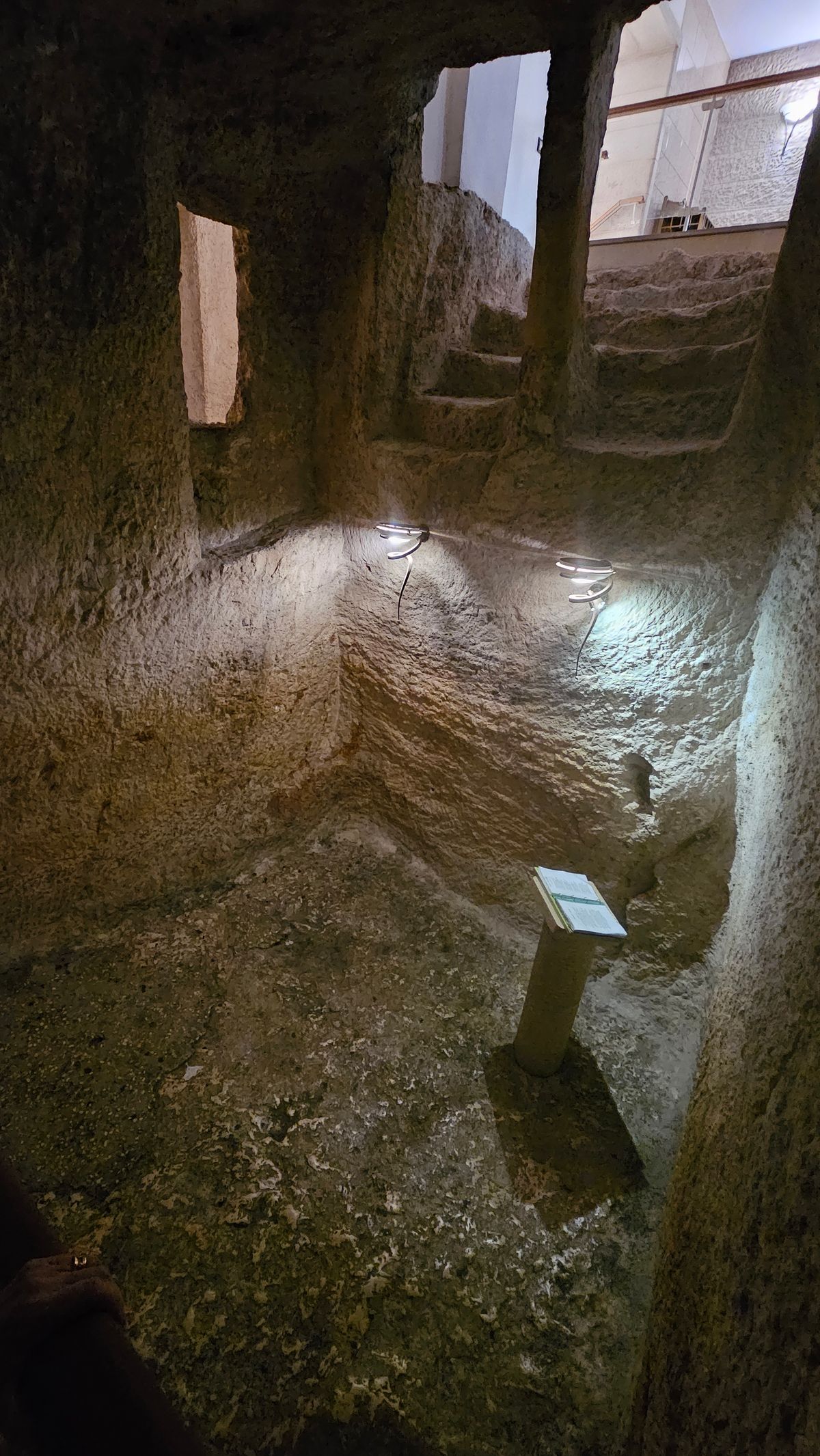
Sacred Pit
Below the church, a network of rock-cut chambers descends into the hillside. The upper chambers include what tradition identifies as a guardroom, with fixtures carved into the rock that may have been used to restrain prisoners, holes in stone pillars where hands and feet could be bound, and small bowls carved into the floor that some believe held salt or vinegar. Whether this was indeed a detention facility, a stable, or some other domestic installation in a wealthy first-century household remains an open question, the archaeology allows for multiple interpretations.
The deepest chamber, accessible only by a narrow staircase carved into the rock, is known as the Sacred Pit. It is a small, cold, dark space hewn from the bedrock. Tradition holds that this may have been the place where Jesus was held overnight after his trial before Caiaphas, before being taken to Pontius Pilate in the morning. An opening in the ceiling above is traditionally identified as the hole through which a prisoner may have been lowered by rope into the chamber below.
Christian pilgrims have come here for centuries to read Psalm 88, one of the most despairing psalms in the Bible and the only psalm that ends without a note of hope: “You have put me in the lowest pit, in the darkest depths” (Psalm 88:6). “Darkness is my closest friend” (Psalm 88:18). Reading these words in the pit itself, surrounded by cold stone and silence, is one of the most powerful moments in any pilgrimage to Jerusalem. Whether or not this is the exact spot, the physical experience of descending into darkness and reading the psalm brings the Passion narrative to a reality that few other sites can match.
Ancient Steps
Outside the church, a set of ancient stone steps descends the hillside toward the Kidron Valley. These steps date to the Second Temple period and are among the most authentic first-century remains in Jerusalem. They may well be the path that tradition holds that Jesus walked, under guard, from Gethsemane to the house of the High Priest on the night of his arrest.
The steps are part of a broader network of ancient paths that connected the upper and lower parts of Jerusalem. Excavations beside the church have uncovered remains of grand residences on the slope, including cisterns, storage rooms, and ritual baths. Some scholars believe these may include the remains of the High Priest’s own house, the place where tradition holds Jesus stood trial that night. Walking down these steps in the evening light, with the Kidron Valley below and the Mount of Olives across the valley, is one of the most powerful experiences on Mount Zion.
The View of the City of David and Kidron Valley
The terrace outside the church is one of the best viewpoints in Jerusalem for understanding the geography of the Passion. The panoramic view that takes in the City of David the Kidron Valley the village of Silwan, and the Mount of Olives. The view connects the geography of the Passion: from Gethsemane across the valley, up the ancient steps to Caiaphas’s house, and then (the next morning) to Pilate’s judgment hall and the Via Dolorosa.
Visit with Hoshen Tours
St. Peter in Gallicantu brings the Passion narrative to life with archaeological evidence, architectural design, and a physical descent into the darkness of that night. The church works on multiple levels, literally and figuratively, taking visitors from the story of Peter’s denial in the upper church, down through the trial before Caiaphas, into the pit where Jesus may have spent his last night, and out to the ancient steps he may have climbed under arrest. Hoshen Tours includes it in Mount Zion and Passion itineraries, and recommends visiting in the late afternoon when the light on the Kidron Valley and Mount of Olives is at its best.
Ready to experience Israel in true colors?
Plan Your TourPrivate tours designed around your interests, schedule, and pace.