



The Church of the Visitation stands on the hillside above Ein Karem, marking the place where, according to the Gospel of Luke, the young Mary, newly pregnant with Jesus, traveled from Nazareth to visit her elderly cousin Elizabeth, who was pregnant with John the Baptist. The meeting of the two women, described in Luke 1:39–56, produced one of the most important prayers in Christianity: the Magnificat.
The Visitation Jerusalem
Luke’s Gospel describes Mary hurrying “to a town in the hill country of Judea” to visit Elizabeth. When Elizabeth heard Mary’s greeting, the baby in her womb, the future John the Baptist, leaped for joy. Elizabeth cried out: “Blessed are you among women, and blessed is the child you will bear! But why am I so favored, that the mother of my Lord should come to me?” (Luke 1:42–43). The unborn John recognized the unborn Jesus, the first act of recognition in the Gospel narrative, before either child had been born.
The scene is rich with meaning. Mary, a young woman from the Galilee, makes a journey of about 150 kilometers through the Judean hills, alone, pregnant, and in haste. The meeting of the two women is the meeting of two miracles: Elizabeth, old and barren, carrying the last prophet of the old covenant; Mary, young and virgin, carrying the one who would fulfill it. For Christian theology, this moment in a hillside village in Judea is where the Old Testament and the New Testament embrace.
The Magnificat
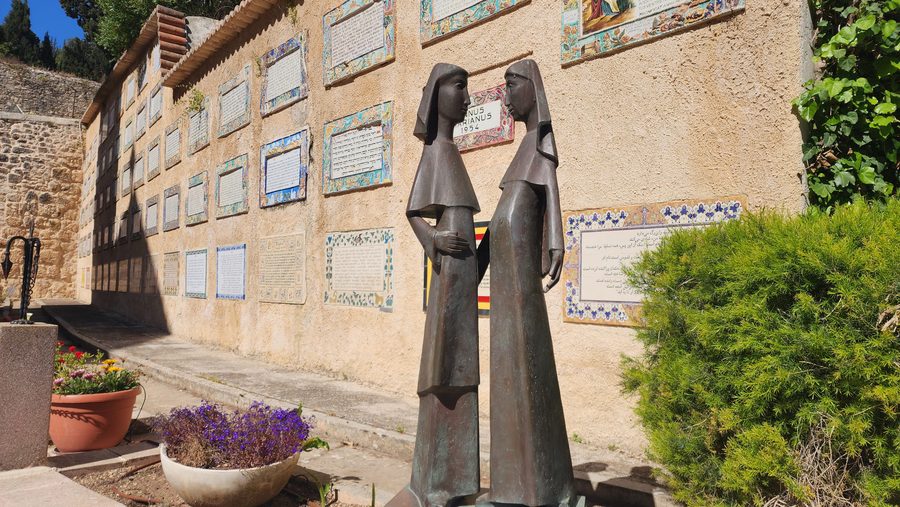
Mary responded with the prayer known as the Magnificat, one of the most recited texts in Christian liturgy: “My soul magnifies the Lord, and my spirit rejoices in God my Savior, for He has looked with favor on the lowliness of His servant” (Luke 1:46–48). The prayer continues with themes of divine justice: the mighty brought low, the humble exalted, the hungry filled, that echo through the social teaching of Christianity. In the courtyard of the church, the Magnificat is inscribed on ceramic tiles in 42 languages, each translation a testimony to the prayer’s reach across cultures and centuries. Visitors often search for their own language on the wall, and finding it, reading the words of a first-century Jewish girl in their mother tongue, is one of the unexpectedly moving moments of a visit to Ein Karem.
The Church of the Visitation
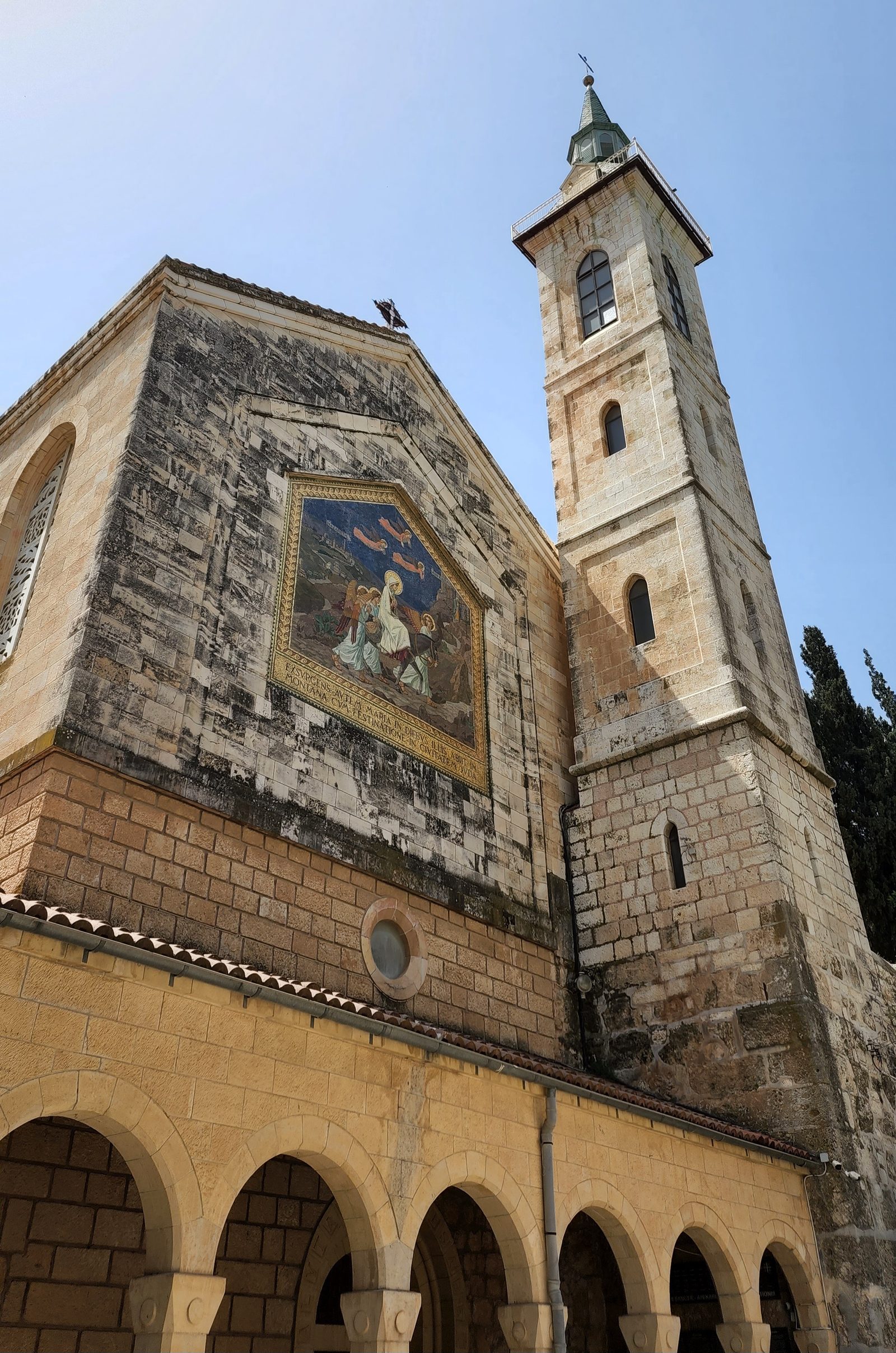
The current church was designed by the Italian architect Antonio Barluzzi and completed in 1955. It is built on two levels. The lower church, dark and cave-like, incorporates a grotto and a rock cistern traditionally associated with the hiding place of the infant John the Baptist during the Massacre of the Innocents. The upper church is bright and airy, its walls covered with large frescoes depicting scenes related to the Magnificat and the Visitation. The facade features a mosaic of Mary on a donkey traveling through the Judean hills to visit Elizabeth, a depiction of the journey that Luke describes in a single verse.
Barluzzi, sometimes called “the Gaudí of the Holy Land,” designed each of his churches to make the visitor feel the event, not just learn about it. Here, the contrast between the dark, cave-like lower church and the bright, celebratory upper church is deliberate: the lower level evokes the hiddenness and mystery of the pregnancies, while the upper level bursts with the joy of the Magnificat. It is architecture as theology.
The church stands on the remains of earlier Byzantine and Crusader churches that marked the same tradition. Archaeological remains of the earlier structures are visible in the lower church.
The Setting
The church is reached by climbing a steep path up the hillside from the center of Ein Karem. The walk takes about ten minutes and the path is lined with olive trees and bougainvillea. From the church courtyard, the view looks down over the village of Ein Karem with its stone houses, church towers, and terraced gardens, a landscape that has changed remarkably little since the Crusader period.
Ein Karem itself is one of the most beautiful villages in the Jerusalem hills, a place of narrow lanes, artists’ studios, stone terraces, and ancient springs. Before 1948 it was an Arab village; today it is a neighborhood of Jerusalem with a bohemian character and a concentration of churches, monasteries, and convents that reflect its importance in the Christian story. The name Ein Karem means “spring of the vineyard,” and the spring that gave the village its name still flows at the foot of the hill.
Visit with Hoshen Tours
The Church of the Visitation is one of the two essential churches in Ein Karem, together with the Church of St. John the Baptist in the village below. Hoshen Tours visits both, telling the story of the two miraculous pregnancies, the meeting of the two mothers, and the prayer that emerged from that meeting. The walk up the hill to the Church of the Visitation, through olive trees and past the Magnificat wall, is itself part of the experience, a small pilgrimage within the pilgrimage.
Ready to experience Israel in true colors?
Plan Your TourPrivate tours designed around your interests, schedule, and pace.