



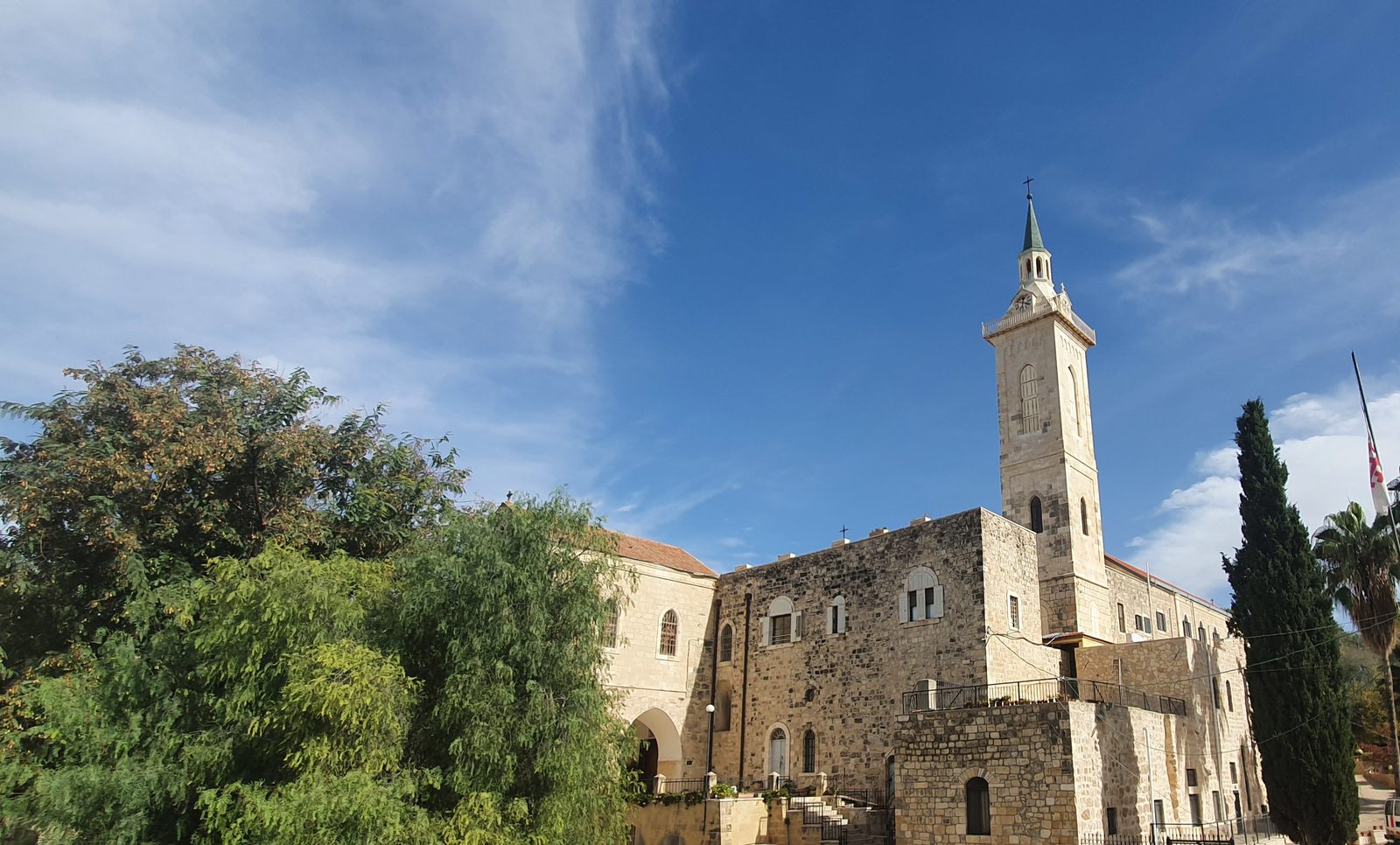
Church of St.The Church of St. John the Baptist stands in the heart of Ein Karem, marking the traditional birthplace of John the Baptist, the prophet who baptized Jesus in the Jordan River and whose voice, “crying in the wilderness,” announced the coming of the Messiah. The church is one of the oldest in the Jerusalem hills, built over a grotto where tradition holds that John was born to the elderly priest Zechariah and his wife Elizabeth. The Gospels never mention Ein Karem by name. Luke refers only to “a town in the hill country of Judea” (Luke 1:39), but Christian tradition has identified this village as the home of Zechariah and Elizabeth since at least the Byzantine period.
The Birth of John
The Gospel of Luke tells the story in extraordinary detail. The angel Gabriel appeared to Zechariah while he was serving in the Temple in Jerusalem, announcing that his wife Elizabeth, old and barren, would bear a son who would “make ready a people prepared for the Lord” (Luke 1:17). Zechariah doubted, and Gabriel struck him mute: “You will be silent and not able to speak until the day this happens, because you did not believe my words” (Luke 1:20). Elizabeth conceived. When the child was born, the family expected him to be named Zechariah after his father, but Elizabeth insisted on John. They turned to the mute Zechariah, who wrote on a tablet: “His name is John.” Immediately his tongue was loosed, and he spoke the prophecy known as the Benedictus (Luke 1:68–79).
The prayer begins: “Blessed be the Lord God of Israel, for He has visited and redeemed His people.” Zechariah prophesies that his son John will “go before the Lord to prepare His ways, to give knowledge of salvation to His people by the forgiveness of their sins” (Luke 1:76–77). The Benedictus is the counterpart to Mary’s Magnificat: where Mary’s prayer celebrates what God is about to do, Zechariah’s declares what God has already set in motion. Like the Magnificat, the Benedictus is recited daily in the liturgy of the hours in churches around the world. Every morning, as the sun rises, the words that a mute priest spoke in a village in the Judean hills echo across every continent.
The scene is extraordinary: a priest struck mute in the Temple for his disbelief, silent through his wife’s entire pregnancy, suddenly given back his voice at the moment he obeys, and the first thing he does with that voice is prophesy. The Benedictus, like Mary’s Magnificat at the Church of the Visitation up the hill, is still recited daily in churches around the world.
The Grotto of the Nativity of John
Beneath the church, a grotto carved into the hillside rock is venerated as the birthplace of John. A marble inscription on the floor reads: “Hic praecursor Domini natus est”: “Here the precursor of the Lord was born.” The grotto is small, candlelit, and deeply atmospheric. A niche in the rock marks the traditional spot where Elizabeth gave birth. The grotto predates the church above it and has been a site of Christian veneration since at least the 5th century. For pilgrims, descending into this small rock-cut space beneath the church floor is a moment of intimacy: the birthplace of the man who would one day stand in the Jordan River and declare, “Behold, the Lamb of God, who takes away the sin of the world” (John 1:29). The contrast between the humility of this cave and the enormity of what began here is part of the power of the site.
The Church of St. John the Baptist in Ein Karem
The current church is a Franciscan structure, rebuilt multiple times over the centuries. The core of the building dates to the Crusader period (12th century), though it incorporates elements of earlier Byzantine construction. The interior has three naves separated by columns, and the walls display remnants of medieval frescoes. The church’s architecture reflects the layers of history that characterize so many Holy Land churches: ancient grotto, Byzantine foundations, Crusader walls, and modern restoration. A courtyard shaded by citrus trees and lined with archaeological fragments surrounds the building, creating one of the most peaceful spaces in Ein Karem. The Franciscans, who have maintained the church since the 17th century, also run a small monastery adjacent to the church. The bell tower, visible from across the village, is one of the landmarks that gives Ein Karem its distinctive skyline of stone houses and church spires.
Zechariah and the Temple
The story of John’s birth begins not in Ein Karem but in the Temple in Jerusalem, where Zechariah was chosen by lot to enter the Holy Place and offer incense, a once-in-a-lifetime privilege for a priest. It was there that Gabriel appeared to him. The connection between the Temple in Jerusalem and the grotto in Ein Karem, between the announcement and the birth, between silence and speech, is one of the great narrative arcs of the Gospel of Luke. Zechariah was an ordinary priest from a minor division, not a high priest, not a figure of power, and the lot that chose him to enter the Holy Place was a moment of pure chance. Or, as Luke would have it, divine design. The angel’s appearance to this ordinary man, in the holiest space in Judaism, announcing the birth of the last prophet. It is a scene that belongs both to the end of the Hebrew Bible and the beginning of the Gospel.
John the Baptist
The child born in this grotto would grow up to live in the wilderness, wearing camel hair and eating locusts and wild honey. He would preach at the Jordan River, calling Israel to repentance and baptizing those who came. He would baptize Jesus himself, the moment that launched Jesus’ public ministry. And he would be executed by King Herod Antipas after denouncing the king’s marriage to his brother’s wife. The arc from this quiet grotto in the Jerusalem hills to the banks of the Jordan and the executioner’s sword is one of the most dramatic in the New Testament. Jesus himself said of John: “Among those born of women there has not risen anyone greater than John the Baptist” (Matthew 11:11), a statement that places the child born in this cave above every prophet, king, and priest in the Hebrew Bible. And yet, Jesus added, “the least in the kingdom of heaven is greater than he”, a paradox that has occupied Christian theologians for two thousand years.
The prophet Malachi closed the Old Testament with a promise: “Behold, I will send you Elijah the prophet before the great and awesome day of the Lord comes” (Malachi 4:5). When the angel Gabriel appeared to Zechariah in the Temple, he announced that his son would go before the Lord “in the spirit and power of Elijah” (Luke 1:17). John was not Elijah reborn. He was the one who would fulfill Elijah’s role: the forerunner, the voice that prepares the way. Like Elijah, John lived in the wilderness. Like Elijah, he confronted kings and demanded repentance. Like Elijah, he pointed not to himself but to what was coming. Jesus confirmed the connection directly: “If you are willing to accept it, he is the Elijah who was to come” (Matthew 11:14). For Christians, the child born in this grotto in Ein Karem is the bridge between the last prophecy of the Old Testament and the first chapter of the New.
Visit with Hoshen Tours
The Church of St. John the Baptist is one of two essential churches in Ein Karem, together with the Church of the Visitation up the hill. Hoshen Tours visits both, descending from Mary’s Magnificat to John’s birthplace, connecting the two miraculous births that set the stage for the Gospel story.
Ready to experience Israel in true colors?
Plan Your TourPrivate tours designed around your interests, schedule, and pace.