



 Hamat Tiberias lies just south of the city of Tiberias on the western shore of the Sea of Galilee, at a location that has drawn human activity for thousands of years. The site combines two remarkable attractions: natural hot springs that have drawn visitors since antiquity, and a 4th-century synagogue containing one of the finest and most debated mosaic floors ever found in Israel. That floor, a stunning zodiac wheel flanked by Jewish symbols, raises profound questions about the relationship between Jewish worship and Greco-Roman artistic traditions, and continues to fascinate archaeologists, historians, and visitors alike. Few sites in Israel manage to unite the pleasures of the physical world so seamlessly with the complexities of ancient intellectual and religious life.
The Hot Springs of Hamat Tiberias Galilee
Seventeen natural hot springs emerge at Hamat Tiberias, with water temperatures reaching up to 60 degrees Celsius (140 degrees Fahrenheit) and a mineral composition that ancient and medieval physicians regarded as medicinally powerful. The springs are rich in sulfur, sodium, calcium, and magnesium, a combination long associated with the treatment of skin conditions, arthritis, and respiratory ailments. When Herod Antipas founded the city of Tiberias between 18 and 20 CE, the presence of these springs was almost certainly a central consideration. The Roman world prized thermal bathing, and a city situated on the shores of a beautiful lake with natural hot springs at its doorstep was a prize of enormous value. Pliny the Elder, writing in the first century CE, mentioned the springs of Tiberias among the notable thermal waters of the region. Throughout the Roman and Byzantine periods, Hamat’s springs attracted visitors from across the eastern Mediterranean. Today a modern spa operates nearby, preserving a tradition of therapeutic bathing that stretches back more than two millennia.
The Synagogue and the Zodiac Mosaic
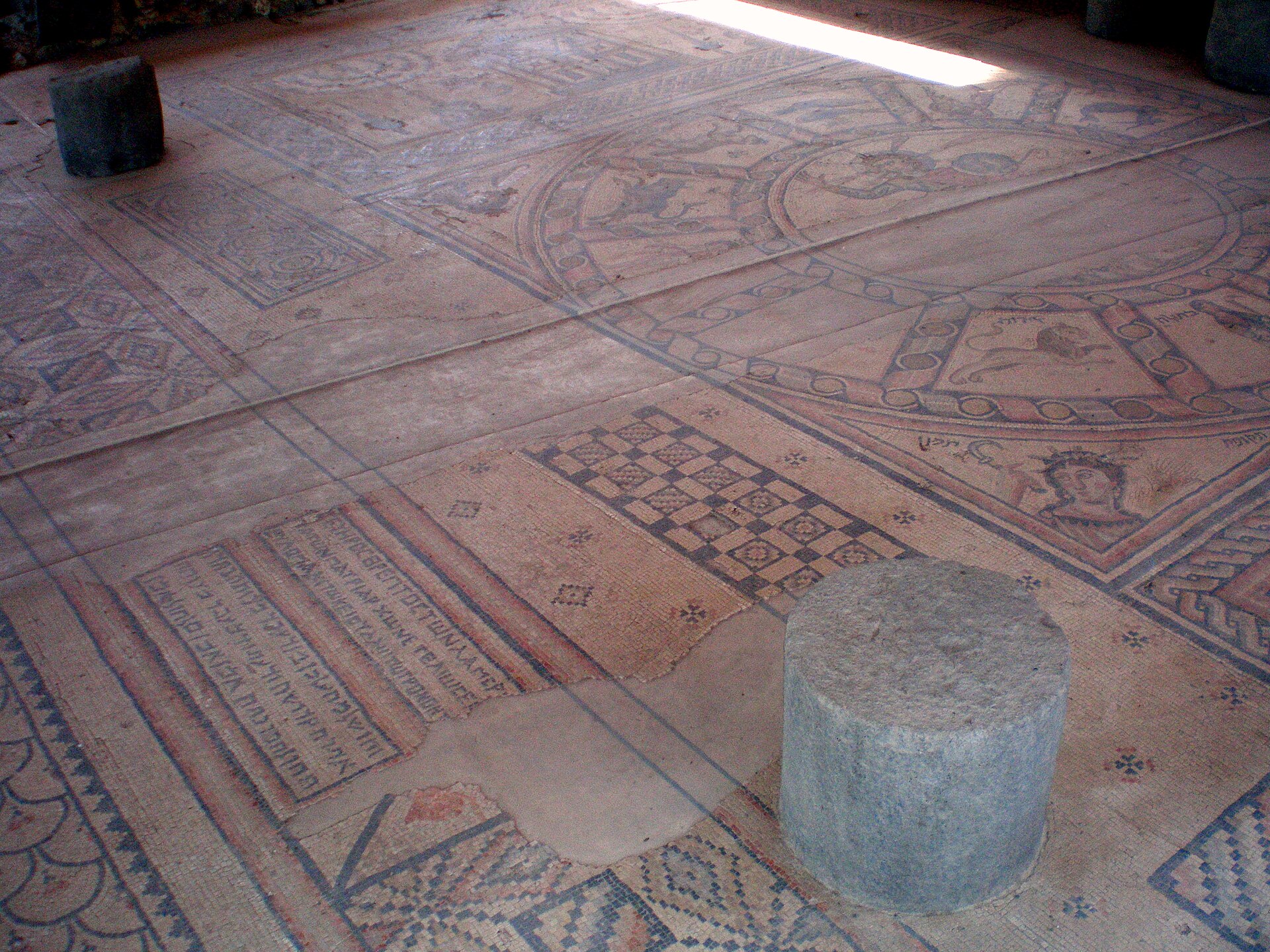
The ancient synagogue at Hamat Tiberias was first identified in 1947 during construction work and systematically excavated by Moshe Dothan in 1961–1963. The structure dates primarily to the 4th century CE, placing it in the late Roman and early Byzantine period, a time of great cultural and religious complexity in the Galilee. What makes this synagogue exceptional, even among the many remarkable ancient synagogues of Israel, is its mosaic floor, which is divided into three distinct decorative panels arranged along the building’s central nave.
The northernmost panel, closest to the Torah ark, depicts the ark itself flanked by two menorahs. Surrounding them are the ritual objects of Jewish worship: shofars, lulavs, and etrogim, rendered with careful detail. The central and most dramatic panel is the zodiac wheel. At its center stands Helios, the Greco-Roman sun god, driving a four-horse chariot across the sky. He is surrounded by the twelve signs of the zodiac, each labeled in Hebrew, Aries, Taurus, Gemini, and so on through the full cycle. The four corners of the panel feature female figures personifying the four seasons, also labeled in Hebrew. The southernmost panel contains a dedicatory inscription in Greek, naming the individuals who funded the synagogue’s construction. The mosaic is stylistically similar to the famous zodiac at Beit Alpha, but considerably more refined in its artistry and execution, with greater detail in the figures and more sophisticated use of color and perspective.
Helios in a Synagogue: The Scholarly Debate
The presence of Helios, a pagan deity, at the center of a synagogue floor has generated scholarly debate ever since the mosaic’s discovery. How should we understand an image of the sun god driving his chariot in a space dedicated to Jewish prayer and Torah reading? Several interpretations have been proposed, none of them conclusive. Some scholars argue the imagery was purely decorative, borrowed from the visual vocabulary of Greco-Roman art without any theological meaning. Others suggest it functioned as a cosmic calendar, with the zodiac serving as a visual aid for determining the timing of Jewish festivals and lunar months. A third view holds that the mosaic expressed a sophisticated theological idea: that God, the creator, rules over the heavens and the cycles of time, and that Helios, stripped of his divine identity, became simply an emblem of that cosmic sovereignty.
What the Hamat Tiberias mosaic makes undeniable is that ancient Jewish communities of the Galilee engaged deeply with the visual culture of the Greco-Roman world, and did not always regard pagan imagery as incompatible with Jewish sacred space. Similar zodiac mosaics have been found at the synagogues of Beit Alpha, Sepphoris (Zippori), and Huqoq, and a zodiac is referenced in an ancient inscription from Ein Gedi. Taken together, these discoveries have fundamentally reshaped scholarly understanding of ancient Jewish art, challenging assumptions that rabbinic prohibitions on images were universally applied in the late antique period.
Tiberias as a Center of Jewish Learning
The synagogue at Hamat Tiberias cannot be understood in isolation from the broader story of Tiberias itself. After the destruction of the Second Temple in 70 CE, Jewish leadership was forced to reconstitute itself outside of Jerusalem. The Sanhedrin, the supreme council of Jewish law, eventually settled in Tiberias, making the city the de facto center of rabbinic Judaism for several centuries. It was in Tiberias that the Jerusalem Talmud, the Palestinian counterpart to the better-known Babylonian Talmud, was compiled and edited, a process completed around 400 CE. That date corresponds almost exactly with the construction of the Hamat Tiberias synagogue, placing the two achievements in the same moment of extraordinary Jewish intellectual productivity.
Tiberias was also the home of the Masoretes, the scholars who between the 6th and 10th centuries CE developed the system of vowel markings and cantillation notes that stabilized the pronunciation and reading of the Hebrew Bible for all subsequent generations. The city was, and remains, one of Judaism’s four holy cities, alongside Jerusalem, Hebron, and Safed. The Hamat Tiberias synagogue, with its rich mosaic floor and its layered visual language, is a physical artifact of this period of intense Jewish spiritual and intellectual achievement.
Visit with Hoshen Tours
Hamat Tiberias pairs naturally with a full day on the shores of the Sea of Galilee and in the city of Tiberias itself. Hoshen Tours recommends combining the site with a visit to the Tomb of Maimonides in central Tiberias, where the great medieval philosopher and legal authority is believed to be buried, and to the Tomb of Rabbi Meir Baal HaNes, one of the most visited pilgrimage sites in the region. A short drive north along the western shore of the Sea of Galilee brings you to Magdala, the first-century synagogue discovered in 2009 in the hometown of Mary Magdalene, with its extraordinary Magdala Stone bearing the earliest known carved menorah.
The Sea of Galilee itself, its light, its fishermen, its Gospel associations, and its remarkable freshwater ecology, provides an unforgettable backdrop to all of it. Shuki Cohen of Hoshen Tours brings deep knowledge of this landscape and its layered histories, helping guests move fluidly between Jewish, Christian, Roman, and Byzantine layers of meaning without losing sight of either the human stories or the spectacular scenery. Whether you are a student of history, a pilgrim, or simply a curious traveler, Hamat Tiberias offers one of the most genuinely surprising and thought-provoking stops in the entire Galilee.
Explore Our Tour Collection
Ready to experience Israel in true colors?
Plan Your TourPrivate tours designed around your interests, schedule, and pace.