



Jacob’s Well is one of the few biblical sites whose identification is accepted by virtually all scholars, pilgrims, and traditions. Located at the eastern entrance to the valley between Mount Gerizim and Mount Ebal, near ancient Shechem, the well has been in continuous use for approximately 3,800 years. It is one of the deepest wells in the region, drawing from an underground spring rather than collected rainwater, and it still produces fresh water today. For Christians, tradition identifies this as the place where Jesus met the Samaritan woman and spoke the words that transformed the meaning of worship: “God is spirit, and his worshipers must worship in spirit and in truth” (John 4:24). For Jews, it is the well that Jacob dug when he settled near Shechem after his years with Laban. The well sits today inside a Greek Orthodox church that has been rebuilt, destroyed, and rebuilt again over nearly two thousand years.
Jacob at Shechem at Jacob’s Well: Where Jesus Met the Samaritan Woman
Genesis 33:18-20 records that Jacob, returning from his years with Laban in Haran, arrived at Shechem and purchased a plot of land from the sons of Hamor: “For a hundred pieces of silver, he bought the plot of ground where he pitched his tent. There he set up an altar and called it El-Elohe-Israel.” The well is not mentioned explicitly in Genesis, but the tradition that Jacob dug it on his purchased land is ancient and universal. The location makes practical sense: anyone settling in this valley would need a reliable water source, and the well’s depth (over 40 meters) and quality indicate serious, permanent construction, not a temporary camp well.
Jesus and the Samaritan Woman
The Gospel of John (chapter 4) describes Jesus arriving at Jacob’s Well, tired from his journey through Samaria, around noon. His disciples went into the nearby town to buy food. A Samaritan woman came to draw water, and Jesus asked her for a drink. The request itself was shocking: Jews did not share vessels with Samaritans, and a man would not normally speak to an unknown woman alone. The woman said as much: “You are a Jew and I am a Samaritan woman. How can you ask me for a drink?” (John 4:9).
What followed is one of the longest personal conversations Jesus has in any Gospel. He told the woman about “living water” that would become “a spring of water welling up to eternal life” (John 4:14). He revealed that he knew her personal history. And when she raised the central question dividing Jews and Samaritans, whether God should be worshiped on Mount Gerizim (visible from the well) or in Jerusalem, Jesus answered with words that redefined worship for all of Christianity: “A time is coming when you will worship the Father neither on this mountain nor in Jerusalem… God is spirit, and his worshipers must worship in spirit and in truth” (John 4:21-24). The woman became one of the first people to whom Jesus revealed his identity as the Messiah (John 4:26), and she then brought her entire town to meet him.
The story is remarkable for several reasons. It crosses ethnic boundaries (Jew and Samaritan), gender boundaries (man and woman alone), and religious boundaries (the question of where to worship). Christian tradition honors the Samaritan woman as Saint Photina (“the luminous one”), and regards her as the first evangelist, since she brought others to Jesus.
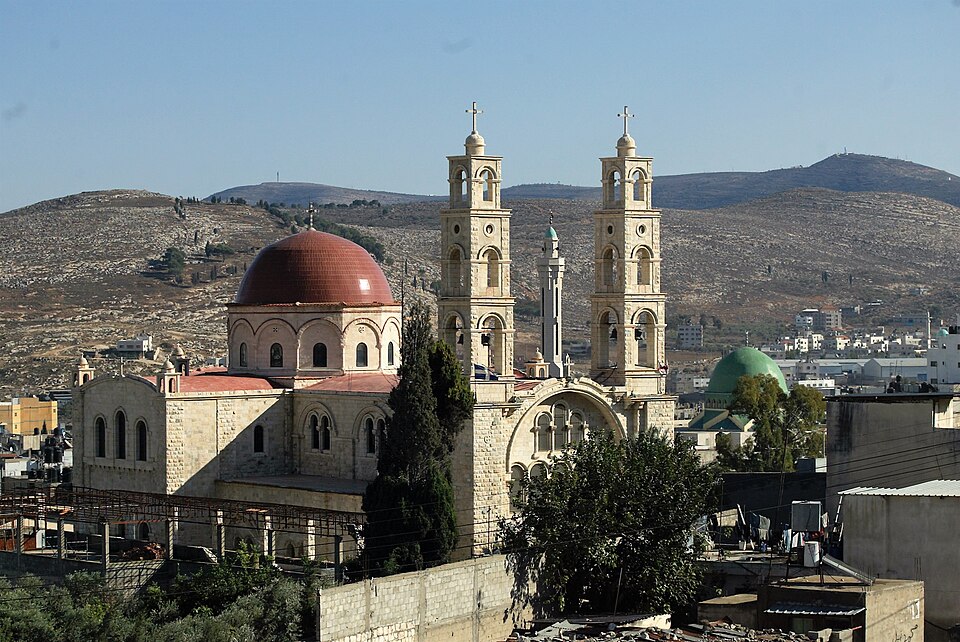
The Church of St. Photina
The name Photina comes from the Greek word for “light” (φωτεινή). According to Orthodox Christian tradition, this is the name given to the Samaritan woman whom Jesus met at the well. Though the Gospel of John does not name her, the Eastern Church venerated her as a saint who later traveled to Carthage and Rome, where tradition holds she was martyred during the reign of Emperor Nero. The church built over the well bears her name — a tribute to the unnamed woman whose conversation with Jesus became one of the most theologically significant encounters in the New Testament.
The first church over the well was built by the late 4th century CE, during the reign of Emperor Theodosius I. The Bordeaux Pilgrim, visiting in 333 CE, already noted the well’s location and its identification with John 4. The Byzantine church was a cruciform basilica with the well at the crossing point, directly beneath the altar. The church was destroyed during the Samaritan revolts of the 5th-6th centuries and rebuilt by the Crusaders in the 12th century, who maintained a small chapel over the well.
The current Greek Orthodox church, dedicated to St. Photina, whose site was acquired by the Greek Orthodox Patriarchate in 1860. Construction began in 1893 and, after earthquakes and many interruptions, was completed only in 2007. The church’s crypt preserves the well itself: visitors descend a staircase to the well chamber, where a priest lowers a bucket and draws fresh water for pilgrims to drink. The water is cold, clean, and abundant, still flowing from the same underground source that served Jacob’s family, the Samaritan woman, and millions of pilgrims across the centuries. The experience of drinking water from a well that Jesus sat beside is, for many Christian visitors, one of the most tangible connections to the Gospel narratives available anywhere in the Holy Land.
The Well Itself
The well is approximately 21 meters deep today (though measured at 41 meters in 1935, before accumulated debris reduced its depth), cut through limestone into an underground water source. Unlike cisterns, which collect rainwater, Jacob’s Well draws from a living spring, which is why Jesus’s words about “living water” carry a double meaning that would have been immediately obvious to the Samaritan woman. The well’s opening is lined with stone, and the water remains drinkable without modern treatment. The depth and quality of the well confirm that it was dug with permanent settlement in mind, consistent with the biblical account of Jacob purchasing land and establishing himself at Shechem.
Visit with Hoshen Tours
Jacob’s Well is where tradition holds Jesus met the Samaritan woman. Hoshen Tours pairs it with Mount Gerizim and Mount Ebal, the overlook at Har Bracha, Abraham’s first camp at Alon Moreh, and the patriarchal site of Beit El.
Ready to experience Israel in true colors?
Plan Your TourPrivate tours designed around your interests, schedule, and pace.