



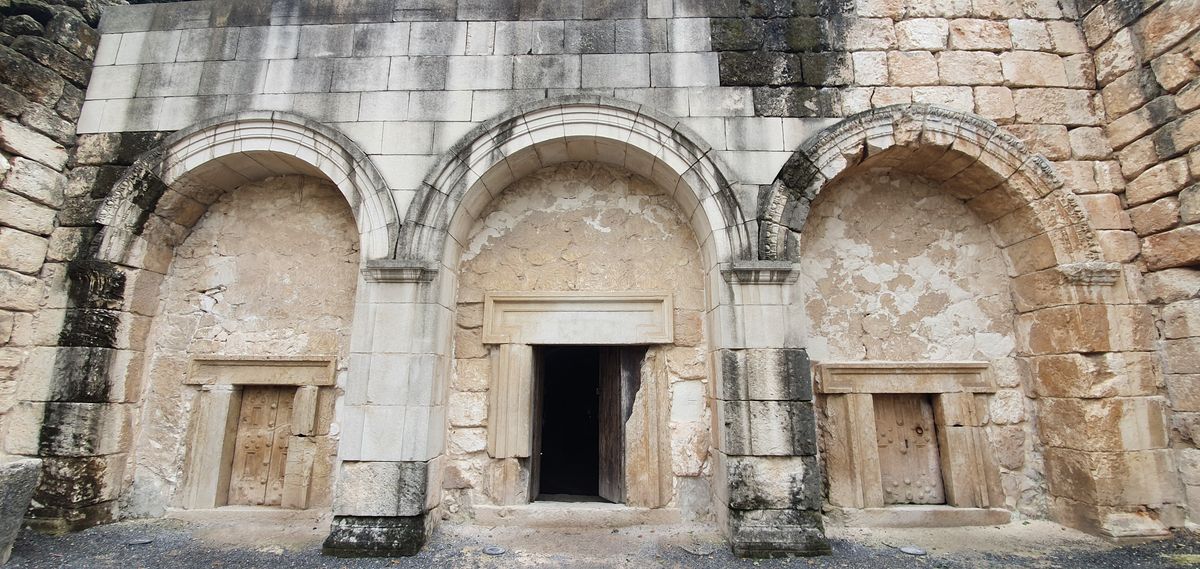
Tucked into the gentle foothills of the lower Galilee, just minutes from the modern town of Kiryat Tivon, lies one of the most remarkable Jewish heritage sites in the ancient world. Beit She’arim is a sprawling necropolis carved into the limestone hills, a city of the dead that drew Jews from across the Roman Empire and beyond. Declared a UNESCO World Heritage Site in 2015, the site preserves an extraordinary chapter in Jewish history: the era of the Sanhedrin, the codification of the Mishnah, and the emergence of the rabbinic tradition that would shape Judaism for all subsequent generations. For the visitor willing to leave the major tourist corridors and travel into the Galilee foothills, Beit She’arim offers an experience that is at once deeply archaeological and profoundly spiritual.
Beit She’arim in the Roman Period
During the 2nd through 4th centuries CE, Beit She’arim was far more than a burial ground. It was a thriving Jewish town of considerable administrative and religious importance at a time when the Jewish community of Roman Palestine was rebuilding its institutions following the catastrophic destruction of the Second Temple in 70 CE and the subsequent failed revolts. The town served for a period as the seat of the Sanhedrin, the supreme Jewish judicial and legislative council, after that body relocated northward through a series of towns, from Yavneh to Usha, Shefar’am, and finally to Beit She’arim, before later moving on to Sepphoris and Tiberias. Under Roman administration, Beit She’arim was permitted a degree of Jewish self-governance that allowed its scholars and leaders to exercise extraordinary influence over Jewish communities across the empire. The town prospered materially as well, functioning as a regional center of trade and craft production, and its population included not only local families but visiting scholars, students, and pilgrims drawn by the presence of the Nasi , the patriarch, and the institutions he led. The combination of political authority, scholarly prestige, and proximity to the Galilee’s agricultural heartland made Beit She’arim a singular community in the Roman Jewish world.
Rabbi Judah HaNasi and the Mishnah
No figure looms larger over Beit She’arim than Rabbi Judah HaNasi , Judah the Patriarch, one of the towering personalities of Jewish intellectual history. Born around 135 CE into the family of the Nasi, the recognized leader of the Jewish community under Roman authority, Judah grew up amid the great scholars of his generation and eventually became both the political leader of Palestinian Jewry and its foremost religious authority. His defining achievement was the compilation and editing of the Mishnah, the systematic codification of Jewish oral law that had been transmitted by word of mouth for generations. By organizing this vast legal tradition into a written document , arranged thematically into six orders covering agricultural law, the Sabbath, civil matters, purity, and Temple ritual, Rabbi Judah created the foundational text of rabbinic Judaism, the document upon which the Jerusalem Talmud and the Babylonian Talmud would later be built. He is believed to have carried out much of this monumental work while residing in Beit She’arim, before moving in his later years to Sepphoris. His relationship with Roman authorities was notably cordial; ancient sources describe a close friendship with a Roman emperor , the Talmud calls this emperor Antoninus, a name often identified by scholars with Caracalla, that granted him unusual access and political protection. Rabbi Judah HaNasi is believed to have died around 217 CE, and tradition holds that he was buried at Beit She’arim, making the site a place of enduring reverence for subsequent generations of Jews worldwide.
The Necropolis: Why the Ancient World Came to Be Buried Here
The decision to be buried at Beit She’arim was not merely a local custom observed by Galilean families. Jews from across the Roman Empire and beyond , from as far as Palmyra in Syria, Himyar in southern Arabia, Phoenicia, and cities throughout Asia Minor, arranged for their remains to be transported to this hillside necropolis in the lower Galilee. The reasons were multiple and deeply rooted in Jewish religious sensibility. The burial of Rabbi Judah HaNasi at the site, and the general proximity of the Nasi’s seat of authority, lent the ground an aura of holiness and prestige that radiated far beyond Palestine. Burial in the Land of Israel was considered by many in the diaspora to carry profound spiritual significance, and to rest near the seat of the Sanhedrin and the tomb of one of Judaism’s greatest sages compounded that significance considerably. The site thus became a pan-Jewish burial ground in a manner rare in the ancient world, drawing wealthy and prominent families who commissioned elaborate tomb complexes, carved sarcophagi, and inscribed epitaphs in Greek, Hebrew, and Aramaic. Archaeologists have identified more than 30 burial caves at the site, with the complex extending across a substantial area of the hillside and representing centuries of continuous use from the 2nd through the 4th century CE.
The Catacombs: What Visitors Encounter Underground
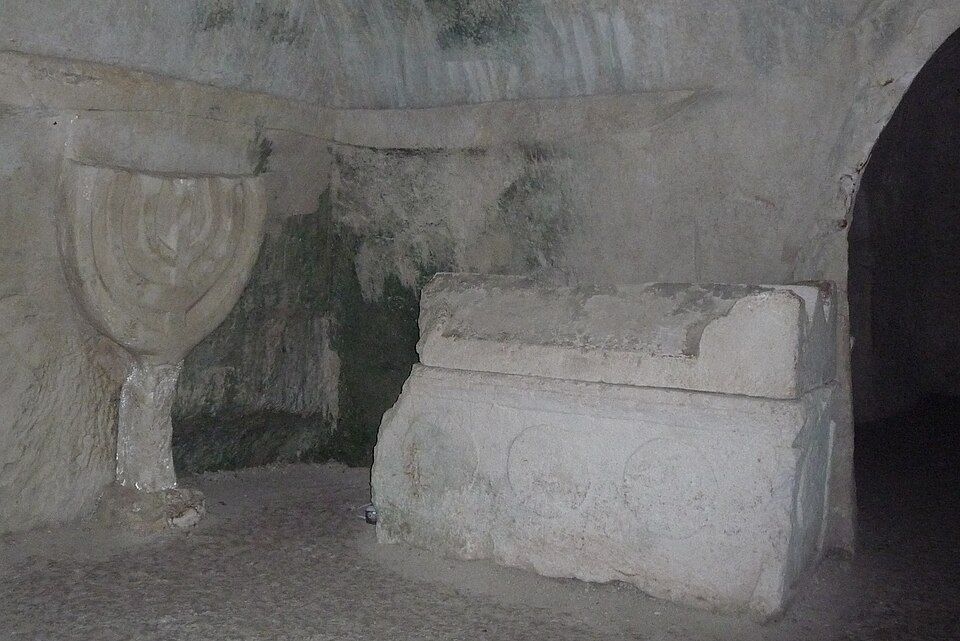
Descending into the catacombs of Beit She’arim is one of the more genuinely arresting experiences available at any archaeological site in Israel. The caves were hewn directly from the soft limestone and then elaborately finished, with arched doorways, carved facades, and interior chambers lined with burial niches. The most celebrated is the Cave of the Coffins , Catacomb 20, where visitors encounter dozens of elaborately carved sarcophagi decorated with Jewish symbols: the menorah, the shofar, the lulav, and the etrog appear repeatedly, alongside mythological motifs, geometric designs, and images of animals that reflect the visual vocabulary of the Hellenistic and Roman artistic traditions within which the craftsmen worked. Inscriptions on the walls and sarcophagi, in Greek, Hebrew, and Aramaic, record names, titles, and occasionally brief epitaphs that give the dead a human face across seventeen centuries. Another catacomb, traditionally associated with the burial of Rabbi Judah HaNasi himself, is among the most visited at the site, and while the precise identification of his tomb cannot be established with certainty, tradition holds this as the resting place of one of Judaism’s greatest teachers. The variety of burial styles, languages, and artistic influences visible across the different caves reflects the remarkable diversity of the Jewish diaspora communities that sent their dead to rest in this Galilean hillside, creating an underground record of a civilization at the peak of its creative and intellectual confidence.
Discovery, Excavation, and UNESCO Recognition
The modern rediscovery of Beit She’arim is itself a story with a romantic cast. Alexander Zaid, a Jewish watchman and rural activist who had devoted his life to protecting Jewish settlement in the Galilee, made his home near the site in the early decades of the 20th century and recognized that the caves in the hillside were far more than natural formations. He alerted scholars to their significance and is credited with drawing attention to the site before his death in 1938. A statue of Zaid on horseback, erected near the site, commemorates his role in its rediscovery. Systematic archaeological excavation was undertaken by Benjamin Mazar , later one of Israel’s most distinguished archaeologists and a former president of the Hebrew University, beginning in the 1930s and continuing through the 1950s. Mazar’s work revealed the full extent of the catacomb complex, recovered the remarkable collection of sarcophagi and inscriptions now preserved at the site and in the Israel Museum in Jerusalem, and established the historical framework that subsequent scholars have refined but not fundamentally displaced. Later excavations added detail to the picture of the ancient town itself, including remains of a synagogue, a basilica structure, and evidence of glass production and other industries. In 2015, UNESCO inscribed Beit She’arim on its World Heritage List, acknowledging the site’s outstanding universal value as a testament to the creativity of Jewish funerary art and to the vitality of Jewish communal life during the Talmudic period.
Visit Beit She’arim with Hoshen Tours
Beit She’arim sits at the natural heart of a rich northern itinerary and pairs beautifully with several of the region’s most compelling destinations. From the necropolis, it is a short drive to the summit of Mount Carmel, where panoramic views over the Jezreel Valley and the Mediterranean coast set the landscape of the ancient world into vivid geographic relief. The ancient tel of Megiddo , biblical Armageddon, and a UNESCO World Heritage Site in its own right, lies within easy reach to the south, offering visitors a sweep through layers of Canaanite, Israelite, and later history. To the north, the city of Haifa and the magnificent Bahai Gardens on the Carmel slopes provide a striking contrast between ancient heritage and living spiritual tradition. Hoshen Tours designs private, customized itineraries that bring these sites together into coherent, unhurried experiences led by expert guides carrying deep knowledge of the history, the archaeology, and the landscape. Whether you are traveling with a group focused on Jewish heritage, a family seeking to connect with the deep roots of the biblical world, or a church group exploring the Jewish foundations of early Christianity, Beit She’arim belongs in your Galilee day. Explore the Haifa and Carmel region, or contact us to begin planning your private tour of the Galilee.
Ready to experience Israel in true colors?
Plan Your TourPrivate tours designed around your interests, schedule, and pace.