



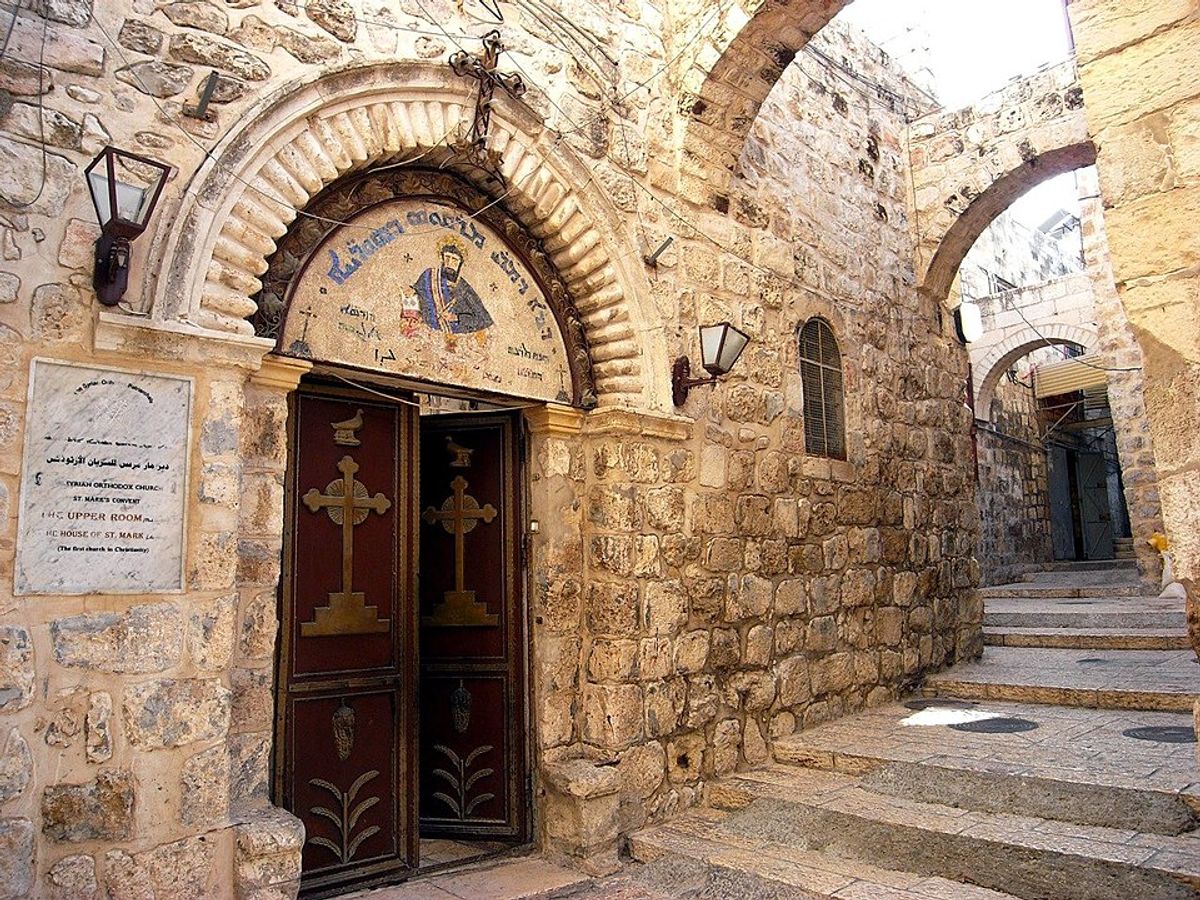
St.Hidden in the narrow streets of the Armenian Quarter, St. Mark’s Church is one of the most extraordinary and least visited churches in Jerusalem. It belongs to the Syriac Orthodox community, one of the oldest and smallest Christian communities in the Holy Land, and it carries a claim that, if true, would make it the most important church in Christianity: the Syriac Orthodox believe that this, not the Cenacle on Mount Zion, is the true site of the Last Supper and the house where the early Church was born.
The Claim at St. Mark’s Church: The Syriac Orthodox Claim to the Upper Room
According to Syriac Orthodox tradition, the church stands on the site of the house of Mary, mother of John Mark, as described in Acts 12:12: “He went to the house of Mary, the mother of John whose other name was Mark, where many had gathered and were praying.” The community maintains that the Last Supper took place here, that Jesus appeared to the disciples after the Resurrection in this house, that doubting Thomas touched the wounds of Christ in this room (John 20:24-28), and that the Holy Spirit descended upon the apostles at Pentecost here (Acts 2:1-4). An English inscription at the entrance identifies it as “the first church in Christianity.”
The mainstream tradition, accepted by most scholars and denominations, places the Upper Room at the Cenacle on Mount Zion. The Cenacle site has 4th-century archaeological support. But the Syriac claim has its own logic: the basement room at St. Mark’s is small enough for thirteen people, and in the original 1st-century topography, one would have had to climb up to reach what is now below street level, making it literally an “upper room.”
The Inscription and the Painting
During a restoration in 1940, a stone inscription in classical Syriac (Estrangelo script) was discovered set into a pillar inside the church. It reads: “This is the house of Mary, mother of John, called Mark. Proclaimed a church by the holy apostles under the name of Virgin Mary, mother of God, after the ascension of our Lord Jesus Christ into heaven. Renewed after the destruction of Jerusalem by Titus in the year AD 73.” The Syriac Orthodox date the inscription to the 6th century, though some scholars have proposed later dates. The dating remains debated, but the inscription itself is a remarkable artifact of Syriac Christian heritage.
The church also houses a painting on leather depicting the Virgin Mary holding the infant Jesus, attributed by tradition to St. Luke the Evangelist, who is said to have painted it around 50 CE during Mary’s lifetime. Art historians date the painting to the Byzantine period, considerably later than the 1st century, but the tradition of Luke as a painter of sacred images is ancient and widespread in Eastern Christianity. The painting was recently restored as part of renovations completed in 2025-2026.
The Syriac Orthodox Community of Jerusalem
The Syriac Orthodox trace their presence in Jerusalem to the earliest centuries of Christianity. Their liturgical language is Syriac, a dialect of Aramaic, the language tradition holds Jesus spoke. The community’s heartland was Tur Abdin in southeastern Turkey, home to ancient monasteries dating back to the 4th century. During World War I, the Syriac Christians suffered the Seyfo, a genocide concurrent with the Armenian Genocide, in which an estimated 250,000-275,000 Syriac-Aramean Christians were killed. Survivors fled to Syria and some to Jerusalem, where St. Mark’s became a refuge. The community today numbers approximately 600 people in Jerusalem, making it one of the smallest Christian communities in the city. Services are still conducted in Syriac Aramaic, preserving what is believed to be one of the oldest surviving Christian liturgies.
A remarkable footnote in the church’s history: in 1947, when Bedouin shepherds discovered scrolls in caves near the Dead Sea, four of the initial seven Dead Sea Scrolls were brought to the Metropolitan of St. Mark’s, Mar Athanasius Yeshue Samuel. He later placed them for sale via a Wall Street Journal advertisement, and they were purchased by Israel for $250,000.
St. Mark’s Church’
The present structure dates to the Crusader period (12th century), built over 4th-century ruins. The church sits below street level, entered through an unassuming doorway that gives no hint of what lies within. Inside, a single vaulted room, dark and intimate, is filled with Byzantine-style icons, Syriac inscriptions, and centuries of accumulated devotion. Steps lead down to a crypt believed to represent the lower floor of Mary’s original house, preserving Roman and Byzantine architectural elements. A stone baptismal font is displayed, which tradition holds was used for the baptism of the Virgin Mary herself. The modesty of the space stands in sharp contrast to the grandeur of the claim: that this small, quiet room is where Christianity began.
Visit with Hoshen Tours
St. Mark’s Church is easy to miss and rarely crowded. Hoshen Tours visits it for those who want to hear the other side of the Last Supper story, to see the inscription and the painting, and to meet one of the oldest and smallest Christian communities in the world, still praying in the language of Jesus. Hoshen Tours often combines this site with Sephardic Synagogues, Deir es-Sultan, and Sisters of Zion for a memorable day exploring the region.
Ready to experience Israel in true colors?
Plan Your TourPrivate tours designed around your interests, schedule, and pace.