



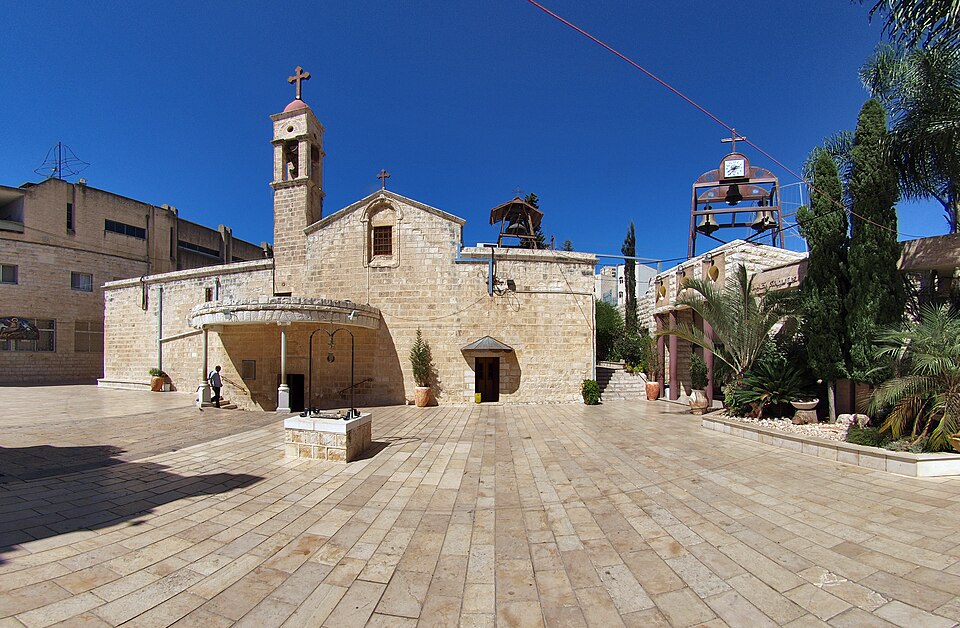
 The Church of Mary’s Well (also called the Church of the Annunciation at the Spring, or the Church of St. Gabriel) is a Greek Orthodox church in Nazareth built over the spring that was the town’s only water source in the time of Jesus. According to the Eastern Orthodox tradition, the Annunciation did not take place in a house (as the Catholic tradition holds) but at the spring, where Mary had come to draw water. The church is one of the oldest continuously venerated Christian sites in Nazareth, predating the great Catholic basilica by centuries, and it preserves a distinctly Eastern understanding of the most celebrated moment in the New Testament.
Orthodox Tradition: The Annunciation at the Spring at Church of Mary’s Well (Church of the Spring)
The Greek Orthodox tradition of the Annunciation at the spring rests on the Protoevangelium of James, an early Christian text from the 2nd century CE, which predates many of the Gospel traditions in its influence on Christian piety and iconography. In this account, Mary was at the spring filling a pitcher of water when she heard a voice: “Hail, highly favored one, the Lord is with you; blessed are you among women.” She looked around, saw no one, trembled, and returned home: where the full encounter with Gabriel is described as completing. The Greek Orthodox tradition understands the Annunciation as a two-stage event: the first moment of divine address happened at the water source, the full revelation at the house.
This tradition has shaped Orthodox iconography for nearly two millennia: in Eastern icons of the Annunciation, the thread Mary is spinning is sometimes shown trailing behind her, suggesting she was walking when the angel first spoke. The Catholic tradition, by contrast, places the entire event at the house, now marked by the Grotto inside the Basilica of the Annunciation, and does not give the spring a role in the story. Neither tradition claims certainty; both claim antiquity. The difference is a matter of sacred text and living community, not archeological proof.
Mary’s Well: The Ancient Water Source of Nazareth
The spring that feeds the church is the ancient water source of Nazareth, and in a village as small as 1st-century Nazareth, population estimated at 200 to 400 people, every woman in the village would have come to this spring daily. If tradition holds that Mary lived in Nazareth, she drew water from this spring. This is not tradition; it is hydrology. The spring still flows. The water emerges in the crypt of the church, channeled through ancient stonework into a small basin where visitors can see and sometimes touch the water. The experience of contact with a spring that has been flowing continuously for thousands of years, in the village where Jesus grew up, carries a weight that is hard to overstate. The water is the one thing in Nazareth that has not changed: the same geology, the same aquifer, the same spring Mary would have visited every morning.
The Church Interior and Iconostasis
 The current church building dates to 1750, constructed over Crusader-era and Byzantine foundations that themselves preserved the memory of the spring across many centuries. The interior is richly decorated in the Orthodox tradition: icons, frescoes, hanging oil lamps, and the smell of incense that permeates all Greek Orthodox sacred spaces. The iconostasis, the ornate wooden screen that separates the nave from the sanctuary in Orthodox churches, is the visual centerpiece of the interior. It is painted with gold leaf and bears icons of Christ, the Theotokos (Mother of God), and the major saints, arranged according to the fixed theological program of Orthodox church design. Behind the iconostasis, the altar is visible only during services; the screen embodies the Orthodox theology of the holy as present yet veiled. The crypt, where the spring emerges beneath the main floor, is reached by a staircase and is atmospheric and intimate: a low-ceilinged space lit by candles and oil lamps, where the sound of running water is audible beneath the stone.
Mary’s Well in the Town Square
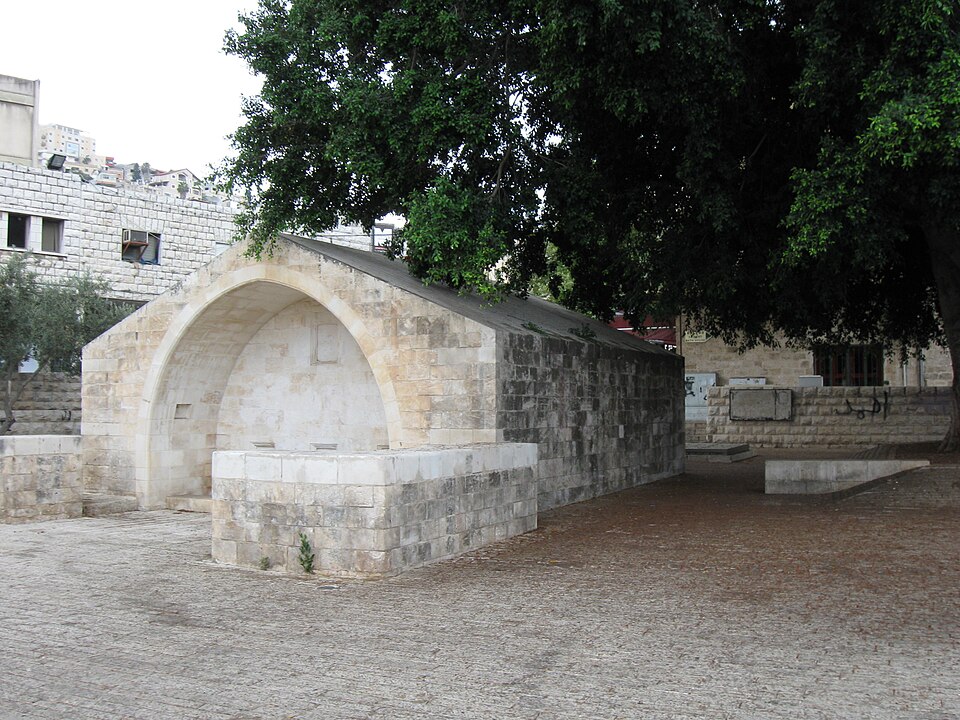
In the town center of Nazareth, a reconstructed fountain called Mary’s Well marks the spot where the spring water was traditionally collected by the villagers. The well has been rebuilt multiple times over the centuries and the current structure is a modern reconstruction, but it marks the location of the ancient public water point and serves as a landmark in the center of the city. The area around Mary’s Well has been developed into a pedestrian plaza, and the well itself is surrounded by cafes, shops, and a small visitor area. It is a useful orientation point in Nazareth’s often confusing urban landscape, and it connects the Church of the Spring, a few meters away, with the broader story of the village’s water history.
Two Traditions, One City
Visiting both the Church of Mary’s Well and the Basilica of the Annunciation in a single visit to Nazareth allows pilgrims and travelers to encounter the two great Christian traditions of the Annunciation side by side. The Catholic basilica is monumental: one of the largest churches in the Middle East, built over a grotto that tradition holds was Mary’s house, with its famous collection of Marian mosaics from around the world. The Greek Orthodox church is small, ancient-feeling, and intimate, with the spring still flowing beneath the floor. The theological difference between them is genuinely significant, rooted in different textual traditions and different understandings of the sacred event. But both traditions agree on the core: that in this unremarkable village in the Galilee, something of eternal weight took place.
Visit with Hoshen Tours
The Church of the Spring offers the Orthodox perspective on the Annunciation and the tangible experience of the water that served 1st-century Nazareth. Hoshen Tours visits both Annunciation traditions, Catholic and Orthodox, explaining the theological distinction between them and allowing guests to encounter both the grandeur of the Basilica and the intimacy of the spring. The two churches together give a fuller picture of how the same event has been remembered and venerated across different Christian communities for nearly two thousand years.
Explore Our Tour Collection
Ready to experience Israel in true colors?
Plan Your TourPrivate tours designed around your interests, schedule, and pace.