



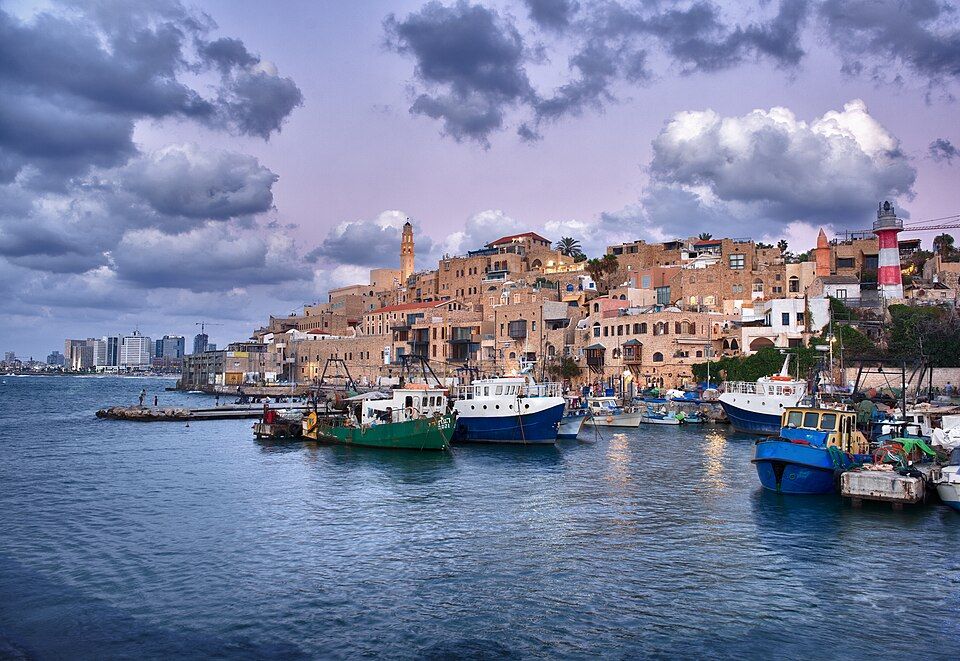
 Jaffa is one of the oldest port cities in the world. People have been living here, trading here, fighting over this harbor for at least four thousand years. Egyptian pharaohs garrisoned it. Cedars from Lebanon were floated here to build Solomon’s Temple. The prophet Jonah boarded a ship here, fleeing from God. Greek mythology chained a princess to the rocks offshore. The apostle Peter had a vision on a rooftop here that opened Christianity to the non-Jewish world. Napoleon stormed the walls and massacred its defenders. Mark Twain stepped ashore and found it unimpressive. And in 1948, a city of 70,000 Arabs became, almost overnight, a neighborhood of Tel Aviv. Jaffa’s Hebrew name, Yafo, may derive from “yafeh”, beautiful, or from the biblical Japheth, son of Noah, who tradition holds founded the city after the Flood. Whatever the origin, the name has been in continuous use for millennia, and the city has earned every layer of its history.
The Oldest Port
Jaffa appears in the conquest records of the Egyptian pharaoh Thutmose III, carved into the walls of the Karnak Temple, dating to approximately 1457 BCE. The city is listed as “Yapu”, one of the Canaanite cities subdued during Egypt’s campaigns in the Levant. An Egyptian garrison was maintained here, and a monumental gate bearing an inscription of Ramesses II has been uncovered in excavations at the tel. One of the most colorful episodes from this period is preserved in Papyrus Harris 500, now in the British Museum: the story of the Egyptian general Djehuty, who captured Jaffa by hiding soldiers inside large baskets carried into the city as tribute, a ruse predating the Greek Trojan Horse by centuries. Jaffa also appears in the Amarna Letters of the 14th century BCE, correspondence between Canaanite vassal rulers and the pharaoh, confirming its continued importance under Egyptian control.
But Jaffa’s greatest role in the biblical world was as the port of Jerusalem. When King Solomon built the First Temple, the cedars of Lebanon were floated down the coast by sea and landed at Joppa, then carried overland and up through the Judean hills to Jerusalem, a journey of roughly 55 kilometers. “We will cut whatever timber you need from Lebanon and bring it to you in rafts by sea to Joppa, and you can take it up to Jerusalem” (2 Chronicles 2:16). Five centuries later, when the exiles returned from Babylon to build the Second Temple, the same route was used: “They gave money to the masons and carpenters, and food, drink, and oil to the people of Sidon and Tyre, so that they would bring cedar logs by sea from Lebanon to Joppa” (Ezra 3:7). For a thousand years, Jaffa was the gateway through which the most sacred building materials in Jewish history passed on their way to the Temple Mount.
Jonah, Andromeda, and Peter
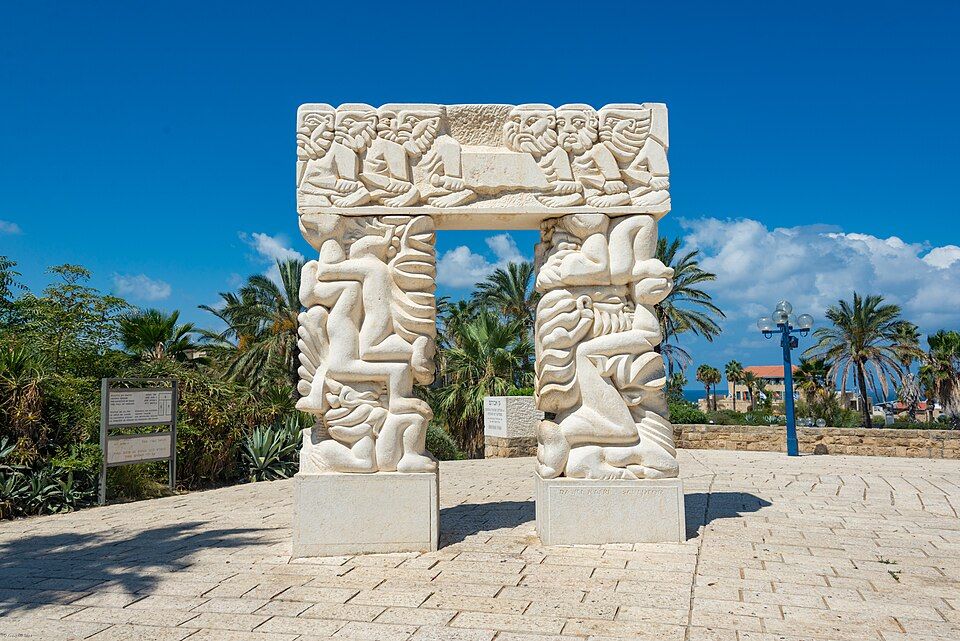 Three of the most famous stories associated with Jaffa come from three different traditions, and all of them center on the harbor. In the Hebrew Bible, the prophet Jonah fled from God’s command to go to Nineveh and instead went down to Joppa, “where he found a ship bound for Tarshish” (Jonah 1:3). He paid the fare and sailed west, away from his mission, into a storm, and eventually into the belly of a great fish. The port from which Jonah embarked on his doomed voyage is the same harbor visitors see today, and the story has been inseparable from Jaffa for nearly three thousand years.
In Greek mythology, this same coastline was the setting for the legend of Andromeda. The princess, chained to a rock by the sea as a sacrifice to a sea monster, was rescued by the hero Perseus. Ancient writers took the association seriously. Strabo, Pliny, Josephus, and Pausanias all placed the Andromeda legend at Joppa. Josephus wrote that the marks of Andromeda’s chains were still shown to visitors, and Pliny claimed that the bones of the sea monster itself were brought to Rome. The dark reef visible just offshore from Jaffa’s port is still known as Andromeda’s Rock.
And in the New Testament, Jaffa is the setting for one of the most consequential moments in Christian history. The apostle Peter, staying at the house of Simon the Tanner by the sea, raised a beloved disciple named Tabitha (Dorcas) from the dead (Acts 9:36–43). Then, on the rooftop of the same house, Peter had a vision: a sheet descended from heaven containing animals considered ritually unclean, and a voice said, “Do not call anything impure that God has made clean.” This vision led Peter to travel to Caesarea and baptize the Roman centurion Cornelius, the first Gentile conversion, the moment when Christianity ceased to be a Jewish sect and became a faith open to all peoples. A site traditionally identified as Simon the Tanner’s house still stands in old Jaffa, and St. Peter’s Church, built on the hilltop where the vision is said to have occurred, dominates the skyline of the old city.
Napoleon, Mark Twain, and the American Dreamers
 Jaffa’s more recent history is no less dramatic. In March 1799, Napoleon Bonaparte besieged the city during his Egyptian campaign. After the walls were breached on March 7, French troops committed widespread massacre and looting. Napoleon then ordered the execution of some 2,500 to 4,100 Ottoman soldiers who had surrendered, they were marched to the beach and shot or bayoneted over several days, one of the most controversial acts of his career. A plague broke out among his troops, and Napoleon’s visit to the plague hospital was later immortalized in Antoine-Jean Gros’s famous painting “Bonaparte Visiting the Plague Victims of Jaffa” (1804), now in the Louvre, a masterpiece of propaganda depicting the general heroically touching the sores of the dying.
In September 1866, a charismatic American preacher named George Adams led approximately 157 settlers from Jonesport, Maine, to Jaffa with a vision of establishing a Christian colony to prepare for the Second Coming. They brought prefabricated wooden houses, farming equipment, and high hopes. The colony was a disaster. Unprepared for the climate, disease, and local conditions, and led by a man increasingly accused of drunkenness and mismanagement, most colonists fell ill and several died. Within two years the colony collapsed, and the survivors straggled home. Mark Twain, who visited Jaffa in 1867, encountered some of these colonists and later wrote about Jaffa in “The Innocents Abroad” (1869) with characteristic skepticism, describing the perilous landing through the reef in small boats, the holy sites pointed out to credulous tourists, and a port city that had, in his view, a great name but not much else to show for it.
1948 and After
Before 1948, Jaffa was the largest Arab city in Palestine, with a population of approximately 70,000. It was a center of Arab cultural, economic, and political life, home to newspapers, cinemas, coffeehouses, and a thriving port. The 1947 UN Partition Plan designated Jaffa as part of the Arab state, even though it was essentially surrounded by territory allocated to the Jewish state. As fighting intensified in late 1947 and early 1948, Jaffa’s position became untenable. In late April 1948, the Irgun launched an assault on the Manshiyya neighborhood between Tel Aviv and Jaffa. By mid-May, as the British Mandate ended, the city’s military and civil order had collapsed. The vast majority of Jaffa’s Arab population fled, by sea to Gaza, by land to the interior, and by the time of the final surrender on May 13, 1948, only a few thousand remained. Jaffa was officially merged with Tel Aviv on April 24, 1950, forming the municipality of Tel Aviv-Yafo. Today, a small Arab community, centered in the Ajami neighborhood, maintains a presence in a city whose character was transformed beyond recognition in a matter of weeks.
The Old City, the Clock Tower, and the Flea Market
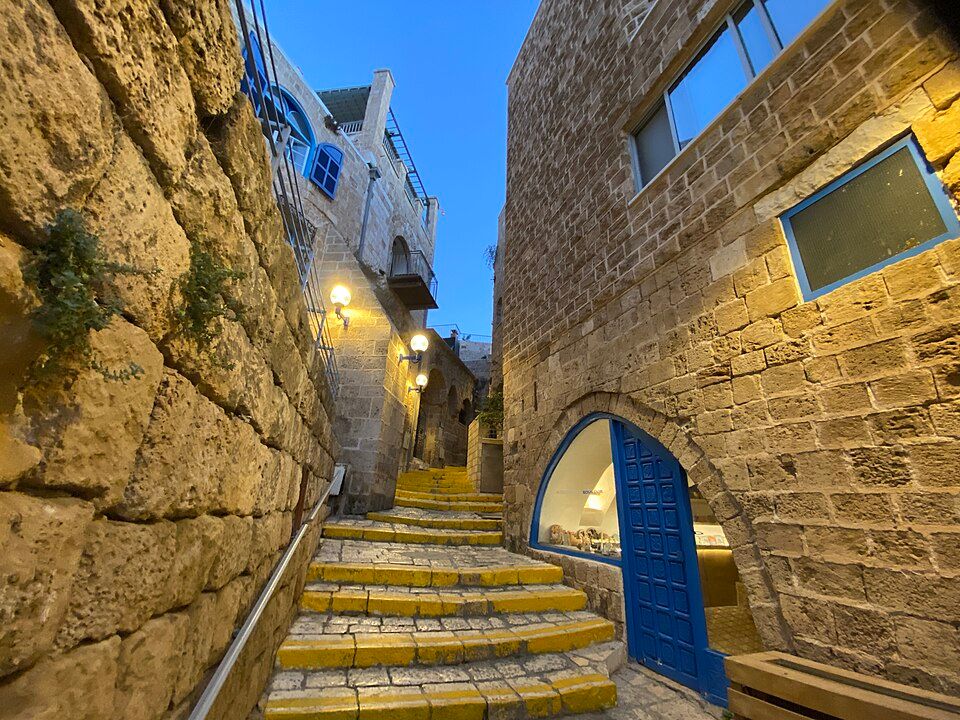
 The restored old city of Jaffa sits on the hilltop above the ancient harbor, a compact labyrinth of stone alleys, galleries, and restaurants that feels worlds away from the bustle of Tel Aviv a few minutes to the north. At its heart stands St. Peter’s Church, with its bell tower visible from across the coast. The ancient port below, still a working fishing harbor, is where tradition places Jonah’s departure and where the cedars arrived from Lebanon. An elevated park at the top of the tel offers one of the most photographed views in Israel: the Tel Aviv skyline stretching north along the coast, the Mediterranean to the west, and four thousand years of history at your feet.
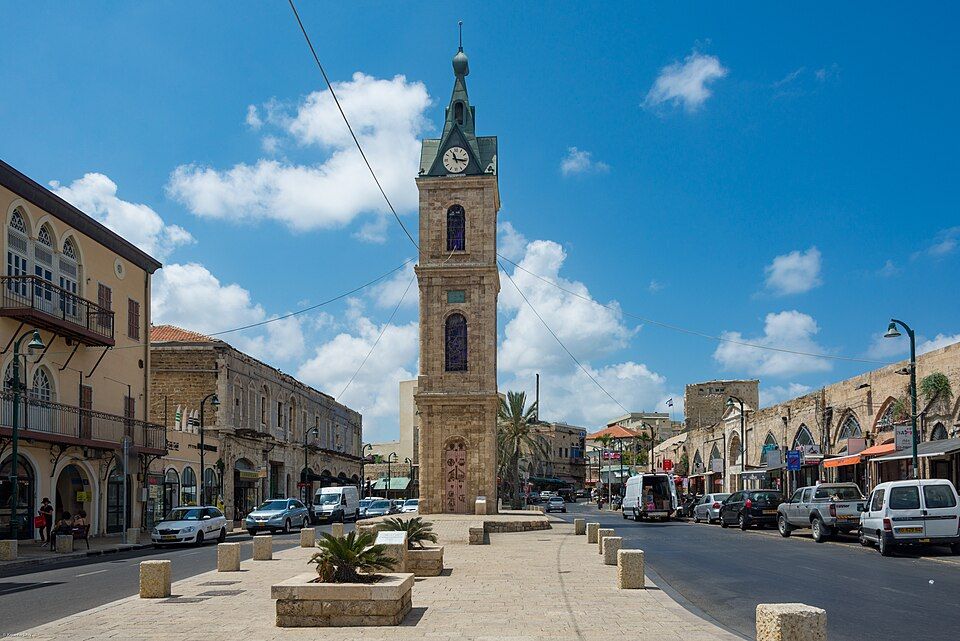
At the entrance to the old city, the Ottoman Clock Tower, built between 1900 and 1903 to mark the silver jubilee of Sultan Abdul Hamid II, stands as a landmark and a meeting point. It is one of approximately seven similar towers built across Ottoman Palestine for the same occasion, others stood in Jerusalem (demolished by the British in 1922), Haifa, Akko, Nablus, and Safed. From the clock tower, the streets lead into the Shuk HaPishpeshim, the Flea Market, a maze of antique shops, vintage furniture, design studios, and some of Tel Aviv’s best restaurants and bars. The market developed in the emptied commercial buildings of Arab Jaffa after 1948, took on its flea-market character as vendors sold second-hand goods in the old shops, and has since been gentrified into one of the trendiest neighborhoods in the city. The combination of crumbling Ottoman architecture and sleek modern design is quintessentially Jaffa.
Visit with Hoshen Tours
Jaffa is where the story of this land begins for many visitors. Hoshen Tours walks you through the old city and its alleys, past the harbor where Jonah fled and the cedars arrived, past the rocks where Andromeda was chained, up to the hilltop where Peter’s vision changed the world, and into the flea market where ancient stones meet modern life. A private guide connects the layers, Egyptian generals hiding in baskets, a prophet running from God, a Greek hero slaying a sea monster, an apostle on a rooftop, Napoleon on a beach, Mark Twain in a rowboat, and a city that lost its people and found a new identity. No other place in Israel tells so many stories in so small a space.
Ready to experience Israel in true colors?
Plan Your TourPrivate tours designed around your interests, schedule, and pace.