



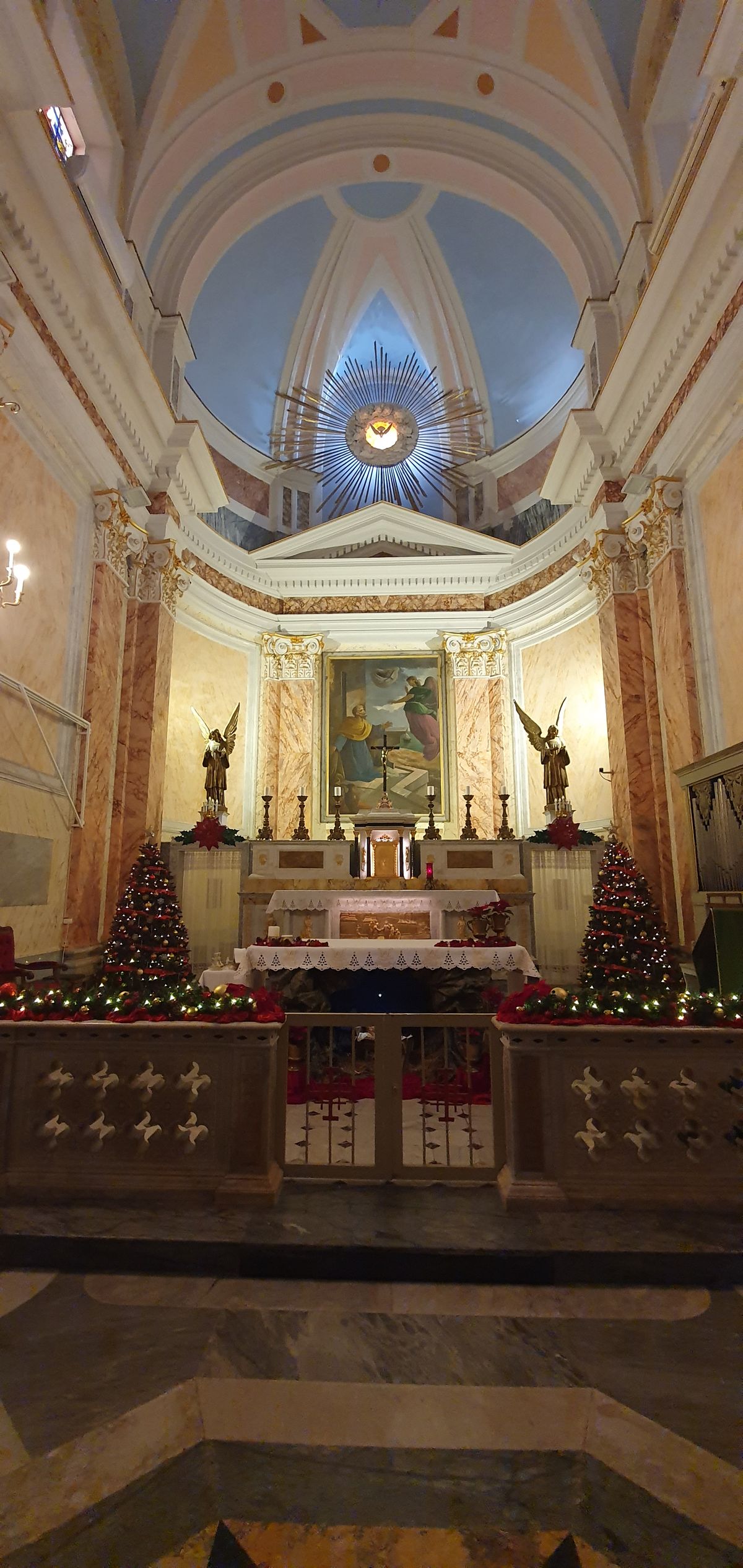
St.St. Peter’s Church stands on the highest point of Old Jaffa its bell tower visible from across the coast. This is not just another Franciscan church in the Holy Land. Jaffa is where the Apostle Peter received the vision that changed the trajectory of Christianity, the moment when a faith born in Judaism opened its doors to the entire non-Jewish world. What happened on this hilltop two thousand years ago was nothing less than a theological revolution, and its consequences shaped the religion of two billion people.
Peter in Jaffa: Miracles and a Vision
According to the Book of Acts, Peter came to Jaffa (Joppa) and stayed at the house of Simon the Tanner, by the sea (Acts 9:43). While here, he performed a miracle that echoed the power of Jesus himself: he raised from the dead a woman named Tabitha (Dorcas in Greek), a beloved disciple known for her charity and good works (Acts 9:36–42). The miracle drew many to faith and established Peter’s presence in the city.
But the defining moment, according to Acts, came on the rooftop. Peter went up to pray and fell into a trance. He saw a great sheet descending from heaven, filled with all kinds of animals, creatures that Jewish dietary law declared unclean and forbidden to eat. A voice said: “Get up, Peter. Kill and eat.” Peter refused: “Surely not, Lord! I have never eaten anything impure or unclean.” The voice replied: “Do not call anything impure that God has made clean” (Acts 10:13–15). The vision came three times.
Opening the Gates: The Baptism of Cornelius
The meaning of the vision became clear almost immediately. While Peter was still puzzling over what he had seen, messengers arrived from Caesarea sent by Cornelius, a Roman centurion of the Italian Cohort, a God-fearer who worshipped the God of Israel but had not converted to Judaism. According to Acts, an angel had told Cornelius to send for Peter. Peter went to Caesarea, entered the home of a Gentile, something a devout Jew would not normally do, and preached. As he spoke, the Holy Spirit fell upon Cornelius and his entire household, just as it had fallen on the Jewish believers at Pentecost. Peter baptized them.
This was the watershed moment. Cornelius is traditionally regarded as the first Gentile convert, though the Ethiopian eunuch baptized in Acts 8 may precede him. The gates that had been open only to Jews were now open to all. Peter’s vision on the rooftop in Jaffa, “do not call anything impure that God has made clean”, became the theological foundation for a universal faith. Without this moment, Christianity might have remained a Jewish sect. Instead, it became a world religion. The story is told in Acts 10–11, and it was cited as the decisive precedent at the Council of Jerusalem (Acts 15), where the early church formally decided that Gentile converts did not need to follow Jewish law.
Simon the Tanner’s House
A traditional site identified as the house of Simon the Tanner stands nearby on the Jaffa hillside, marked by a small sign at 8 Simon the Tanner Street. The modest building, overlooking the sea, claims to be the location where Peter stayed and received his rooftop vision. Whether or not the identification is historically precise, the connection between Jaffa and Peter’s transformation is anchored in the New Testament text itself.
St. Peter’s Church’
The Franciscans have maintained a presence in Jaffa since the 13th century. The current church was largely built between 1888 and 1894, though earlier structures on the site date to the 17th century. It stands in Kdumim Square (Kikar Kdumim), the central plaza of Old Jaffa, surrounded by galleries, restaurants, and the excavated ruins of ancient Jaffa. The interior features stained glass windows depicting episodes from Peter’s life, and the courtyard offers views of the Mediterranean and the Tel Aviv coastline. A painting inside the church depicts Peter’s vision of the sheet descending from heaven, the moment that happened, according to tradition, on this very hilltop.
The church stands on ground that has served the Franciscan order for centuries, though the current building dates only to 1888–1894. An earlier Franciscan hospice on this same hilltop served as Napoleon’s headquarters during his brief and bloody siege of Jaffa in March 1799. A room inside the complex is still pointed out as “Napoleon’s room”, tradition rather than proven fact, since the building was entirely reconstructed, but the association is old and persistent. What is certain is that the Franciscan compound on this hill has served as a landmark and a refuge for Western visitors to Jaffa for the better part of a millennium.
From the church’s courtyard, the view stretches north along the coastline to the towers of modern Tel Aviv, a striking juxtaposition of ancient and new. To the west, the Mediterranean fills the horizon. Below, the ancient port where Jonah boarded his ship and where cedars arrived from Lebanon for Solomon’s Temple lies just a few minutes’ walk down the hill. The church sits at the intersection of everything that makes Jaffa extraordinary: four thousand years of history, the birth of a world religion’s universal mission, and one of the most beautiful views on the Israeli coast.
Visit with Hoshen Tours
St. Peter’s Church is the centerpiece of any Old Jaffa walk. Hoshen Tours visits the church, the courtyard with its panoramic views, and tells the story of the vision that opened Christianity to the world, a story that began on a rooftop in this ancient port city. Hoshen Tours often combines this site with Migdal Tzedek, Simon the Tanner, and Eretz Israel Museum for a memorable day exploring the region.
Explore Our Tour Collection
Ready to experience Israel in true colors?
Plan Your TourPrivate tours designed around your interests, schedule, and pace.