



Magdala (Migdal) was one of the most important towns on the western shore of the Sea of Galilee in the 1st century, a prosperous center of fishing, fish processing, and trade, and the hometown of Mary Magdalene. In 2009, what began as a construction project for a pilgrim guesthouse turned into one of the most significant archaeological discoveries in the Galilee: a complete 1st-century synagogue containing a carved stone that stunned the archaeological world. The layers uncovered here, a fishing town, a sacred space, a remarkable artifact, and a woman at the heart of the Gospel story, make Magdala one of the most affecting sites in all of Israel.
The Ancient City
In the time of Jesus, Magdala was a major town on the Sea of Galilee. The Jewish historian Josephus, who commanded forces here during the Great Jewish Revolt against Rome (66–73 CE), called it Taricheae, from the Greek for “place of salted fish”, a name that tells you exactly what the town was famous for. Magdala’s fishing industry was industrial in scale: fish caught in the Sea of Galilee were salted, dried, and packed here, then exported across the Roman Empire along the nearby Via Maris trade route. Josephus described the town as defending itself with a fleet of boats and a population that may have numbered in the tens of thousands; ancient estimates, while difficult to verify precisely, suggest Magdala was among the largest settlements on the lake in the 1st century CE. The Hebrew name Migdal means “tower”, possibly referring to a watchtower used for fish drying, for signaling, or for coastal defense. Whatever its origin, the name stuck across languages and millennia, and it is the name that Mary Magdalene carried with her through the Gospels and into history.
Streets, Marketplace, and Ritual Baths
Archaeological excavations at Magdala have revealed the physical fabric of a prosperous 1st-century Galilean town with remarkable clarity. Well-preserved paved streets run through the site, lined by the remains of residential and commercial buildings. A marketplace, a colonnaded public space where merchants and fishermen would have transacted their daily business, has been uncovered in excellent condition, its layout communicating the scale and organization of the town’s commerce. Fish pools and harbor installations point to the industrial processing that gave Magdala its Greek name and its economic identity. Seven ritual baths (mikva’ot) have been discovered across the site, testifying to a community for whom Jewish purity practice was a daily reality. The walls of some structures retain traces of painted plaster in the Pompeian style, a reminder that 1st-century Jewish Galilee was not isolated from the broader Roman world but engaged with it, absorbed its aesthetics, and shaped those influences into a distinctively local cultural life. Taken together, the excavated remains of Magdala give visitors a vivid and grounded sense of what life looked like in the Galilee at the very moment the Gospels describe.
The Discovery Story
The story of Magdala’s rediscovery begins with a plan to build a hotel. Father Juan Solana, a Mexican-born priest of the Legionaries of Christ, secured a plot of land on the shore of the Sea of Galilee in 2004 with the vision of constructing a guesthouse where Christian pilgrims could stay close to the sacred sites of the northern shore. When construction began in 2009 and bulldozers broke ground, the machinery almost immediately encountered ancient stone walls. Work stopped. The Israel Antiquities Authority was notified. What followed was an excavation that uncovered an entire urban district of 1st-century Magdala, streets, a marketplace, ritual baths, residential quarters, and, most remarkably, a synagogue in exceptional condition.
The discovery meant the hotel plans had to be reimagined entirely. Father Solana, rather than mourning the loss of the original project, embraced the archaeological site as the foundation for something far more meaningful: a pilgrimage center built directly over and around one of the most important discoveries in the Galilee. The Duc In Altum church and visitor center rose from this revised vision, and the site opened to pilgrims in 2014. It is a rare example in Israel of a religious building project that found not just a location but a living archaeological context beneath its foundations.
The Magdala Synagogue’
The synagogue discovered at Magdala in 2009 dates to the 1st century CE, placing it firmly within the lifetime of Jesus and the earliest decades of what would become both rabbinic Judaism and Christianity. It is one of fewer than ten synagogues confirmed from the Second Temple period found anywhere in Israel, a small and precious group that includes structures at Masada, Herodium, Gamla, Jericho, Modi’in, and Qiryat Sefer. The Magdala synagogue is among the best preserved of these. The rectangular hall has stone benches running along the walls for seating, a mosaic floor decorated with geometric patterns, and walls that once bore painted plaster in the Pompeian style. The Gospels record that “Jesus went throughout Galilee, teaching in their synagogues” (Matthew 4:23). Magdala was one of the most significant towns on the lake during the years of his ministry, and tradition holds that he was known in this region. Whether or not he taught in this specific room cannot be stated with certainty, but the possibility is entirely plausible, and that plausibility is part of what makes standing in the Magdala synagogue such a charged experience for Christian pilgrims.
The Magdala Stone
At the center of the synagogue’s floor, excavators found something no one had anticipated: a carved stone block unlike anything previously discovered. The Magdala Stone, roughly the size and shape of a large table, is decorated on all four sides and on its top surface with relief carvings of extraordinary detail and symbolic density. On one face, a seven-branched menorah stands on a triangular base flanked by two amphorae, rendered with careful attention to its form. The surrounding faces show an arch, rosettes, columns, wheels of fire (possibly evoking the divine chariot described in Ezekiel’s vision), and a facade that appears to represent the Temple in Jerusalem, its columns, its gates, its layered sacred architecture depicted in stone.
What makes this find so significant is its date. The stone was carved and placed in the synagogue while the Second Temple still stood, while the menorah it depicts was still burning in Jerusalem, tended by priests, visible to pilgrims who came to the city for the great festivals. The person who carved this menorah may have seen the actual menorah with their own eyes. This is the earliest known carved depiction of the Temple menorah in stone, created by someone who lived in the same world as the Temple, who may have walked its courts. No other artifact in Israel carries quite the same weight of proximity, physical, temporal, and theological, to the lost sacred center of ancient Judaism. The Magdala Stone has been described by leading archaeologists as one of the most important finds of the 21st century. The original stone is held at the Israel Museum in Jerusalem; a high-quality replica is displayed at the Magdala site so that visitors can examine it up close.
Mary Magdalene
The woman the Gospels call Mary Magdalene, or, more precisely, Mary of Magdala, takes her name directly from this town. “Magdalene” is not a surname or a title; it simply means “of Magdala,” distinguishing her from the many other women named Mary in the Gospel accounts. She was a woman of Galilee, from a fishing town on the shore of the lake, and she became one of the most significant figures in the New Testament narrative.
It is important to state clearly what the Gospels do and do not say about her. The identification of Mary Magdalene as a prostitute or a sinful woman has no basis in the New Testament text. That conflation arose from a sermon preached by Pope Gregory I in 591 CE, in which he merged three separate women from Luke’s Gospel into a single composite figure, an interpretive move that has since been formally recognized as erroneous and corrected by the Catholic Church in 1969. The Gospels themselves say nothing of the sort. What they do say is this: Mary Magdalene was among the women who had been healed and who accompanied Jesus and his disciples on their travels through Galilee. Luke 8:1–3 names her explicitly among the women who “were helping to support them out of their own means”, a detail that suggests she was a woman of some independent resources, very possibly connected to the prosperous fish-trade economy of Magdala.
The Gospel Connection
She was present at the crucifixion when most of the male disciples had fled (Matthew 27:56, Mark 15:40). She watched as Jesus was buried (Matthew 27:61). She came to the tomb before dawn on the first day of the week. And according to the Gospel of John, she was the first person to encounter the risen Christ. The scene in John 20 is one of the most intimate in the entire New Testament: Mary stands weeping outside the empty tomb, turns, and sees a man she takes for a gardener. He says her name, “Mary”, and she recognizes him instantly: “Rabboni!”, Teacher. Jesus then sends her to tell the other disciples what she has witnessed, making her, in the words of the early church, apostle to the apostles. The woman first entrusted with the news of the resurrection came from this town, walked these streets, and would have known the synagogue now standing at the center of the Magdala archaeological site.
Duc In Altum Church
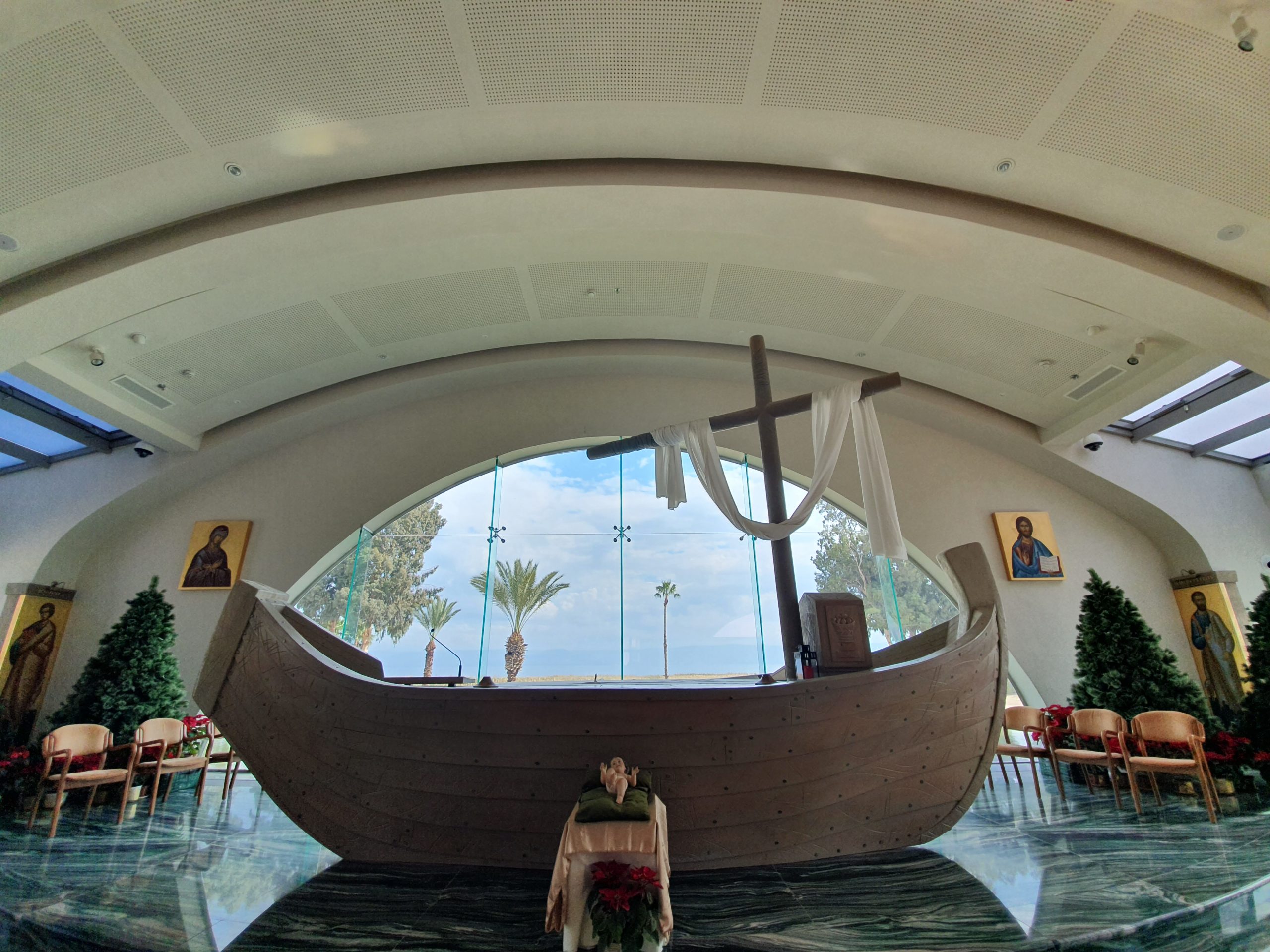
The modern church at Magdala was built by the Legionaries of Christ on the land that Father Solana’s original project had acquired. It is named Duc In Altum, Latin for “Put Out Into the Deep”, from the words Jesus speaks to Peter on the Sea of Galilee in Luke 5:4, when he tells the discouraged fisherman to try once more after a fruitless night on the water. The phrase has long been used in Catholic spirituality as a call to deeper faith and bolder action, and it gives the church its character and its tone. The building is designed to evoke a 1st-century fishing boat: its prow-shaped form angles toward the Sea of Galilee, as though poised to set out onto the water. Inside, a full-sized wooden boat serves as the central feature of the altar area, and floor-to-ceiling windows frame the lake beyond. The architecture is modern but deeply rooted in the history and landscape of the shoreline it overlooks.
The Women’s Atrium, a colonnaded courtyard within the complex, features painted columns honoring women who appear in the Gospel accounts of Jesus’ ministry, women who encountered him, followed him, and bore witness to the central events of his life. One column has been left intentionally unnamed, representing all women of faith throughout history whose names were never recorded. The lower level of the church preserves and displays a portion of the original archaeological excavations in place, so that visitors can move between ancient stone and contemporary worship in a single visit. The integration of archaeology and pilgrimage space at Magdala is handled with unusual care, and the result is a site that speaks to both the historically curious and the spiritually seeking.
Visit with Hoshen Tours
Magdala brings together first-century archaeology, one of the most important stone carvings ever found in Israel, and the hometown of the woman who tradition holds was the first witness to the resurrection, all on the shore of the Sea of Galilee. Hoshen Tours visits the synagogue, the Magdala Stone replica, the streets and marketplace, and the Duc In Altum church, telling the story of a fishing town, a carved stone, and a woman whose name has been spoken for two thousand years. The site pairs naturally with Capernaum and Tabgha for a full day on the Gospel shore, and can also be combined with Hamat Tiberias for a deeper exploration of Galilean Jewish life across the centuries.
Explore Our Tour Collection
Explore this site and 65 more in Sacred Steps in the Holy Land
225 pages · The Life, World, and Footsteps of Jesus · Maps, photos, and Scripture references
Ready to experience Israel in true colors?
Plan Your TourPrivate tours designed around your interests, schedule, and pace.