



Safed sits at 937 meters above sea level on a steep peak in the heart of the upper Galilee, making it the highest city in Israel and one of the four cities considered holy in Jewish tradition, alongside Jerusalem, Hebron, and Tiberias. Its cobblestone alleys, blue-painted buildings, and hilltop synagogues have drawn mystics, artists, and pilgrims for centuries. In the 16th century, Safed became the undisputed center of Jewish mysticism, and the spiritual energy of that era still lingers in its narrow streets.
A City on a Mountain
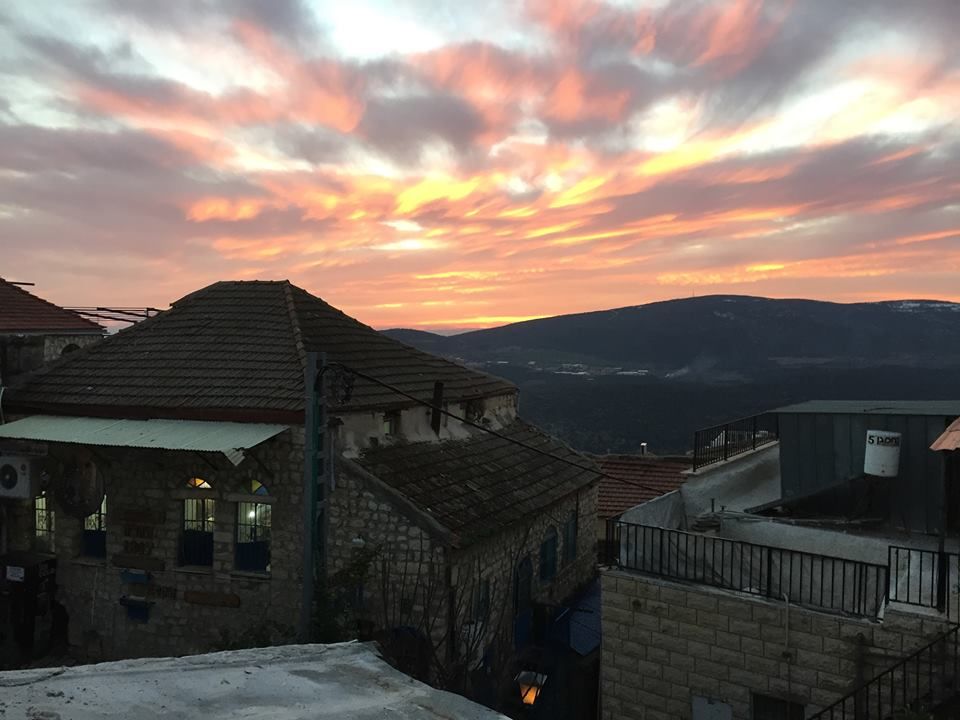
Safed occupies one of the most dramatic positions of any city in Israel. Perched at 937 meters above sea level, it looks out over a vast panorama that stretches from the summit of Mount Meron, the highest peak in the Galilee at 1,208 meters, to the shimmering blue surface of the Sea of Galilee far below. On clear days, the view extends north toward the white slopes of Mount Hermon and south across the lower Galilee hills. The altitude gives Safed a climate unlike any other city in Israel: cooler in summer, misty and cold in winter, with occasional snow that blankets the stone alleys and blue-painted walls in white. Residents speak of the quality of the light here, sharp, clear, and peculiarly beautiful, as one of the reasons artists have come to Safed for generations. The air at nearly a thousand meters has a sharpness and clarity that feels appropriate for a city that has spent five centuries contemplating the nature of heaven.
Ancient and Medieval Safed
Safed’s recorded history stretches back to the Second Temple period, when Jewish communities inhabited the surrounding Galilee hills. The Talmud mentions a hilltop in the Galilee where signal fires were lit to announce the new month. In the Crusader period, Safed rose to strategic prominence: the Crusader fortress known as Safed Castle was constructed on the hilltop in the 12th century and expanded over the following decades into one of the most powerful fortifications in the entire Kingdom of Jerusalem. At its height, the castle was considered capable of garrisoning 2,000 knights and 10,000 foot soldiers, with water cisterns and grain stores sufficient for years of siege. It dominated the road from Acre to Damascus, controlling movement through the upper Galilee and into the Golan. The Mamluks, who defeated the Crusaders in the 13th century, recognized the castle’s value, repaired and expanded it, and made Safed the capital of a province that extended across much of the Galilee. Earthquakes in 1759 and 1837 leveled much of the medieval city, but the Jewish community returned each time to rebuild on the same stones.
The Spanish Expulsion and the Golden Age
In 1492, the Jews were expelled from Spain, ending centuries of what had been one of the most creative and sophisticated Jewish communities in history. Waves of Sephardic refugees scattered across the Ottoman Empire, and many found their way to Safed, which was then a modest Galilean town under Ottoman rule. They brought with them the intellectual traditions of Spanish Jewry, the mystical teachings of the Zohar, and a burning desire to rebuild. Within a generation, Safed had become the spiritual capital of the Jewish world.
The golden age that followed, roughly 1530 to 1590, produced an extraordinary concentration of Jewish scholarship, legal codification, and mystical creativity in a town of perhaps 10,000 people. Rabbi Joseph Caro wrote the Shulchan Aruch here, the definitive code of Jewish law still followed by observant Jews worldwide, his full story here. Rabbi Isaac Luria (the Ari) arrived in 1570 and in just two years revolutionized Jewish mysticism so profoundly that his system redefined virtually everything that came before it, his full story here. Kabbalah as a living tradition, its ideas, its texts, and its global reach, is explored on the dedicated Kabbalah page. Rabbi Moses Cordovero, whose philosophical synthesis preceded the Ari, taught large circles of disciples in Safed’s courtyards. Rabbi Shlomo Alkabetz composed Lecha Dodi, the Friday evening hymn now sung in virtually every synagogue in the world, while walking through Safed’s fields on the eve of Shabbat.
In 1577, a further milestone: Safed became home to the first Hebrew printing press established in the Land of Israel. The press, operated by Eliezer ben Isaac Ashkenazi and the local financier Abraham ben Isaac Ashkenazi, produced rabbinic and Kabbalistic works that spread the teachings of Safed’s scholars across the Jewish world. Books that had circulated only in handwritten manuscripts could now be printed and distributed throughout the Ottoman Empire and beyond. This technological leap accelerated the diffusion of the Shulchan Aruch and the Kabbalistic literature emerging from Safed, cementing the city’s influence on Jewish civilization for generations to come.
The Synagogue Quarter
The Synagogue Quarter is home to some of the most historically significant synagogues in the Jewish world, each maintaining traditions that go back five centuries. The Ari Ashkenazi Synagogue is where Isaac Luria prayed and went out each Friday evening to welcome the Shabbat in the fields, the tradition behind Alkabetz’s poem Lecha Dodi. The Caro Synagogue marks the site where Rabbi Joseph Caro is believed to have composed the Shulchan Aruch. The Abuhav Synagogue is perhaps the most visually striking of all, its ornate painted dome and the sacred Torah scroll it houses are described in full on the Abuhav Synagogue page. Walking from one synagogue to the next through the narrow stone alleys, you feel the density of Jewish history in a way that few other places in the world can match.
Blue City
The blue-painted doors, walls, window frames, and iron railings that define Safed’s visual character are said to represent the sky and heaven, a Kabbalistic practice meant to ward off evil and invite divine presence. The custom may also have practical origins: some accounts suggest the blue paint repelled insects. Whatever the reason, the effect is striking in all seasons. In the morning, the blue glows cool and clear against the Galilean stone. In late afternoon, it deepens to something closer to indigo as the sun drops toward Mount Meron. At night, in the glow of lanterns in the narrow alleyways, the blue walls take on a quality that generations of visitors have found difficult to describe, something between melancholy and joy, which may be the most accurate description of Safed itself.
The Old City and the Artists’ Quarter
Safed’s Old City is a labyrinth of narrow stone alleys, sudden staircases, vaulted passages, and courtyards hidden behind heavy wooden doors. The alleyways are too narrow for cars and barely wide enough for two people walking side by side, which means the city must be explored on foot and at a pace slow enough to notice the details: the mezuzot on every doorpost, the blue paint chipped to reveal layers of earlier blues beneath, the sound of prayers drifting from synagogue windows, the smell of baking bread from a bakery tucked into a stone vault. Every corner opens onto a new view, a slice of valley, a minaret against the sky, the terraced hillside falling away toward the plain below.
After Israeli independence in 1948, the old stone houses of the lower section of the city, abandoned during the fighting, were settled by Israeli artists seeking inexpensive studios in a place with extraordinary light. The Artists’ Quarter that grew from this settlement has been a center of painting, sculpture, and printmaking ever since. Galleries line the narrow streets, and the combination of ancient stone architecture and contemporary art creates an atmosphere that is unique in Israel. The quarter draws artists who feel that something in Safed’s air and light is genuinely different, that the altitude, the history, and the quality of the Galilean light add up to an environment that nourishes creative work in ways that are hard to explain but easy to feel when you are there.
The Battle of Safed and the Davidka
In the spring of 1948, as the British Mandate was ending and war was breaking out across the land, Safed was a city divided. The Jewish Quarter occupied the lower slopes and the synagogue district; the Arab population held the upper neighborhoods and the approaches to the old Crusader citadel. The Jewish force in Safed was small, poorly armed, and significantly outnumbered. By most conventional military assessments, holding the city, let alone capturing it, appeared nearly impossible.
The weapon that tradition holds turned the battle was the Davidka: a homemade mortar of limited accuracy but tremendous noise, designed by David Leibowitz and built in improvised workshops. The Davidka’s shells exploded with a concussive roar that far exceeded their actual destructive power, and during the fighting for Safed in the first days of May 1948, the psychological impact of the weapon proved decisive. A memorial to the Davidka stands today in the center of Safed as a reminder of one of the War of Independence’s most improbable victories. The Jewish forces captured the city on May 10, 1948, three days before the Declaration of Independence, in a battle that opened the road to the entire upper Galilee and secured Israel’s northern border region at a critical moment. The Davidka memorial, a simple mortar on a stone pedestal, is easy to walk past without noticing, but it represents something significant: a moment when improvisation, courage, and psychological advantage overcame a larger force in a city where the odds were strongly against the defenders.
The Citadel
The ruins of the Crusader citadel crown the very top of the hill, within a public park that offers the best panoramic views in Safed. From here, the landscape opens in every direction: the slopes of Mount Meron to the west, the Sea of Galilee gleaming far below to the southeast, the ridgelines of the Golan Heights beyond. The fortress that once stood here was among the most formidable in the Crusader kingdom. The Mamluks who took it in 1266 recognized its military value and spent years repairing and strengthening what they had captured. Today the walls are broken and the towers are stubs of stone, but the site retains its commanding presence. Standing on the hilltop, it is easy to understand why every power that controlled the Galilee wanted to control this hill.
Old Cemetery
Below the city, on the slope facing Mount Meron, lies one of the most important Jewish cemeteries in the world. The Ari, Rabbi Joseph Caro, Rabbi Shlomo Alkabetz (who composed Lecha Dodi), Rabbi Moses Cordovero, and many other luminaries of the 16th-century golden age are buried here. The cemetery is a pilgrimage site for Jews from around the world, and visiting the graves is a deeply moving experience. The old headstones, worn smooth by centuries of rain and touch, face the mountain where Rabbi Shimon bar Yochai is buried, a landscape in which the dead of Safed’s golden age seem to be in perpetual dialogue with the earlier generations who preceded them. At sunset, the light on the ancient headstones turns a deep amber, and the city above glows against the darkening sky of the Galilee.
The Atmosphere of Safed
Safed is one of those places that resists easy summary. It is a living city of about 35,000 people, with ordinary streets and supermarkets and traffic, and yet the mystical dimension of its history is not merely a museum exhibit, it continues in the prayer communities of the synagogue quarter, in the scholars who study Kabbalah in the city’s yeshivot, in the pilgrims who come to the cemetery to pray at the graves of the Ari and the Caro, in the artists who feel that something in the air here, the altitude, the light, the ancient stone, nourishes their work in ways that cannot be measured. Kabbalistic tradition holds that Safed possesses a quality of sacred air (avir) that is conducive to mystical understanding, and while that claim may belong to the language of faith rather than geography, visitors who spend a day in the city’s alleys often find something in it that seems, at least partly, true. The light at this altitude is different. The silence in the old synagogues is a different kind of silence. And the view from the Citadel hill, Meron to the west, Galilee below, the horizon in every direction, has a quality that makes it easy to understand why people have come here for five hundred years to think about heaven.
Visit Safed with Hoshen Tours
Safed is not a place you can understand in a quick stop. The synagogues, the alleys, the art, the cemetery, the Davidka memorial, and the views all need time, and a guide who can connect the history to the stones and the stories to the light. Hoshen Tours designs Safed visits that go beyond the surface, combining the Synagogue Quarter with the Artists’ Quarter, the Citadel, the Old Cemetery, and the food (Safed has excellent Galilean restaurants), for an experience that stays with you long after you descend the mountain.
Safed is one of the highlights of our Jewish heritage tours of Israel, where centuries of mystical tradition come alive in every synagogue and narrow lane.
Ready to experience Israel in true colors?
Plan Your TourPrivate tours designed around your interests, schedule, and pace.