



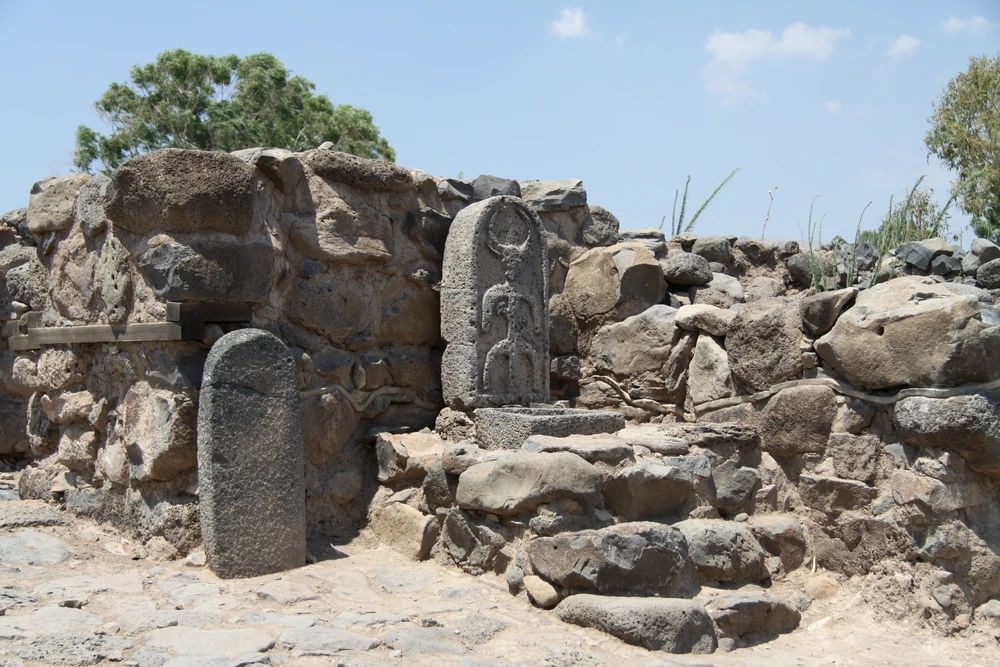
Bethsaida is one of the most frequently mentioned towns in the Gospels, and for centuries, one of the most frustratingly lost. Tradition holds that Jesus performed more miracles here than almost anywhere else. He healed a blind man here (Mark 8:22-26). He fed the 5,000 nearby (Luke 9:10-17). Three of his closest disciples, Peter, Andrew, and Philip, came from Bethsaida (John 1:44). And yet, despite all this, the town vanished so completely that archaeologists spent over a century arguing about where it was.
The Mystery – Bethsaida Sea of Galilee
The problem was simple: the Gospels describe Bethsaida as being on the shore of the Sea of Galilee, but no convincing remains were found at the water’s edge. For decades, the leading candidate was a site called e-Tell, a hilltop about 2 kilometers from the current shoreline. The excavations there uncovered a significant Iron Age and Roman-era settlement, but the distance from the lake troubled many scholars. How could a fishing village named Bethsaida (“House of the Fisherman” in Aramaic) be so far from the water?
The answer, some argued, was that the shoreline had shifted over two thousand years due to geological changes and sediment from the Jordan River. Others were not convinced. The debate ran for decades.
El-Araj: The Game Changer
In 2017, a new excavation began at el-Araj, a site on the northeastern shore of the Sea of Galilee, east of the Jordan River’s entry into the lake. What the team found changed the conversation entirely.
Beneath layers of mud and silt deposited by centuries of flooding, the excavators uncovered a Roman-era settlement with clear first-century remains: pottery, coins, fishing weights, and architectural fragments consistent with a lakeside town from the time of Jesus. Above the Roman layer, they found a Byzantine-era church, complete with mosaic floors and gilded glass tesserae, suggesting a site of considerable importance to early Christians.
The church may be the one described by Willibald, a Bavarian bishop who visited the Holy Land in 725 CE and reported seeing a church in Bethsaida built over the house of Peter and Andrew. If this identification holds, and the evidence is growing stronger with each excavation season, then el-Araj is not just Bethsaida. It is the house of the first apostles.
What Has Been Found
The excavations at el-Araj, led by Professor Mordechai Aviam of Kinneret College and Professor R. Steven Notley of Nyack College, have uncovered:
A Roman-era bathhouse, indicating a settlement of some wealth and sophistication, consistent with the historical sources that describe Bethsaida being elevated to the status of a polis (city) by the tetrarch Philip and renamed Julias in honor of Julia, daughter of Emperor Augustus.
First-century domestic structures with fishing-related artifacts, placing the settlement directly on the lake shore during the time of Jesus.
A Byzantine church with fine mosaic floors, gilded glass tesserae, and fragments of a decorated marble chancel screen. The finds indicate a large and magnificent church that stood at the center of a monastery complex, located within the Beteiha Nature Reserve managed by the Israel Nature and Parks Authority.
Coins, pottery, and other small finds spanning from the Hellenistic period through the Byzantine era, confirming continuous occupation over several centuries.
Bethsaida-Julias: Philip’s City
The ancient sources tell us that Philip, son of Herod the Great and tetrarch of the region east of the Jordan, upgraded the village of Bethsaida to a city and renamed it Julias, after Julia, the daughter of Emperor Augustus. Josephus Flavius records that Philip was buried in Bethsaida-Julias. The combination of the name (a fishing village elevated to a city), the location (on the lake, near the Jordan), and the archaeological finds makes el-Araj the strongest candidate yet for the Bethsaida of the Gospels.
Why It Matters
Bethsaida is not just another dot on the map of the Sea of Galilee. It was the home of the first disciples. It was where Jesus chose to begin building his movement. And the fact that it was lost for so long, buried under centuries of silt at the edge of a lake that millions of pilgrims have visited, makes its rediscovery one of the most exciting archaeological stories in Israel today.
The excavations at el-Araj are ongoing, and each season brings new discoveries. The site is gradually being prepared for visitors, and it is likely to become one of the most important pilgrimage destinations on the Sea of Galilee in the coming years.
Jesus at Bethsaida
Near Bethsaida, tradition holds that Jesus performed the miracle of feeding 5,000 people with five loaves of bread and two fish. Luke’s Gospel places the event explicitly: “He withdrew with them to a town called Bethsaida” (Luke 9:10). The crowd that had followed him was hungry, the disciples had no way to feed them, and a boy offered his small meal. Jesus blessed the food, broke it, and the disciples distributed it to the entire crowd. When the meal was over, twelve baskets of leftovers were collected, one for each tribe of Israel (Luke 9:12-17). The feeding is the only miracle recorded in all four Gospels.
Jesus also healed a blind man at Bethsaida in a two-stage miracle, first restoring partial sight and then full vision: “He took the blind man by the hand and led him outside the village. When he had spit on the man’s eyes and put his hands on him, Jesus asked, ‘Do you see anything?’ He looked up and said, ‘I see people; they look like trees walking around.’ Once more Jesus put his hands on the man’s eyes. Then his eyes were opened, his sight was restored, and he saw everything clearly” (Mark 8:23-25). Despite these miracles, Bethsaida did not repent, and Jesus pronounced judgment on it: “Woe to you, Bethsaida! For if the miracles that were performed in you had been performed in Tyre and Sidon, they would have repented long ago” (Luke 10:13).
Visit with Hoshen Tours
Bethsaida/el-Araj is a must for visitors who want to see biblical archaeology in real time. Hoshen Tours includes it in Sea of Galilee itineraries alongside Capernaum, Magdala, and the Majrase Nature Reserve nearby. Because some discoveries are still being written, and standing at el-Araj, you are watching one unfold.
Visitors exploring the Golan Heights often combine Bethsaida with nearby destinations such as Sea of Galilee, Capernaum, and Kursi, each offering its own distinctive perspective on the region’s layered history and landscape. A broader itinerary might also include Jordan River and Majrase, both within easy reach and rich in their own right.
Every Hoshen Tours itinerary is private and fully customizable. Contact us to begin planning your journey through the Golan Heights.
Explore Our Tour Collection
Ready to experience Israel in true colors?
Plan Your TourPrivate tours designed around your interests, schedule, and pace.