



Nahalal was the first moshav (cooperative agricultural village) in Israel, founded in September 1921 in the Jezreel Valley as an alternative to the kibbutz model. While the kibbutz was based on communal ownership and collective living, the moshav combined cooperative marketing and purchasing with individual family farms. Each family owned its own plot, made its own decisions about crops and livestock, but bought supplies and sold produce through the cooperative. The moshav model, designed by the Labor Zionist thinker Eliezer Joffe, would eventually become far more popular than the kibbutz, and Nahalal was its prototype and proving ground. The original 75 founding families drained the swamps of the Jezreel Valley and built their homes on land that had been malarial marshland.
The Circle That Kauffmann Drew
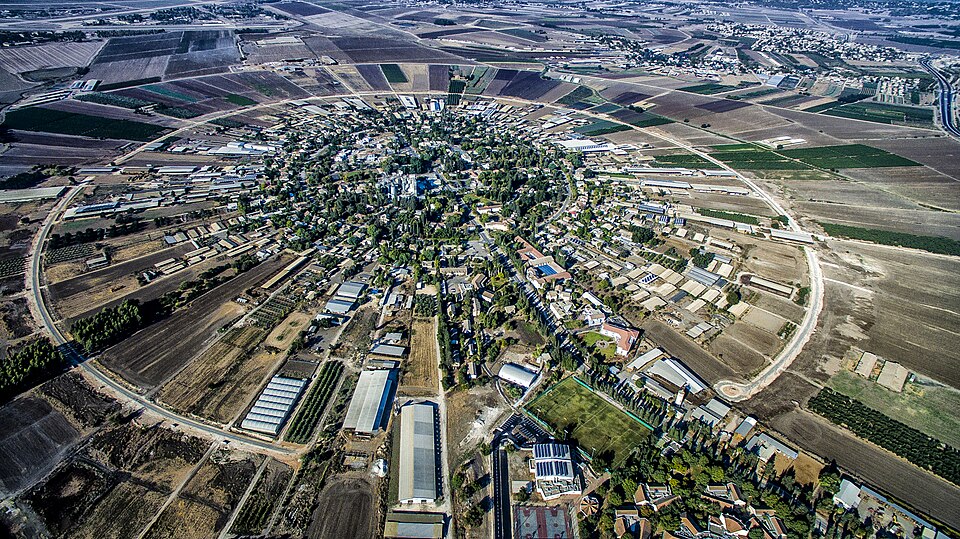
Nahalal was designed by the architect Richard Kauffmann in a distinctive circular plan that remains clearly visible from the air to this day. The public buildings (school, community center, cooperative offices) occupy the center of the circle. The farmhouses radiate outward like spokes of a wheel, each facing the communal center. Beyond the houses, the agricultural plots extend in pie-shaped wedges, giving each family equal access to both the community and their land. The design reflected the moshav’s ideology: each family has its own home and farm, but all face inward toward shared institutions. Kauffmann, a German-Jewish architect who came to Palestine in 1920, designed many of the early agricultural settlements, but Nahalal’s circle is his most famous creation and one of the most recognizable village plans anywhere in the world. The concentric design also ensured that no family was closer to the center than any other, a physical expression of equality.
Moshe Dayan
Nahalal’s most famous son is Moshe Dayan (1915-1981), the one-eyed general who became Israel’s most iconic military figure. Dayan grew up in Nahalal, learned Arabic from the neighboring Arab villagers, and developed the intimate knowledge of the land that would define his military career. He lost his left eye in June 1941 while serving as a guide with a Haganah reconnaissance squad attached to an Australian-led force during the Allied invasion of Vichy French-controlled Lebanon. A bullet struck the binoculars he was using, driving metal and glass into his eye. The black eye patch he wore for the rest of his life became the most recognized symbol of the Israeli military. Dayan served as Chief of Staff during the 1956 Sinai Campaign, as Defense Minister during the 1967 Six-Day War, and as Foreign Minister during the peace negotiations with Egypt that led to the Camp David Accords.
Agricultural School
The WIZO Nahalal Agricultural School, founded in 1929, was one of the first agricultural training schools for women in the country. At a time when farming was considered exclusively male work, the school trained generations of young women in modern agriculture, dairy farming, and land management. Its graduates played a significant role in building the agricultural infrastructure of the state. The school continues to operate today as a boarding school, though its curriculum has expanded well beyond agriculture to include general education, arts, and technology.
Ilan Ramon: From Nahalal Israel to Space
Nahalal’s most famous son in the modern era is Ilan Ramon, Israel’s first astronaut. Ramon grew up in the moshav, attended the local school, and went on to become an F-16 pilot in the Israeli Air Force. In 1981, he was one of the youngest pilots selected for Operation Opera, the daring strike on Iraq’s Osirak nuclear reactor. Two decades later, in January 2003, Ramon flew aboard the Space Shuttle Columbia as a payload specialist, carrying with him a small Torah scroll that had survived the Bergen-Belsen concentration camp and a drawing by a child who perished in the Holocaust. Ramon’s mission ended in tragedy when Columbia disintegrated during re-entry on February 1, 2003, killing all seven crew members. A memorial at Nahalal honors his memory, and the Ramon crater in the Negev — which predates him by millions of years — now carries an additional layer of meaning for Israelis who remember the boy from the circular moshav who reached the stars.
Visit with Hoshen Tours
Nahalal was the first moshav in Israel and the hometown of Moshe Dayan, and its distinctive circular layout, designed by architect Richard Kauffmann, is still visible from the surrounding hills. Hoshen Tours tells the story of the cooperative farming model that became an alternative to the kibbutz, and the influence this small village had on Israeli agriculture and leadership. The pioneering spirit of the Jezreel Valley comes alive here. Combine it with Merhavia where Golda Meir lived, Tel Shimron, Bethlehem of Galilee, and Tel Jezreel.
Explore Our Tour Collection
Ready to experience Israel in true colors?
Plan Your TourPrivate tours designed around your interests, schedule, and pace.