



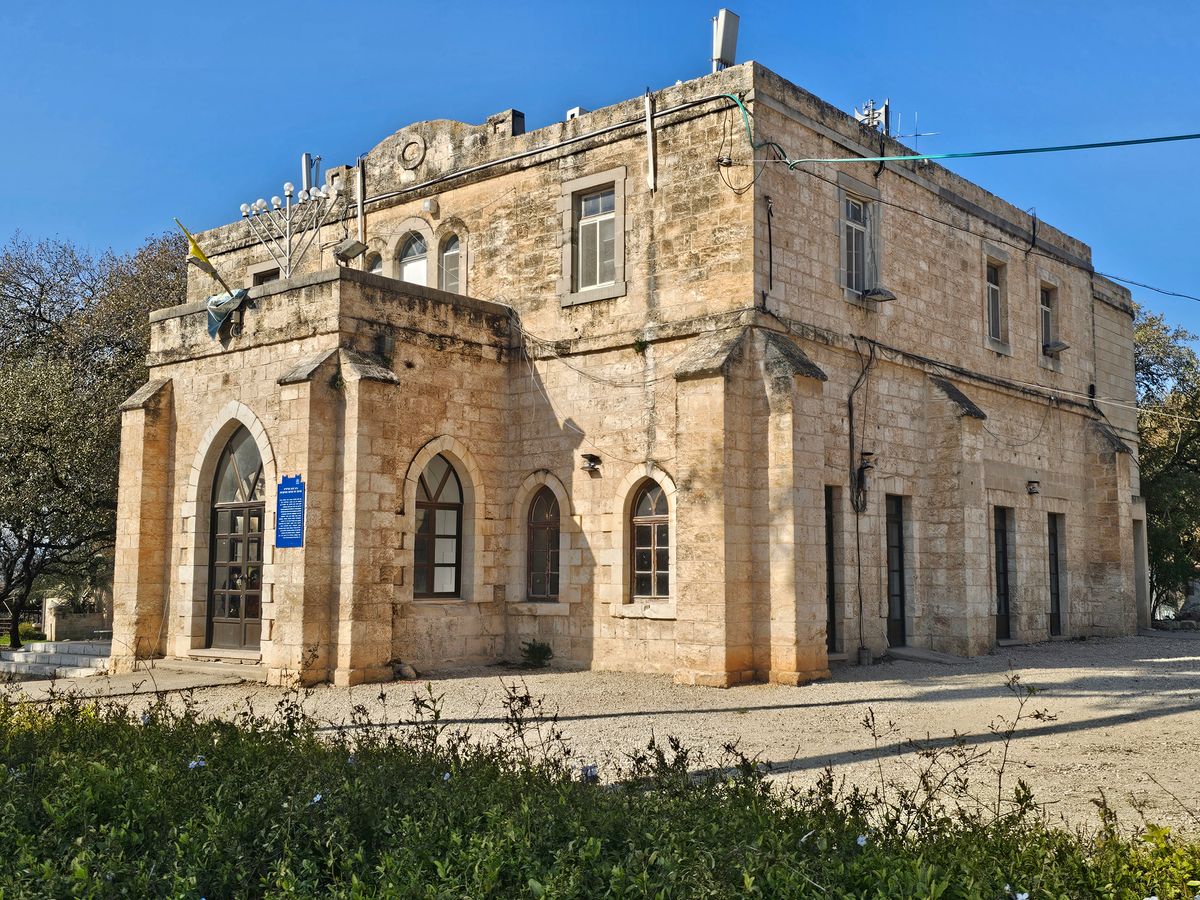
Two small communities in the lower Galilee hills, just a few kilometers apart, tell very different stories about this beautiful corner of Israel. One raises questions about the birthplace of King David. The other preserves traces of a 19th-century German Protestant sect that came to the Holy Land to prepare for the Second Coming of Christ.
Bethlehem of Galilee – Bethlehem of Galilee and Alonei Abba
Yes, there is a Bethlehem in the Galilee. This small community, about 10 kilometers northwest of Nazareth, sits among rolling green hills, and some scholars believe it may be the true birthplace of King David and the Bethlehem referenced in certain biblical passages, not the more famous Bethlehem in Judea, south of Jerusalem.
The name Bethlehem means “House of Bread” (or possibly “House of Meat/Lahmu”). This Galilean Bethlehem is mentioned in the territory of the tribe of Zebulun (Joshua 19:15). Some scholars have argued that references to “Bethlehem Ephratah” in the book of Micah (5:2), the prophecy that the Messiah will come from Bethlehem, may refer to this Galilean village rather than the Judean town, pointing to the proximity to Nazareth and the Galilee’s central role in the Gospel narrative.
Bethlehem of Galilee is a small moshava founded in 1906 by the Jewish Colonization Association (ICA). Today it has a few hundred residents and a quiet rural character. The surrounding landscape, wheat fields, olive groves, and gentle hills, is classic Lower Galilee, and the area is popular with hikers and cyclists.
Alonei Abba and the German Templars
Nearby, the small moshava of Alonei Abba has a surprising connection to one of the most unusual communities in the history of the Holy Land: the German Templars. The Templar Society (Tempelgesellschaft), not to be confused with the medieval Knights Templar, was a Protestant pietist sect founded in Württemberg, Germany, in the 1850s by Christoph Hoffmann. Hoffmann believed that the Second Coming of Christ could be hastened by establishing a devout Christian community in the Holy Land, and in 1868 the first group of Templars arrived in Haifa and began building a colony at the foot of Mount Carmel.
Over the following decades, the Templars established seven colonies across the land: the German Colony in Haifa, Sarona near Jaffa (today the Sarona Market complex in Tel Aviv), the German Colony in Jerusalem, and smaller settlements at Jaffa, Bethlehem of Galilee, Wilhelma (today Bnei Atarot), and in the Galilee. Their colonies were instantly recognizable: stone houses with red-tiled roofs, wide tree-lined streets, orderly gardens, and inscriptions from scripture carved above the doorways. The Templars introduced technologies that were revolutionary in the Ottoman-era Holy Land, steam-powered flour mills, modern plows, wine presses, wheeled carriages, and the first regular stagecoach service between Jaffa and Jerusalem.
The Templar colonies became models of European efficiency in a land that had been neglected for centuries under Ottoman rule. When the first Jewish immigrants of the First Aliyah arrived in the 1880s, they found Templar settlements already demonstrating that modern agriculture was possible here. The irony was not lost on anyone: a German Protestant sect, driven by Christian eschatology, had inadvertently prepared the infrastructure and proven the concept for the Zionist project that would follow.
The Site Today
The Templar story ended badly. During both World Wars, the British interned the German citizens as enemy aliens. In the 1930s, a significant number of younger Templars joined the Nazi party, and swastika flags flew alongside the Templar cross in some colonies. During World War II, the British deported most of the Templars to internment camps in Australia. Their properties were confiscated and later transferred to the new State of Israel. Today, Templar buildings survive across Israel, the beautifully restored colonies in Haifa and Jerusalem, the Sarona complex in Tel Aviv, as architectural reminders of a community that shaped the land and then vanished from it.
Alonei Abba today is a quiet residential community surrounded by the oak forests (alonei = oaks) that give it its name. The Galilee countryside around the village is ideal for hiking, and the area’s proximity to Beit She’arim and the Jezreel Valley makes it a pleasant stop on a lower Galilee tour.
Visit with Hoshen Tours
Bethlehem of Galilee and Alonei Abba tell two very different pioneering stories, and visiting them together with Hoshen Tours reveals how the early settlement movement took different forms in different communities. The biblical connection of the name “Bethlehem of Galilee” and the German Templer history at Alonei Abba add layers of meaning to what might otherwise seem like quiet agricultural villages. These are off-the-beaten-path stops that reward curious visitors. Combine them with Nahalal, Tel Shimron, Merhavia, and the village of Nain.
Explore Our Tour Collection
Ready to experience Israel in true colors?
Plan Your TourPrivate tours designed around your interests, schedule, and pace.