



Alon Moreh (Elon Moreh, the Oak/Terebinth of Moreh) is one of the most significant locations in the Bible: it is the first place where tradition holds Abraham stopped when he entered the land of Canaan, and the first place where God promised the land to his descendants. The site, near Shechem in the Samarian mountains, marks the very beginning of the story that connects the Jewish people to the land of Israel.
The Name: The Teacher’s Tree
The Hebrew word “Moreh” comes from the root meaning “to teach” or “to instruct.” Alon Moreh can be translated as “the oak of the teacher” or “the terebinth of instruction.” In the ancient Near East, large solitary trees often served as landmarks and gathering places, and the tradition of associating a particular tree with teaching or divine revelation is well attested. The name suggests that this tree was already known as a place of instruction or oracle before Abraham arrived, a sacred landmark in the landscape that would become the setting for the first divine communication to Abraham in the promised land. Whether the tree was an oak (alon) or a terebinth (elah) is uncertain, as both species grow in the Samarian highlands and both can reach an impressive age and size.
Abraham’s Arrival: The First Promise in the Land
When Abraham (then Abram) left Haran and entered the land of Canaan, his first stop was at the great tree of Moreh at Shechem: “Abram traveled through the land as far as the site of the great tree of Moreh at Shechem. At that time the Canaanites were in the land. The Lord appeared to Abram and said, ‘To your offspring I will give this land.’ So he built an altar there to the Lord, who had appeared to him” (Genesis 12:6-7). This is the first divine promise of the land, the founding moment of the covenant between God and the Jewish people. The significance of this being the very first place where God spoke to Abraham after his arrival in Canaan cannot be overstated: every subsequent promise, to Isaac, to Jacob, to Moses, refers back to this moment at Alon Moreh. It is here that the entire biblical narrative of a people and a land begins.
Jacob’s Return
Generations later, Jacob returned to Shechem and the area of Alon Moreh after his years of exile with Laban. Before going to meet his brother Esau, Jacob buried the foreign gods that his household had collected: “So they gave Jacob all the foreign gods they had and the rings in their ears, and Jacob buried them under the oak at Shechem” (Genesis 35:4). The tree of Moreh was already a sacred landmark, a place where the patriarchs marked their relationship with God by building altars and burying idols.
Joshua’s Covenant
At the end of the conquest, Joshua gathered all the tribes of Israel at Shechem for a covenant renewal ceremony, standing at the same sacred tree: “On that day Joshua made a covenant for the people, and there at Shechem he reaffirmed for them decrees and laws. And Joshua recorded these things in the Book of the Law of God. Then he took a large stone and set it up there under the oak near the holy place of the Lord” (Joshua 24:25-26). The continuity is striking: according to the biblical account, tradition holds that Abraham built an altar here, Jacob buried idols here, and Joshua established the covenant here. The same tree, the same place, three moments that define the Israelite story.
Blessing and the Curse
Alon Moreh sits in the valley between Mount Gerizim and Mount Ebal, the mountains of blessing and curse. Moses commanded that when the Israelites entered the land, they should stand on these two mountains and pronounce blessings and curses: “When the Lord your God has brought you into the land you are entering to possess, you are to proclaim on Mount Gerizim the blessings, and on Mount Ebal the curses. As you know, these mountains are across the Jordan, westward, toward the setting sun, near the great trees of Moreh, in the territory of those Canaanites living in the Arabah in the vicinity of Gilgal” (Deuteronomy 11:29-30). The explicit mention of “the great trees of Moreh” in this passage ties the blessing and curse ceremony directly to the place where tradition holds Abraham first received the promise. The location of Alon Moreh between the two mountains places it at the geographic and theological center of the covenant.
The View and Landscape
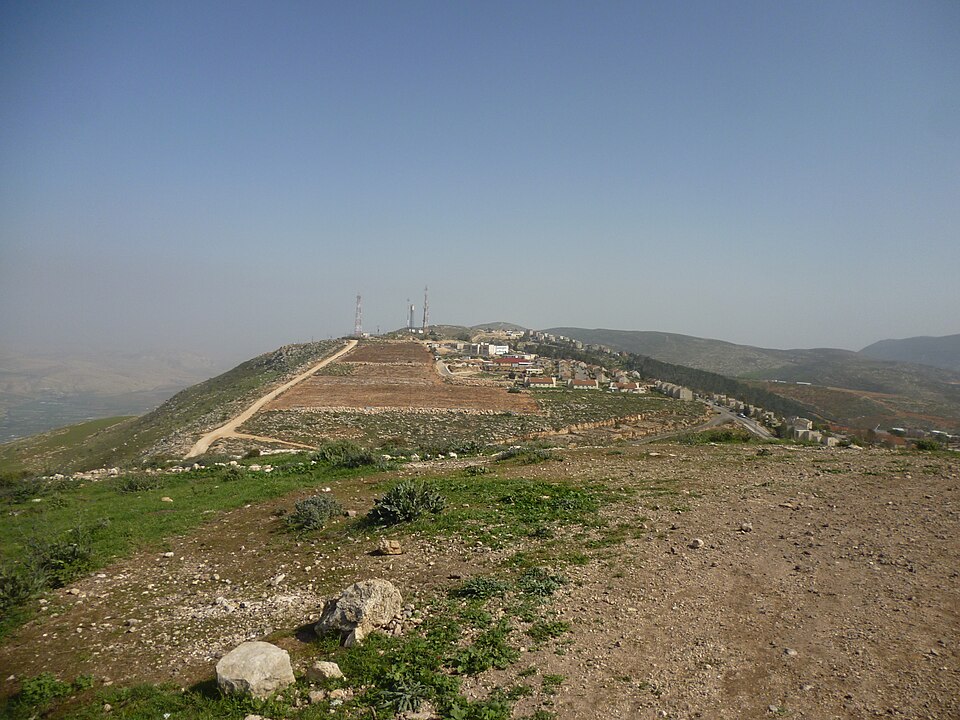
Alon Moreh overlooks the city of Shechem (modern Nablus) from the east. Below, the ancient city sits in the narrow pass between Mount Gerizim, which rises to its south, and Mount Ebal, which rises to its north. Visitors standing here look up at both mountainsides rising steeply on either side, creating a natural amphitheater. The valley floor and lower slopes are covered with olive groves and cultivated terraces that have been farmed continuously for thousands of years. To the east, behind Alon Moreh, the land drops toward the Jordan Valley and the mountains of Gilead beyond. To the west, the view stretches through the pass of Shechem with Mount Gerizim and Mount Ebal framing the ancient city on either side. The ancient tel of Shechem (Tel Balata) sits at the eastern end of the pass. The Samarian highlands stretch green and rolling in every direction, and the landscape retains much of the character it would have had when Abraham first arrived here from Haran.
Alon Moreh is where tradition holds Abraham first pitched his tent in the Promised Land. Hoshen Tours pairs it with Mount Gerizim and Mount Ebal, the overlook at Har Bracha, the encounter at Jacob’s Well, and the patriarchal site of Beit El.
Explore Our Tour Collection
Ready to experience Israel in true colors?
Plan Your TourPrivate tours designed around your interests, schedule, and pace.