



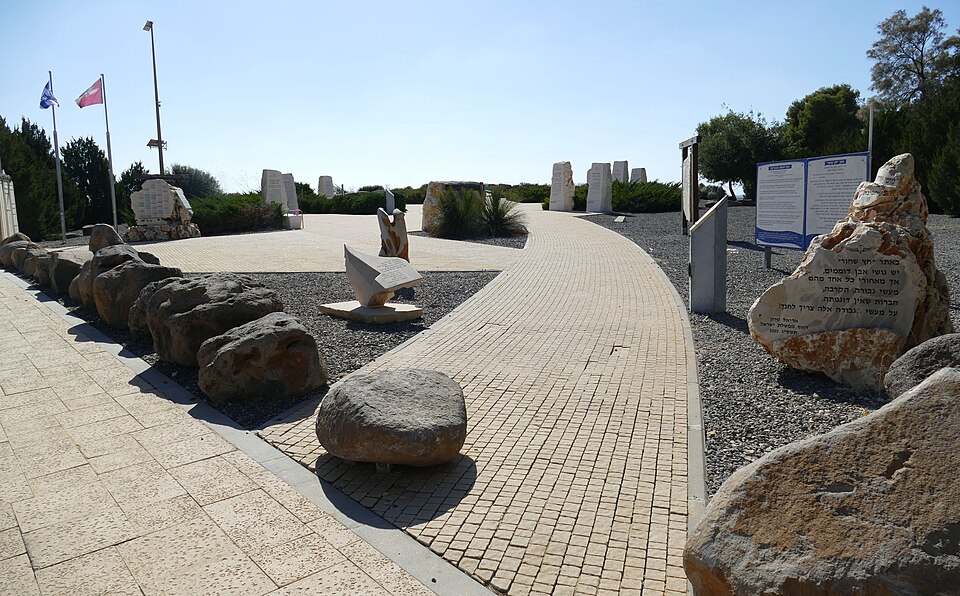
The Black Arrow Memorial (Andartat Hetz Shahor) stands near the Gaza border, commemorating Operation Black Arrow (February 1955), an IDF retaliatory raid on an Egyptian military base in the Gaza Strip that marked a turning point in Israel’s security doctrine. The operation, led by Ariel Sharon’s paratroopers, established the principle of forceful response to cross-border attacks that would define IDF strategy for decades.
Years of Cross-Border Raids
In the early 1950s, fedayeen (Palestinian guerrilla fighters) based in the Egyptian-controlled Gaza Strip carried out cross-border raids into Israeli territory, attacking civilians and military targets. The Israeli government, under pressure to respond, authorized a series of retaliatory operations. Operation Black Arrow, in February 1955, was the largest and most consequential of these raids. The fedayeen attacks had created a climate of fear in the southern communities, with farmers, bus passengers, and families in border towns targeted in ambushes and nighttime infiltrations. The Israeli public demanded action, and the political leadership faced a choice between diplomatic protest and military response.
The Night Raid
A force of approximately 150 paratroopers, commanded by Lieutenant Colonel (Sgan Aluf) Ariel Sharon, attacked an Egyptian military camp near Gaza City at night. The paratroopers engaged Egyptian forces in fierce combat that lasted several hours. The operation left 38 Egyptian soldiers dead and 8 Israeli soldiers killed. The raid was controversial internationally but was seen within Israel as a necessary demonstration that cross-border attacks would have consequences.
From Retaliation to Deterrence
Operation Black Arrow had far-reaching consequences. Egyptian President Gamal Abdel Nasser, humiliated by the raid, accelerated Egypt’s military buildup and sought arms from the Soviet Union, beginning the Cold War’s involvement in the Middle East conflict. The operation contributed to the chain of events that led to the 1956 Sinai Campaign and ultimately to the Six-Day War of 1967. Within the IDF, the operation reinforced the reprisal policy championed by Chief of Staff Moshe Dayan, who believed that decisive military responses would deter future attacks. This doctrine of active defense and disproportionate response became a cornerstone of Israeli security thinking, shaping operations and policy decisions for generations. The debate over whether reprisal raids prevented or provoked further violence continued long after 1955, but the principle that Israel would not absorb attacks passively became firmly established after Black Arrow.
The Black Arrow Monument and the Fallen
The memorial, designed as a black arrow pointing toward the sky, stands in the open fields near the border. The names of the eight fallen soldiers are inscribed on the monument. The site offers views across the flat terrain toward Gaza, and the memorial is visited on memorial days and by military groups. The stark simplicity of the design suits the landscape: flat agricultural fields stretching to the horizon, a wide sky above, and the border just beyond. There are no trees or walls to soften the setting. The memorial stands exposed to the same open ground that the paratroopers crossed on the night of the operation, and the stillness of the place today contrasts sharply with the violence that once took place here.
The location of the memorial, in the agricultural fields near the border, places it within the same landscape that the kibbutz farmers have worked for decades. Visitors standing at the monument can see the greenhouses and orchards of the surrounding communities, a visual reminder that the people who live here have built productive lives on exposed ground. The juxtaposition of the memorial’s stark military history and the peaceful farmland around it captures something essential about the Gaza Envelope: a community that has always lived with danger while continuing to plant, harvest, and raise families.
Visit with Hoshen Tours
The Black Arrow Memorial commemorates a pivotal 1955 operation. Hoshen Tours pairs it with the Steel Division Memorial, the trails of Park Eshkol, the innovation of the Salad Trail, and the ancient mosaics at the Maon Synagogue.
Explore Our Tour Collection
Ready to experience Israel in true colors?
Plan Your TourPrivate tours designed around your interests, schedule, and pace.