



The Austrian Hospice Jerusalem of the Holy Family stands on the Via Dolorosa in the Muslim Quarter, an elegant Habsburg-era building that looks like it was lifted from a Viennese side street and dropped into the middle of the Old City. Built in 1863 as a pilgrim guesthouse for Austrian Catholics, the hospice still operates as a guesthouse and cafe, and its rooftop offers one of the best panoramic views of the Old City.
Franz Joseph and the Holy Land Jerusalem
The Austrian Hospice was founded in 1857 by the Archbishop of Vienna as a guesthouse for Austrian pilgrims to the Holy Land. Its most famous guest arrived in 1869: Emperor Franz Joseph I, who stopped in Jerusalem on his way to the opening of the Suez Canal. Franz Joseph was the first reigning European emperor to make a formal state visit to the Holy Land in centuries. He stayed at the hospice, walked the Via Dolorosa, and visited the Church of the Holy Sepulchre. The visit was a powerful statement of Habsburg interest in the Christian holy sites and a model for generations of Austrian pilgrims who followed. The hospice still considers Franz Joseph one of its founding fathers, and his portrait hangs inside. The Habsburg Empire had long positioned itself as a protector of Catholic interests in the Ottoman Empire, competing with France for influence over the Latin churches and institutions. The founding of the hospice was part of this broader strategy, establishing an Austrian foothold on one of the most sacred streets in Christendom at a time when the great European powers were carving out spheres of religious patronage across the Holy Land.
The Rooftop View
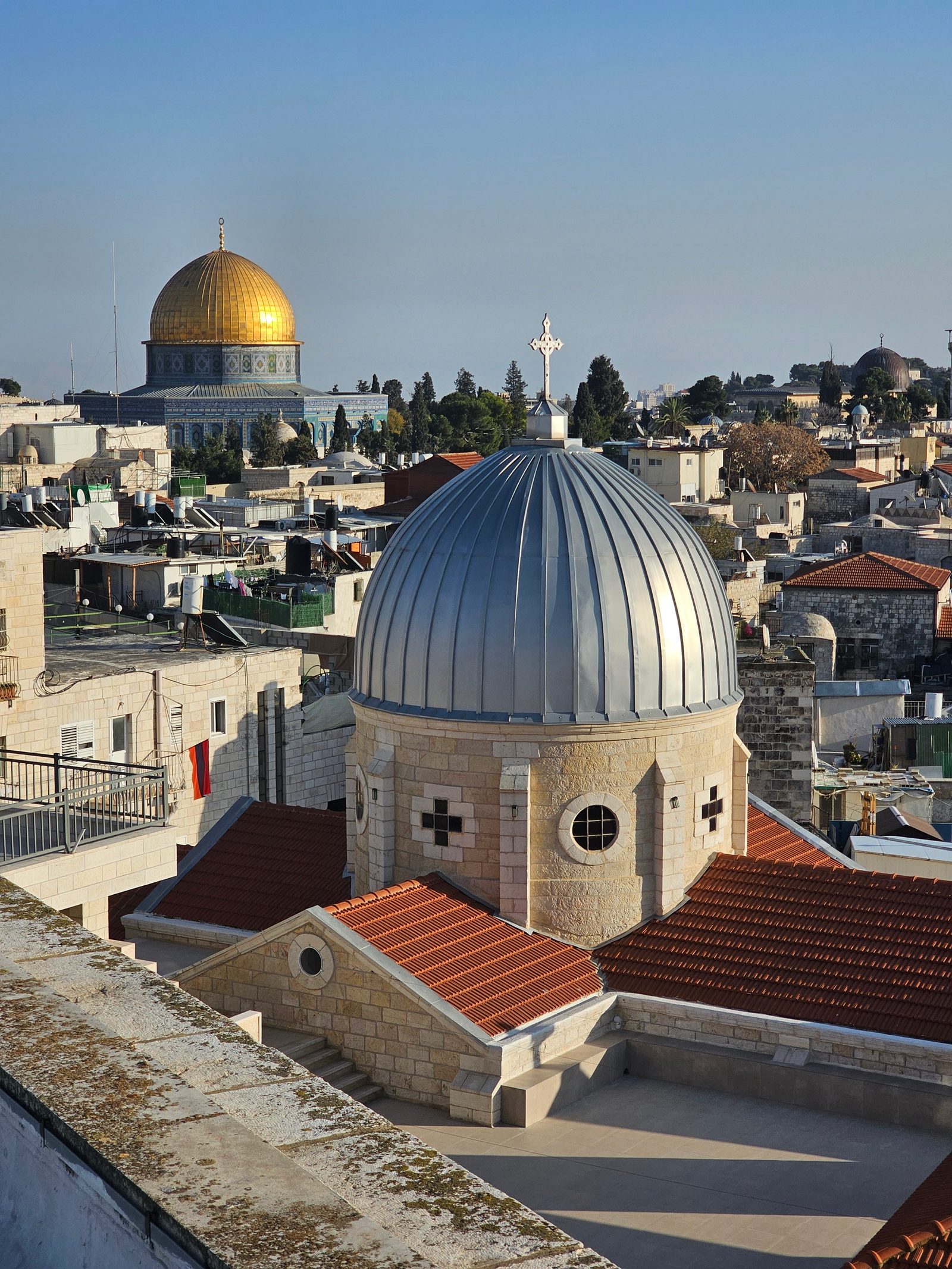
The main reason visitors come to the Austrian Hospice is the rooftop terrace. For a small entrance fee, visitors climb to the roof and are rewarded with a 360-degree view that includes the Dome of the Rock, the Church of the Holy Sepulchre, the Mount of Olives, and the rooftops of all four quarters. The view is particularly fine because the hospice sits at the intersection of the Via Dolorosa and the main market street, placing the viewer at the crossroads of the Old City. From the rooftop you can trace the full line of the Via Dolorosa as it winds westward toward the Church of the Holy Sepulchre, and the forest of domes, minarets, and bell towers that rises from the Old City roofscape tells the story of Jerusalem’s layered religious history at a single glance. On a clear morning, the golden Dome of the Rock catches the sunlight in a way that makes the whole terrace feel like a balcony seat at the center of the world.
Viennese Coffee in the Old City
The ground-floor cafe serves Viennese coffee, apple strudel, and sachertorte in a garden courtyard that feels like Central Europe. The combination of Austrian pastries and Jerusalem’s Old City is surreal and delightful, and the cafe is a perfect rest stop during a long day of walking the Via Dolorosa. The interior rooms preserve the hospice’s original 19th-century character, with high ceilings, tiled floors, and dark wood furniture that would not look out of place in a coffeehouse on the Ringstrasse. Sitting in the courtyard with a melange and a slice of strudel while the sounds of the Old City drift over the walls is one of those small pleasures that visitors remember long after they leave Jerusalem.
From Pilgrims to Paratroopers
The hospice was built during the great wave of European institution-building in Jerusalem, when the Austrian, French, German, Russian, and Italian empires competed for influence through religious and charitable projects. The building served as a military hospital during World War I, was used by the British during the Mandate, and was occupied by the Jordanian army from 1948 to 1967. It was returned to Austrian ownership after 1967 and has been beautifully restored.
Visit with Hoshen Tours
The Austrian Hospice, perched along the Via Dolorosa in the Muslim Quarter, offers one of the best rooftop views in all of Jerusalem. Your Hoshen Tours guide will take you up to the panoramic terrace overlooking the Dome of the Rock, the Church of the Holy Sepulchre, and the Mount of Olives. The hospice is a short walk from Damascus Gate and close to the Sisters of Zion convent, making it an ideal stop on a walking tour through the Old City.
Explore Our Tour Collection
Explore this site and 65 more in Sacred Steps in the Holy Land
225 pages · The Life, World, and Footsteps of Jesus · Maps, photos, and Scripture references
Ready to experience Israel in true colors?
Plan Your TourPrivate tours designed around your interests, schedule, and pace.