



The Muslim Quarter is the largest and most populated of the Old City‘s four quarters, occupying the northeastern section from the Damascus Gate to the Lions’ Gate. With over 22,000 residents, it is the most densely inhabited area of the Old City, and its narrow streets are the busiest, noisiest, and most alive of any quarter.
The Market Streets Along the Ancient Roman Grid Jerusalem
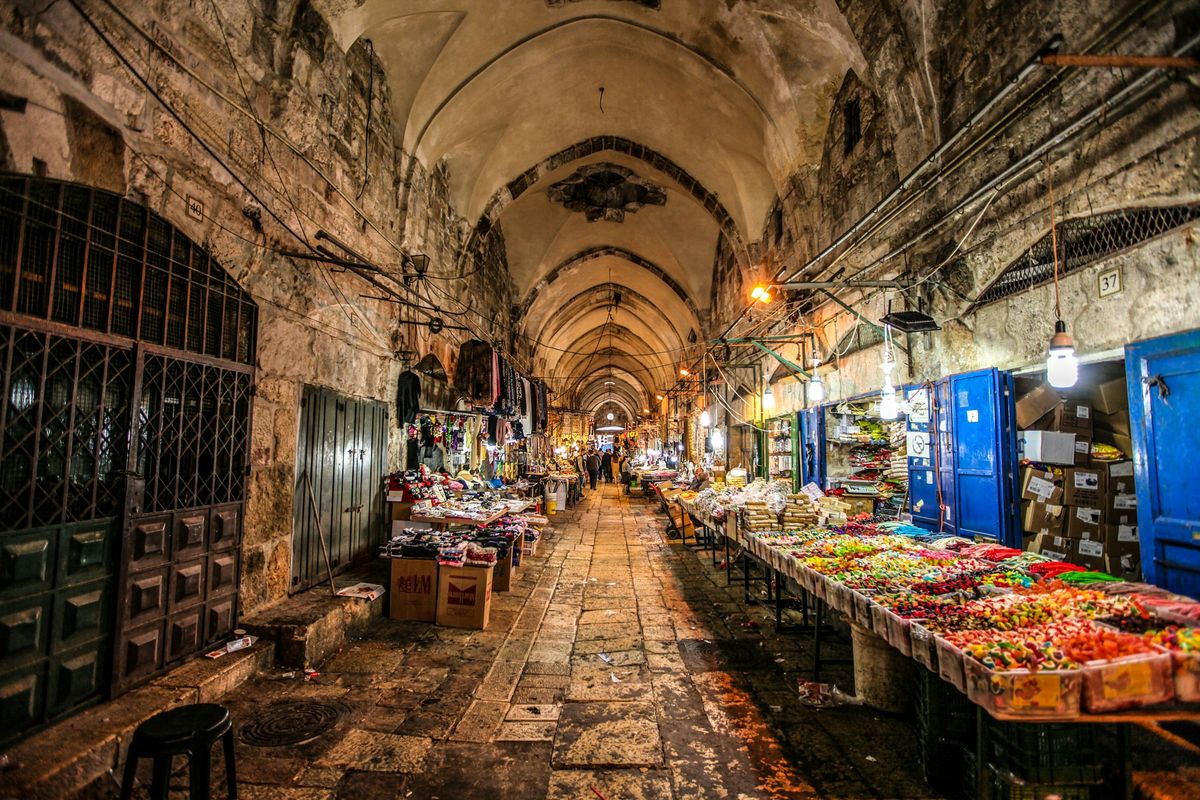
The main market streets of the Muslim Quarter follow the routes of the ancient Roman cardo (north-south) and decumanus (east-west), the grid that Hadrian laid out when he rebuilt Jerusalem as Aelia Capitolina in the 2nd century CE. The Suq Khan ez-Zeit (the market of the olive oil inn) and the Suq el-Attarin (the spice market) are the primary arteries, leading from the Damascus Gate toward the Holy Sepulchre and the intersection with the Via Dolorosa.
Most of the Via Dolorosa passes through the Muslim Quarter, which means that Christian pilgrims carrying crosses walk past Muslim shopkeepers selling vegetables. The juxtaposition is quintessentially Jerusalem: sacred and mundane sharing the same narrow street, neither disturbing the other. On Friday afternoons, when the Franciscan procession moves through the streets, and on Friday midday, when Muslims head to prayer at Al-Aqsa, the quarter becomes the meeting point of two faiths in motion.
Architecture and Landmarks
The Muslim Quarter as it stands today is overwhelmingly a Mamluk creation. The Mamluks, a military dynasty of former slave soldiers who ruled Egypt, Syria, and Palestine from 1250 to 1517, invested heavily in Jerusalem as a center of Islamic learning and pilgrimage. They built dozens of madrasas (religious schools), zawiyas (Sufi lodges), ribats (pilgrim hospices), sabils (public fountains), hammams (bathhouses), and mausoleums, concentrating them along the streets leading to the Temple Mount. The result is one of the finest collections of Mamluk architecture in the world, rivaling Cairo itself. The stonework features the distinctive Mamluk style: alternating bands of red and cream stone (ablaq), carved muqarnas (stalactite-like honeycomb vaulting above doorways), monumental portal entrances, and Arabic inscriptions recording the name of the builder and the date of construction.
Among the most notable buildings are the Tankiziyya Madrasa (built by the governor Tankiz in 1328, later used by the Ottomans as a courthouse), the Tashtamuriyya (a mausoleum with some of the finest carved stonework in the city), the Ashrafiyya Madrasa (described by the historian Mujir al-Din as the “third jewel of the Haram” after the Dome of the Rock and Al-Aqsa), and the Ribat al-Mansuri (a 13th-century pilgrim hospice). Most visitors walk past these buildings without noticing them, but for anyone with an eye for architecture, the Mamluk streets of the Muslim Quarter are one of the great hidden treasures of the Old City.
The Muslim Quarter also contains the majority of the gates leading onto the Temple Mount (Haram al-Sharif). Of the Temple Mount’s open gates, most are accessible only to Muslims, and access is monitored and regulated by the Israel Police. Non-Muslim visitors may enter the Temple Mount compound only through the Mughrabi Gate near the Western Wall plaza, during limited visiting hours. The gates along the Muslim Quarter streets. Nine gates lead from the Muslim Quarter onto the Temple Mount platform, each framed by Mamluk stonework and leading directly from the narrow alleys of the quarter onto the vast open esplanade of the Haram.
Suq al-Qattanin and the Gates
The Suq al-Qattanin (Cotton Merchants’ Market) is the finest surviving Mamluk market in Jerusalem. Built in the 14th century by Tankiz, the covered market features a vaulted stone ceiling, two restored bathhouses (hammams), and a row of shops that leads directly to the Cotton Gate (Bab al-Qattanin), one of the most beautiful gates of the Temple Mount. The view through the gate to the golden Dome of the Rock, framed by the medieval stone arch, is one of the most photographed compositions in the Old City. The Cotton Gate holds special significance for Jewish worshippers because it is traditionally regarded as the closest gate to the site of the Holy of Holies. Since non-Muslims may enter the Temple Mount only through the Mughrabi Gate, and may not enter the Dome of the Rock, some Jews stand near the entrance of the Cotton Market to pray toward the place where the Divine Presence is believed to have dwelled.
The Little Western Wall
Hidden in the alleys of the Muslim Quarter, the Little Western Wall (HaKotel HaKatan) is a short exposed section of the Western Wall that is actually closer to the spot where the Holy of Holies once stood than the main Western Wall plaza. The stones here are massive Herodian ashlars, identical to those at the main plaza, but the setting could not be more different: a narrow alley, no plaza, no crowds, just a few meters of ancient wall with prayer books tucked into the crevices and a handful of worshippers standing in silence. Most tourists never find it. Those who do often describe it as the most powerful prayer experience in Jerusalem, precisely because of its intimacy and its unexpected location deep inside the Muslim Quarter.
Daily Life and Food
The Muslim Quarter is not a tourist attraction; it is a living neighborhood. Families live above the shops, children play in the alleys, and the rhythms of daily life, morning prayers, school runs, afternoon tea, evening shopping, continue around and through the tourists. The quarter’s bakeries produce fresh bread before dawn. The butchers receive their deliveries at first light. The spice merchants arrange their displays with the precision of artists. Understanding the Muslim Quarter means understanding that this is not a museum. It is a neighborhood that happens to contain 2,000 years of history.
The Muslim Quarter is the best place to eat in the Old City. Fresh ka’ak (sesame bread rings) are sold from carts at every corner. The knafeh (sweet cheese pastry soaked in orange-blossom syrup) is one of the iconic flavors of the Old City, served hot and stretchy from shops near the Damascus Gate. Coffee is roasted on the spot, filling the alleys with its aroma. Baklava is piled high in shop windows. Za’atar and sumac are scooped from open bins. And the falafel, shawarma, and hummus served in the market restaurants are among the best in Jerusalem.
Visit with Hoshen Tours
The Muslim Quarter is the largest and liveliest quarter of the Old City, and a private guide makes all the difference in navigating its labyrinthine streets. Entering through Damascus Gate, your Hoshen Tours guide will lead you along the Via Dolorosa with its Stations of the Cross, up to the Austrian Hospice rooftop for a stunning view, and to the Pools of Bethesda near Lions’ Gate. The quarter also provides access to the Temple Mount compound, adding layers of history from every era of Jerusalem’s past. Hoshen Tours often combines this site with Sephardic Synagogues, Deir es-Sultan, and Sisters of Zion for a memorable day exploring the region.
Explore Our Tour Collection
Explore this site and 65 more in Sacred Steps in the Holy Land
225 pages · The Life, World, and Footsteps of Jesus · Maps, photos, and Scripture references
Ready to experience Israel in true colors?
Plan Your TourPrivate tours designed around your interests, schedule, and pace.