



In 1970, archaeologists excavating the rebuilt Jewish Quarter discovered what is now known as the Burnt House — the basement of a mansion destroyed by fire. The house, which belonged to a priestly family named Bar Kathros (known from Talmudic sources as a family criticized for using their position to exploit the common people), was buried under a thick layer of ash and debris from the Roman destruction of Jerusalem in 70 CE. The discovery turned a name from the Talmud into a physical address. The excavation was led by Nahman Avigad as part of the broader archaeological campaign that followed Israel’s capture of the Old City in 1967.
The Finds
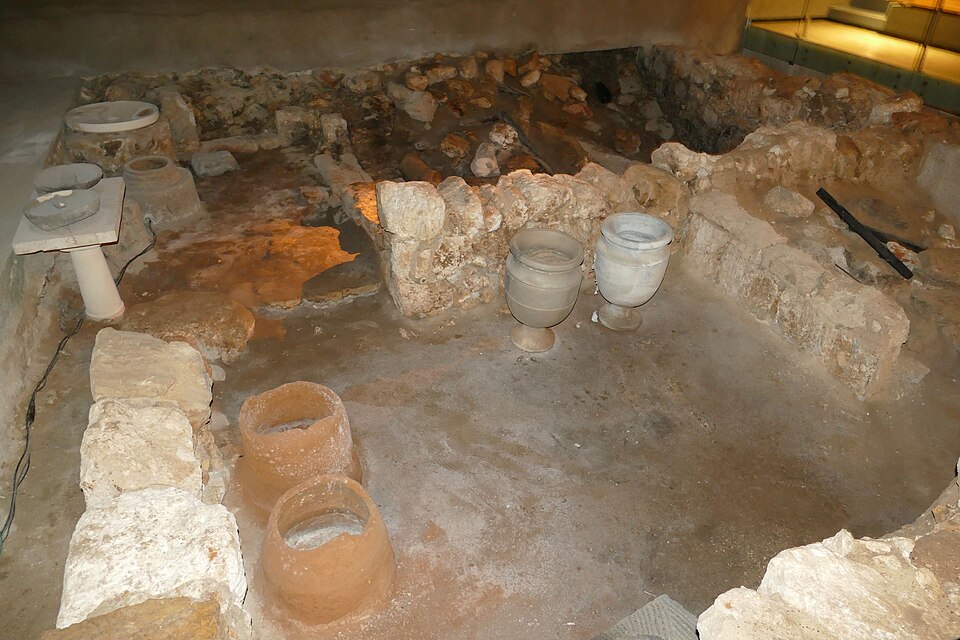
The basement rooms were preserved exactly as the Romans left them. Overturned stone tables. Smashed pottery. Charred wooden beams. Iron nails scattered on the floor. Coins from the last year of the revolt. A spear leaning against a wall, left behind by the soldiers who set the fire. And, most haunting of all, the arm bone of a young woman, found in the kitchen area as she tried to escape the flames. The stone vessels found in the house are significant because Jewish law holds that stone cannot become ritually impure, confirming this was a family that observed the purity laws strictly.
The Kathros Family
The stone vessels, the ritual bath (mikveh), and the fine quality of the house confirm that this was the home of a wealthy priestly family living in the Upper City, just steps from the Temple. A stone weight inscribed with the name “Bar Kathros” identified the family. The Talmud (Pesachim 57a) preserves a bitter folk song about the priestly families who abused their power: “Woe to me because of the house of Kathros, woe to me because of their pens” (referring to their documents of oppression). The discovery of the Bar Kathros house gave this ancient complaint a street address and a layer of ash.
Sound and Light Show
The Burnt House museum includes a short multimedia presentation that recreates the final hours of the house and the city. The film uses the archaeological evidence and the writings of Josephus to tell the story of the family that lived here and the night their world ended. Visitors descend into the actual basement rooms and watch the presentation surrounded by the original walls and artifacts. The experience provides essential context for the physical remains and brings the dry archaeology to life.
Woman in the Doorway
The arm bone found near the doorway belongs to a woman in her twenties. She was not a statistic from Josephus. She was a real person, in a real house, on the worst day of her life. She tried to reach the door and did not make it. The bone, displayed in the museum, is a reminder that the Roman destruction of Jerusalem was not an abstract historical event. It happened to people with names, in houses with addresses, on a specific night in the summer of 70 CE.
Visit with Hoshen Tours
The Burnt House offers a powerful and intimate encounter with the Roman destruction of Jerusalem in 70 CE. Located in the Jewish Quarter, it pairs perfectly with a visit to the nearby Herodian Quarter museum, which showcases the wealthy priestly mansions of the same era. Your Hoshen Tours guide can weave these sites together with the Broad Wall from centuries earlier, the Hurva Synagogue, and a walk down to the Western Wall to complete a journey through Jerusalem’s layered history. Hoshen Tours often combines this site with Sephardic Synagogues, Deir es-Sultan, and Sisters of Zion for a memorable day exploring the region.
Explore Our Tour Collection
Explore this site and 65 more in Sacred Steps in the Holy Land
225 pages · The Life, World, and Footsteps of Jesus · Maps, photos, and Scripture references
Ready to experience Israel in true colors?
Plan Your TourPrivate tours designed around your interests, schedule, and pace.