



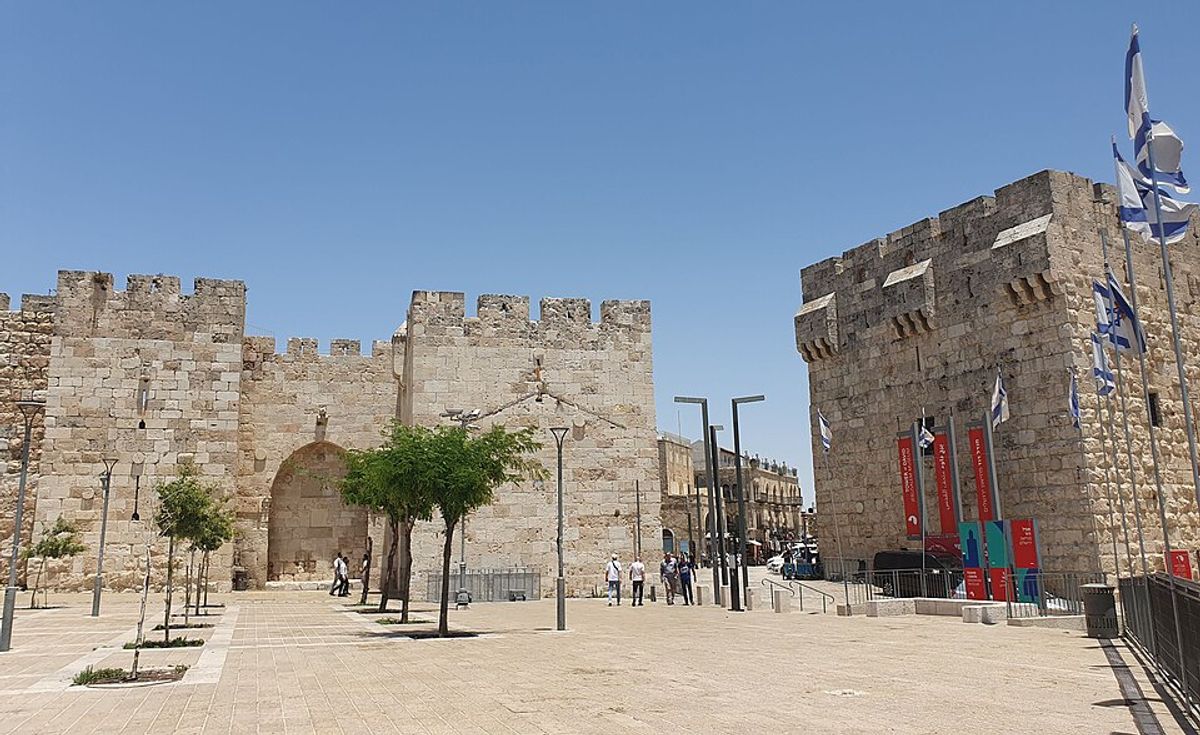
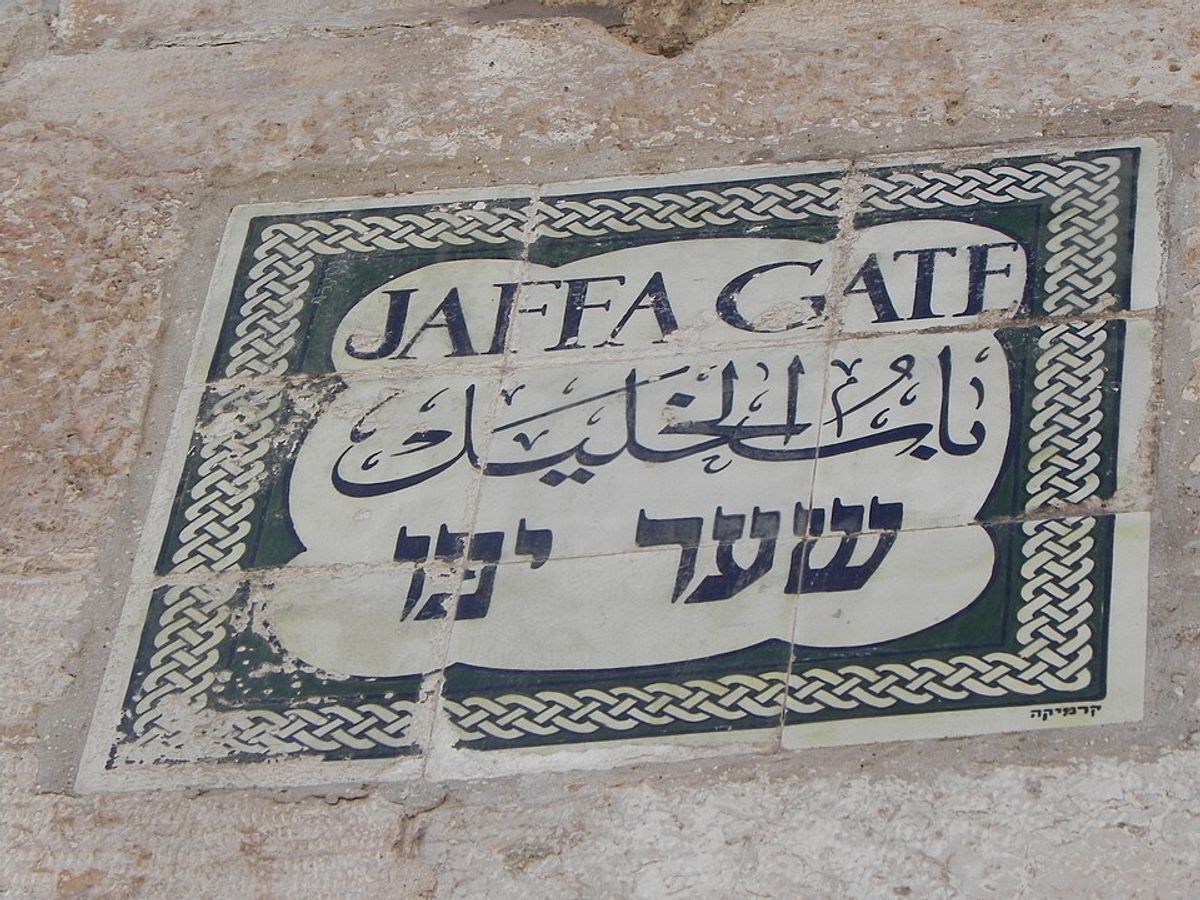
The Jaffa Gate Jerusalem in Jerusalem is the main entrance to the Old City of Jerusalem and the gateway through which most visitors enter for the first time. Its Hebrew name, Sha’ar Yafo, points west toward the ancient port city of Jaffa on the Mediterranean coast, 60 kilometers away. For centuries, the road from this gate was the main route connecting Jerusalem to the sea and to the wider world: pilgrims arriving by ship at Jaffa would travel inland through the Judean Hills, and this gate was the moment they first entered the Holy City. The Arabic name, Bab al-Khalil (Gate of the Friend), points in the opposite direction, south toward Hebron (al-Khalil), the city of Abraham, the “Friend of God.” One gate, two names, two roads, two civilizations.
The L-Shaped Entrance Jerusalem
Like most gates in the Ottoman walls, the Jaffa Gate was designed with a right-angle turn inside, forcing anyone entering to slow down and turn, making it impossible for attackers to charge straight through. The gate was built by Suleiman the Magnificent in 1538 as part of his reconstruction of the city walls. An Arabic inscription above the gate, still legible after nearly five centuries, dedicates the construction to “the Sultan of the two lands and the two seas, the Sultan who conquered the lands of the Persians and the Arabs, Sultan Suleiman son of Sultan Selim Khan” and dates the work to the year 945 of the Hijra (1538-1539 CE). A second inscription invokes divine protection upon the city. In the early 20th century, the Ottoman authorities added a clock tower above the gate, part of a series of clock towers built across the empire to celebrate the silver jubilee of Sultan Abdul Hamid II. The tower was removed by the British in 1922, just a few years after they captured the city from the Ottomans, and the gate returned to its original 16th-century profile.
The Breach for the Kaiser
In 1898, Kaiser Wilhelm II of Germany visited Jerusalem, and the Ottoman authorities breached the wall beside the Jaffa Gate to allow his carriage to enter without passing through the narrow L-shaped gate. The breach was never repaired, and today most visitors walk through the wide opening beside the gate rather than through the original Ottoman archway. The road that passes through the breach leads directly to the Christian Quarter and the Armenian Quarter.
Tower of David
Immediately inside the Jaffa Gate stands the Tower of David (the Jerusalem Citadel), a fortress that has been rebuilt by virtually every ruler of Jerusalem from Herod the Great to the Ottomans. The citadel houses the Tower of David Museum, which tells the story of Jerusalem through archaeological remains and multimedia exhibits. The Herodian base of the tower, with its massive stone blocks, is visible at ground level, and the view from the top of the minaret (which has nothing to do with David and was added by the Ottomans) is one of the best in the city.
Legend of Suleiman
A popular legend says that Suleiman the Magnificent built the walls of Jerusalem because he had a dream in which lions threatened to devour him unless he protected the holy city. The two architects who built the walls are said to be buried in graves beside the Jaffa Gate, either honored for their work or executed to prevent them from building walls as fine for anyone else, depending on which version of the legend you prefer.
Visit with Hoshen Tours
Jaffa Gate serves as the western entrance to the Old City and a natural starting point for many guided itineraries. Just inside, the Tower of David museum offers an excellent overview of Jerusalem’s history across the ages. From here, your Hoshen Tours guide can lead you into the Armenian Quarter with its ancient monastery, through the Christian Quarter to the Church of the Holy Sepulchre, or to nearby Christ Church, the oldest Protestant church in the Middle East. The Ramparts Walk also begins near Jaffa Gate, offering panoramic views from the city walls. Hoshen Tours often combines this site with Sephardic Synagogues, Deir es-Sultan, and Sisters of Zion for a memorable day exploring the region.
Explore Our Tour Collection
Explore this site and 65 more in Sacred Steps in the Holy Land
225 pages · The Life, World, and Footsteps of Jesus · Maps, photos, and Scripture references
Ready to experience Israel in true colors?
Plan Your TourPrivate tours designed around your interests, schedule, and pace.