



The Gvilei HaEsh (Scrolls of Fire) Memorial stands on a hilltop in the Jerusalem Hills, between Jerusalem and Beit Shemesh. It is one of the most powerful and least visited memorials in Israel, a monumental bronze sculpture that tells the story of the Jewish people from the destruction of the Temple to the establishment of the State of Israel.
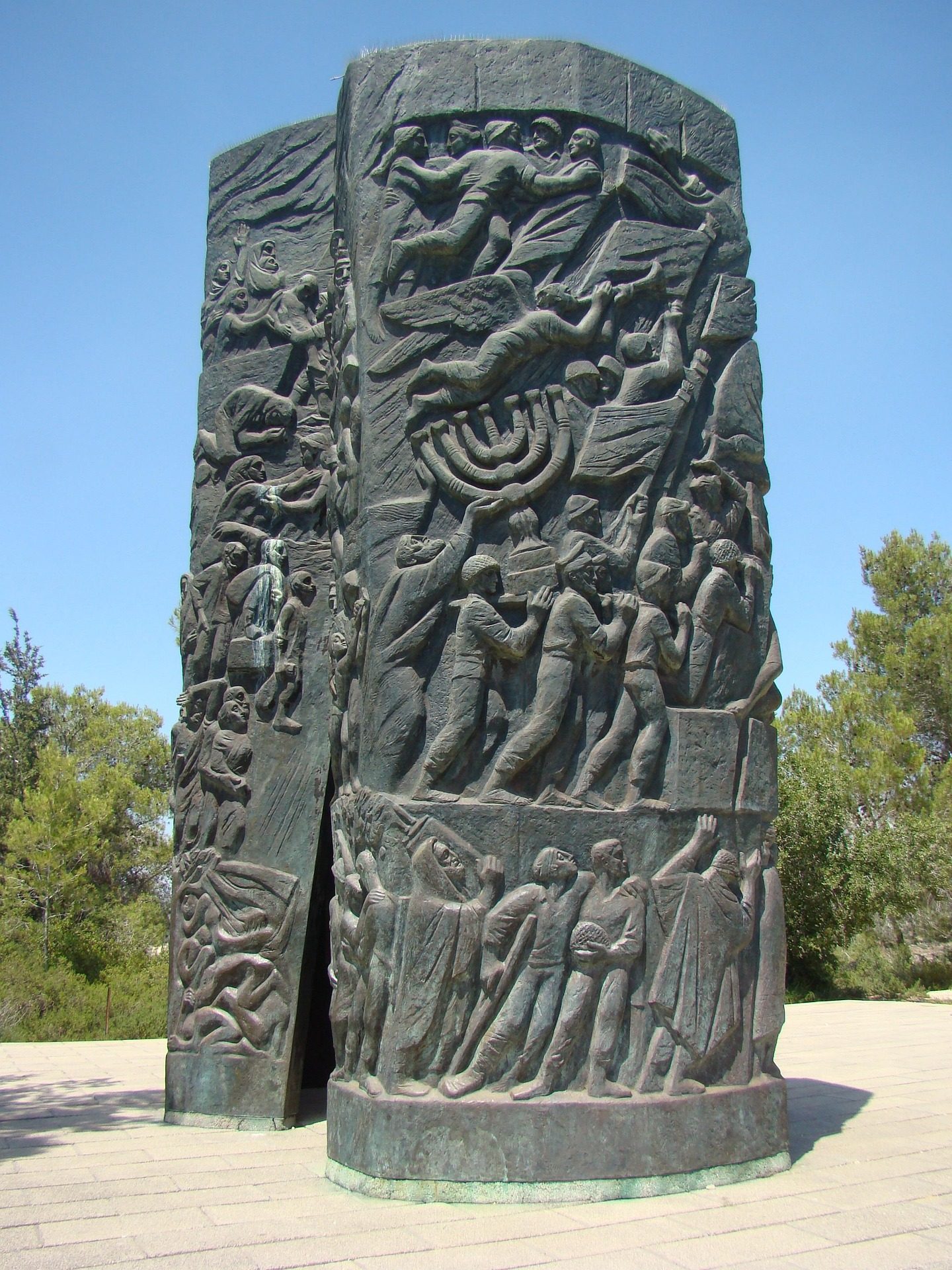
The Sculpture
The memorial was created by the sculptor Nathan Rapoport, who also designed the iconic Warsaw Ghetto Uprising monument in Poland. It consists of two massive bronze scrolls, each about 8 meters tall, standing open like pages of a book. The scrolls are covered with relief panels depicting scenes from Jewish history: the destruction of Jerusalem, the exile, the Crusades, the Inquisition, the pogroms, the Holocaust, the resistance, and finally the birth of Israel. Rapoport’s artistic vision was to compress the sweep of Jewish history into a form that could be read like a sacred text. The scroll shape was deliberate, evoking the Torah scrolls that communities carried with them through centuries of exile, the most precious objects saved from burning synagogues and destroyed towns. By casting this history in bronze, Rapoport created a permanent record that could never be burned or lost.
The name “Scrolls of Fire” comes from a poem by Abba Kovner, the partisan leader and poet who fought in the Vilna Ghetto and later served as an educational officer in the Givati Brigade during the 1948 war. Kovner’s poem traces the arc of Jewish suffering and survival, and the monument brings his words into three-dimensional form.
Bronze Panels in the Forest
Reading the scrolls from right to left, as in Hebrew, the panels move through time. The destruction of the Second Temple. The Bar Kokhba revolt. The exile and dispersion. The medieval persecutions. The Spanish Inquisition. The Eastern European shtetl. The rise of Zionism. The Holocaust, depicted with searing images of the camps, the ghettos, and the resistance. And finally, the founding of the State of Israel, with soldiers, pioneers, and the raising of the flag. Individual panels reward close attention. One depicts the mass expulsion from Spain in 1492, with families carrying children and bundles toward waiting ships. Another shows the Warsaw Ghetto fighters with improvised weapons, their faces set with defiance. The final panels shift from anguish to determination, showing pioneers draining swamps and building settlements, and soldiers defending the newborn state.
The power of the memorial lies in its compression: 2,000 years of history on two bronze scrolls, read in silence on a hilltop overlooking the Jerusalem corridor.
A Clearing in the Hills
The memorial sits in the B’nei Brith Forest (Martyrs’ Forest), a forest planted in memory of the six million Jews who perished in the Holocaust. The hilltop offers a panoramic view of the Jerusalem Hills and the Ayalon Valley below, the same valley where, according to the biblical account, Joshua commanded the sun to stand still (Joshua 10:12). The juxtaposition of the ancient biblical landscape and the modern memorial to Jewish survival is deeply moving. Visitors who stand at the clearing on a quiet morning, with no sound but wind in the pines, often describe the experience as one of the most contemplative moments of their time in Israel. The site receives few tour buses, which means there is space for reflection that busier memorials cannot offer.
Nathan Rapoport
Rapoport (1911-1987) was born in Warsaw and survived the war by fleeing to the Soviet Union. He returned to Warsaw in 1948 to unveil his monument to the Ghetto Uprising, one of the most recognized Holocaust memorials in the world. He later moved to Israel and then to New York, where he continued to create monumental works dedicated to Jewish history and memory. The Scrolls of Fire, completed in 1971, is considered one of his masterpieces.
Visit with Hoshen Tours
The Gvilei HaEsh Memorial is a quiet, contemplative stop in the Jerusalem Hills, usually combined with a visit to Latrun, the Ayalon Valley, or the approach to Jerusalem. Hoshen Tours includes it for groups interested in the story of Jewish survival from exile to statehood. The hilltop setting, overlooking the valley where ancient and modern history converge, makes it a fitting place to pause before continuing toward Jerusalem.
Explore Our Tour Collection
Ready to experience Israel in true colors?
Plan Your TourPrivate tours designed around your interests, schedule, and pace.