



Latrun sits at the gateway between the coastal plain and the hills of Jerusalem, a strategic crossroads that has been fought over for 3,000 years. Today it is best known for two things that stand side by side on the hilltop: the Yad LaShiryon armored corps memorial in the old British fortress, and the Trappist monastery that has watched over the valley since 1890. Few places in Israel pack so much history into a single hillside, and fewer still offer the contrast of monastic quiet set against the memory of some of the most desperate fighting in the country’s history.
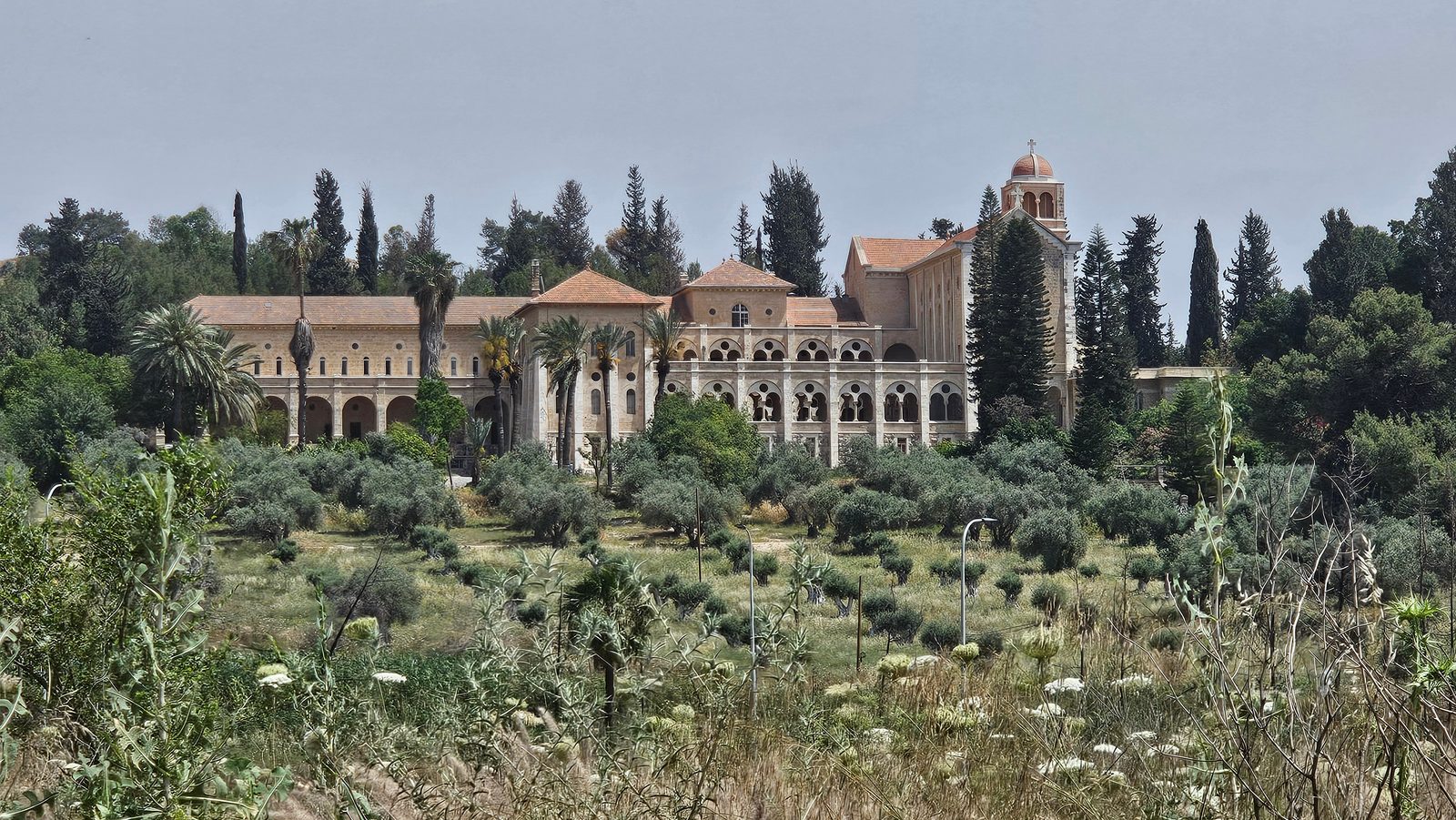
The Trappist Monastery
The monastery was founded in 1890 by French Trappist monks of the Cistercian order, who chose this hilltop at the entrance to the Ayalon Valley deliberately, at the crossroads where the Bible, the Crusaders, and the road to Jerusalem all converge. The Trappists are a silent contemplative order, and that silence is something you feel the moment you step through the gate. The monks follow the Rule of St. Benedict, living a life of prayer, manual labor, and deep quiet. Conversation is rare, and the rhythms of the day are shaped by prayer rather than productivity.
The monastery is largely self-sustaining. The monks cultivate vineyards, olive groves, and orchards on the surrounding hillsides, and produce wines, olive oil, and honey that are sold in the monastery shop. The wines of Latrun are among the most respected in Israel, and the winemaking tradition here stretches back more than a century. Picking up a bottle in the shop and sipping it later is a small, tangible connection to a community that has been quietly tending this land through wars, upheaval, and decades of change.
The Battles of 1948
The road through Latrun was the only paved route to Jerusalem, and in May 1948, as Israel declared independence, the Jordanian Arab Legion seized the old British police fortress here and cut that lifeline. Jerusalem, with roughly 100,000 Jewish residents, was under siege and running desperately short of food, water, and ammunition.
The newly formed Israel Defense Forces launched three frontal assaults on the Latrun fortress in May and June of 1948, and all three failed. The toll was devastating. Many of the soldiers thrown into those attacks were Holocaust survivors who had arrived in Israel just days or weeks earlier, some still wearing the clothes they had been issued at the absorption camps. They were not yet trained, they did not know the terrain, and they were sent forward in daylight across open fields into well-fortified Jordanian positions. The casualties were heavy, and the name Latrun became one of the most painful in the memory of Israel’s War of Independence.
The monastery building still bears shell damage and bullet scars from those battles. The monks remained throughout the fighting, tending their vines and keeping their silence while the hillside around them erupted.
The Burma Road
When the frontal assaults failed, Israeli engineers and volunteers improvised a solution. Working at night to avoid Jordanian fire, they carved a rough track through the hills south of Latrun, bypassing the fortress entirely. They called it the Burma Road, a nod to the famous supply route that kept China connected to its allies during World War II. Trucks, mules, and volunteers on foot hauled supplies through the darkness along this narrow, rocky path, and Jerusalem survived. The Burma Road did not end the siege, but it broke the stranglehold long enough for the city to hold on until the first ceasefire.
Today a stretch of the original Burma Road is preserved and can be walked, and the rusting hulks of supply vehicles that broke down on the route are still visible along the way, left as a monument to the people who drove them.
Biblical Connections: Joshua and Emmaus
Latrun sits at the entrance to the Ayalon Valley, one of the most storied landscapes in the Hebrew Bible. This is where, according to the Book of Joshua, the sun stood still. During the battle against the five Amorite kings, Joshua called out: “Sun, stand still over Gibeon, and you, moon, over the Valley of Aijalon” (Joshua 10:12-13). Whether understood as a literal miracle or as ancient poetry describing a moment of total, overwhelming victory, the passage has echoed through centuries of imagination. Standing at Latrun and looking out across the valley floor, it is easy to see why this place lodged itself so deeply in biblical memory.
The area is also one of several candidates for the ancient village of Emmaus. Tradition holds that it was on the road to Emmaus, according to the Gospel of Luke, that the risen Jesus appeared to two of his disciples and walked with them, unrecognized, before breaking bread and vanishing (Luke 24:13-35). There are competing locations proposed for Emmaus, and scholars have debated the question for centuries. The Trappists, who chose this site partly for its spiritual resonance, maintain a small chapel and garden that reflect the contemplative tradition of their order and invite visitors to sit with that history quietly.
The Courtyard and the View
The monastery’s courtyard, shaded by ancient trees and fragrant with the scent of the winery, is an oasis of stillness that contrasts sharply with the military history just across the road. From the hilltop, the view stretches across the Ayalon Valley to the Judean foothills, the landscape where Samson walked, where tradition holds that David fought Goliath in the neighboring Ella Valley, and where the Maccabees launched their revolt. Just across the road, the Yad LaShiryon Armored Corps Museum preserves the memory of Israel’s tank battles through a striking outdoor display of armored vehicles and a moving memorial to fallen soldiers. It is worth a stop on the same visit.
Visit with Hoshen Tours
Latrun combines Trappist silence, excellent wine, and a strategic hilltop overlooking the road to Jerusalem. Hoshen Tours pairs it with Yad LaShiryon, the Ayalon Valley where Joshua commanded the sun to stand still, the the Burma Road that saved Jerusalem in 1948, and the gateway at Sha’ar HaGai.
Explore Our Tour Collection
Ready to experience Israel in true colors?
Plan Your TourPrivate tours designed around your interests, schedule, and pace.