



Yad LaShiryon (the Armored Corps Memorial and Museum) occupies the Tegart fortress at Latrun the hilltop that controlled the only road from Tel Aviv to Jerusalem in 1948. For David Ben-Gurion, the equation was simple: without Latrun there was no road, without a road there was no Jerusalem, and without Jerusalem there was no state. Hundreds of soldiers, many of them immigrants who had arrived in the country days earlier, some of them Holocaust survivors who barely knew how to hold a rifle, died trying to capture this fortress. The irony of the memorial is deliberate: the building that could not be taken by force is now the home of the armored corps that evolved from those desperate battles into one of the most formidable tank forces in the world.
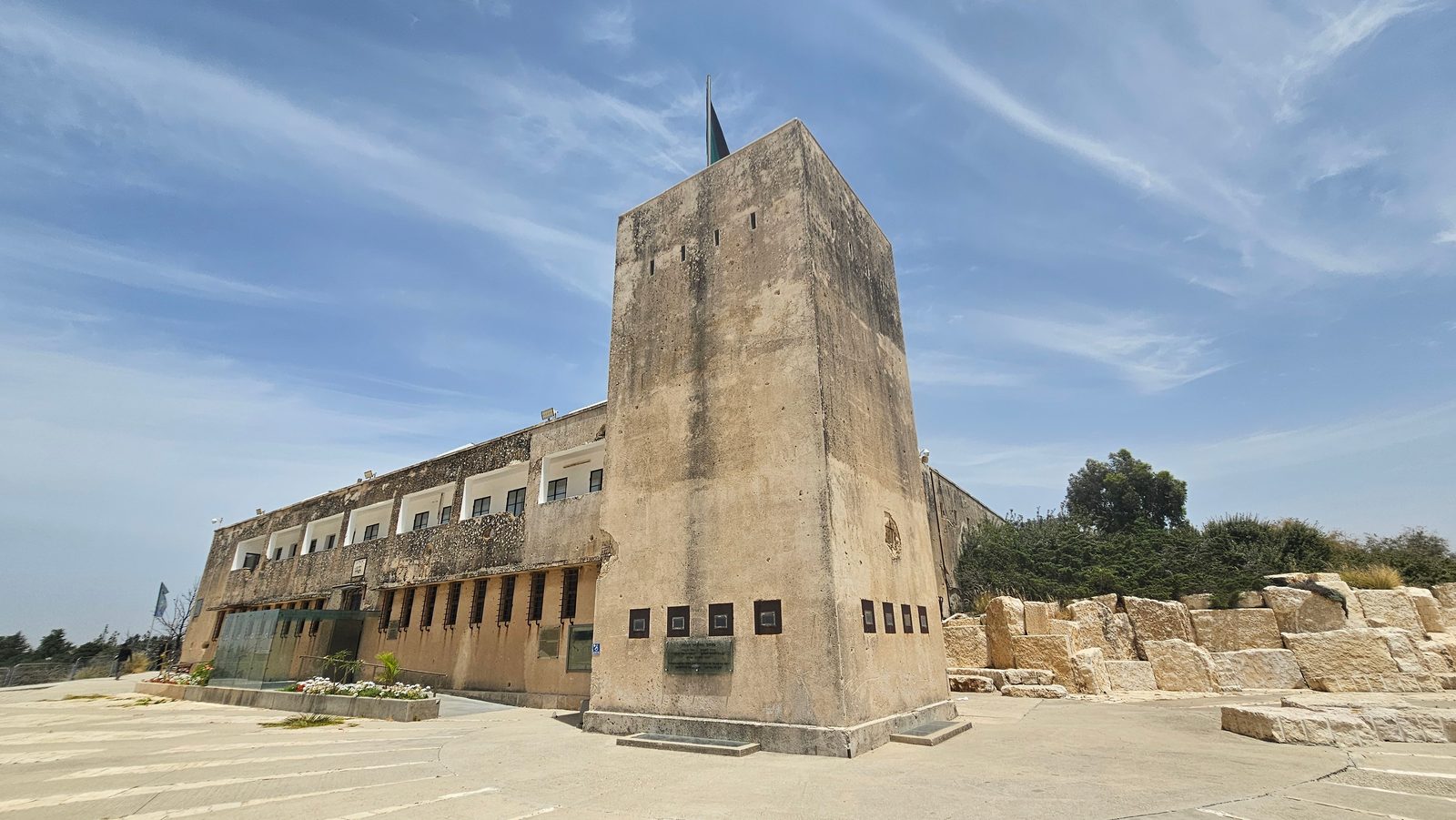
The Tegart Fortress
The building itself is a British Tegart fort, one of approximately 62 concrete fortresses built across Palestine in the late 1930s to suppress the Arab Revolt. They were designed by Sir Charles Tegart, a British police advisor who had served in India, and were built to be virtually impregnable, thick concrete walls, observation towers, and commanding fields of fire. The Latrun fortress was placed at the most strategic point in the country: where the road from the coastal plain enters the narrow Ayalon Valley and begins its climb into the Judean hills toward Jerusalem.
When the British withdrew in May 1948, the Jordanian Arab Legion, trained and commanded by British officers, including the legendary Glubb Pasha, seized the fortress. Its control of the road meant that Jerusalem’s 100,000 Jewish residents were cut off from food, water, and ammunition. The city was starving. Children fainted from hunger. Water was rationed to a trickle.
The Battles for Latrun
The first attempt to capture the fortress, Operation Bin Nun Aleph, was launched on May 25, 1948, just 11 days after the declaration of independence. The 7th Brigade, commanded by Shlomo Shamir, attacked with a force that included many newly arrived immigrants who had been in the country for only days or weeks. Some were Holocaust survivors who had stepped off immigrant ships and were handed rifles they had never fired. Many did not speak Hebrew. The attack was launched at night, across open ground, uphill, against one of the best-fortified positions in the country.
The attack failed with devastating casualties. The immigrants, exhausted, untrained, and unfamiliar with the terrain, were cut down by Legion fire. A second assault five days later (Operation Bin Nun Bet) included Palmach fighters alongside the immigrants, but the result was the same. A third attempt on June 9 (Operation Yoram) also failed. The fortress could not be taken.
The battles cost over 160 Israeli lives. Many of the dead were people who had survived the Holocaust only to die in battle within days of arriving in the land they had dreamed of reaching. Among the wounded was 20-year-old platoon commander Ariel Sharon, hit by machine gun fire, who lay in the field for hours before being evacuated. Sharon would recover and go on to command Unit 101, lead the paratroopers, command a division in the Sinai in 1967 and the canal crossing in 1973, serve as Defense Minister, and ultimately become Prime Minister, but his baptism of fire was in the fields below this fortress.
The controversy over sending untrained immigrants into frontal assaults against fortified positions has never been fully resolved. Ben-Gurion ordered the attacks over the objections of his military commanders, and he bore the weight of that decision for the rest of his life. It was only the construction of the Burma Road a secret bypass through the hills, that broke the siege and saved Jerusalem.
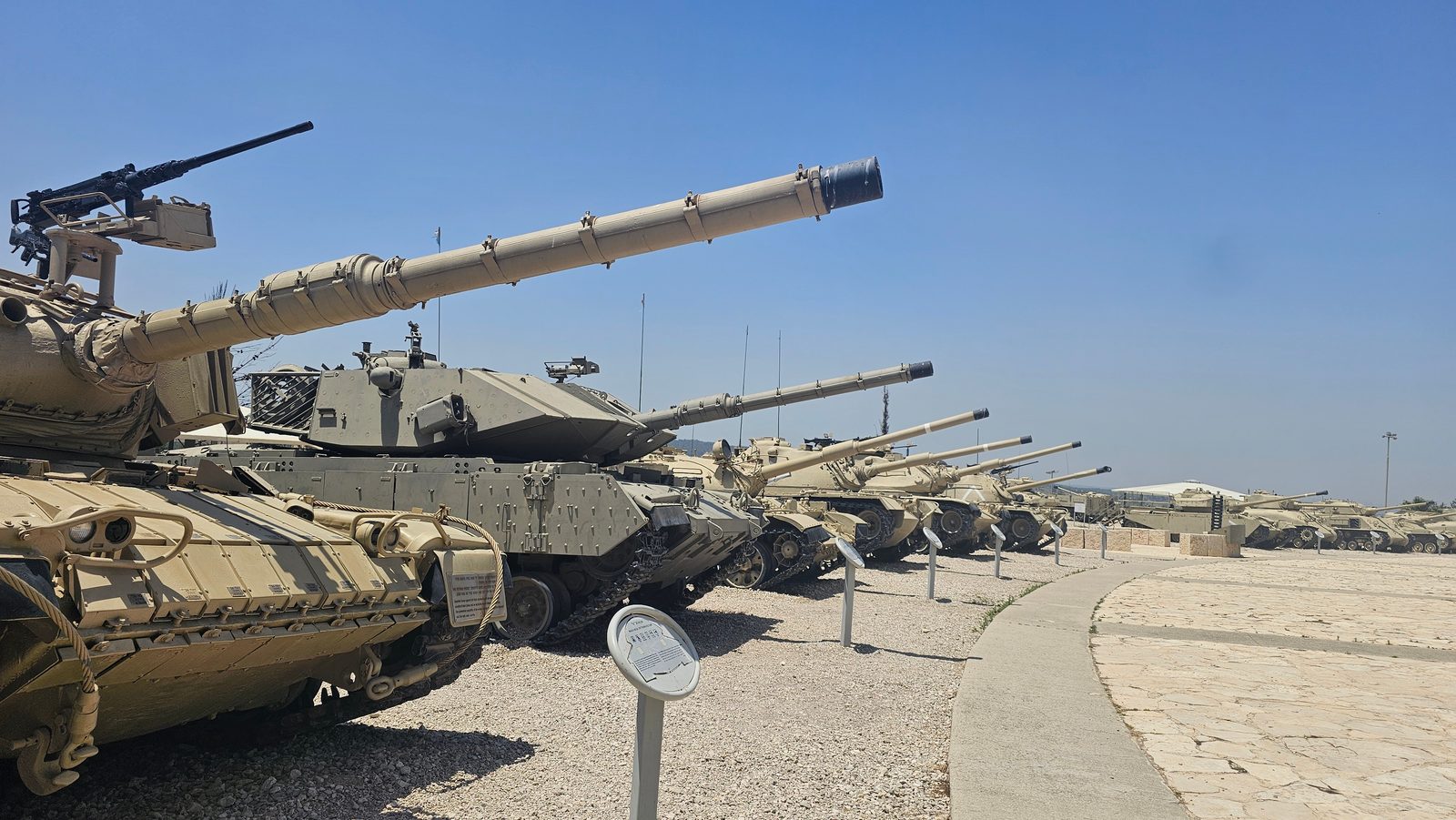
The Tank Park and the Merkava
The outdoor exhibition area displays over 150 tanks and armored vehicles from a dozen countries, arranged across the hillside around the fortress. The collection spans a century of armored warfare: early World War I-era vehicles, Shermans from 1948 still bearing the scars of improvised armor welded on by mechanics who had never seen a tank before, Centurions from the Six-Day War, captured Syrian T-55s and Egyptian T-62s from the Yom Kippur War, and Iraqi tanks seized in Lebanon.
Pride of place belongs to the Merkava (“Chariot”), Israel’s indigenous main battle tank, displayed in all its variants from the Mk. 1 (1979) to the Mk. 4. The Merkava was designed by General Israel Tal after the devastating tank losses of the Yom Kippur War, with a philosophy unique in the world: the engine is placed in the front of the tank, not the rear, providing an additional layer of protection for the crew. Crew survival, not firepower or speed, was the priority. The design reflects a small country’s understanding that every soldier’s life is irreplaceable.
The Armored Corps Memorial Wall
The memorial wall lists the names of over 5,000 armored corps soldiers who fell in Israel’s wars, arranged by war and by unit. The density of names from the Yom Kippur War (1973) is staggering, more names from a single three-week war than from any other conflict. Families visit on memorial days, tracing the letters of a name with their fingers. Fresh flowers and small stones appear beside the names year-round. Above the fortress, a tower rises with a memorial flame visible from across the Ayalon Valley. The wall faces the tank park, so the machines of war stand under the gaze of the names of those who fought in them.
Visit with Hoshen Tours
Yad LaShiryon is Israel’s Armored Corps memorial and museum, housing one of the world’s largest collections of tanks and armored vehicles set in the historic grounds of Latrun. Hoshen Tours walks through the tank park and the memorial hall, telling the story of the armored corps from the improvised vehicles of 1948 to the modern Merkava. The hilltop location overlooking the Ayalon Valley gives the visit both military context and a sweeping view. Combine it with Latrun monastery, the Burma Road, and the gateway at Sha’ar HaGai.
Explore Our Tour Collection
Ready to experience Israel in true colors?
Plan Your TourPrivate tours designed around your interests, schedule, and pace.