



On the night of March 21, 1938, a convoy of trucks wound up a steep, unpaved mountain road toward one of the most remote hilltops in the western Galilee. The settlers aboard carried prefabricated wooden walls, a watchtower in pieces, coils of wire, and enough determination to build a settlement before sunrise. It was the most dangerous location chosen for any Tower and Stockade settlement, and the people building it knew it.
By morning, Kibbutz Hanita stood on the ridge, encircled by a stockade wall and topped by a watchtower. By that same morning, two of the settlers were dead, killed in an attack during the night. Hanita became one of the most dramatic chapters in the Tower and Stockade movement, a campaign of overnight settlement-building that helped define the borders of what would become the State of Israel.
The Tower and Stockade Strategy
The Tower and Stockade strategy was born from a legal technicality in Ottoman land law, which still applied during the British Mandate period. The law stated that a building with a completed roof could not be demolished without a court order. The Jewish leadership realized that if they could erect a settlement overnight, complete with a watchtower, the British authorities would be legally unable to tear it down immediately.
The components were prefabricated in workshops and transported to the site under cover of darkness. Between 1936 and 1939, during the Arab Revolt, 57 Tower and Stockade settlements were established across the land. When the United Nations debated the partition of the land in 1947, the existence of these settlements was a critical factor in determining which areas would be included in the proposed Jewish state.
The Night of March 21, 1938: The Founding and Border
Hanita was the most remote and dangerous Tower and Stockade settlement, sitting on a hilltop at the northwestern tip of the country on the Lebanese border. The convoy climbed the mountain road in darkness, attacked by Arab fighters before even reaching the hilltop. Through the night, working under fire, the settlers assembled the stockade and raised the watchtower.
Before dawn, Arab forces attacked the half-built settlement directly. Two settlers, Ben-Zion Gurevitz and Yitzhak Shechori, were killed defending the site. The remaining settlers finished building the stockade by daybreak and refused to leave. News of the founding spread quickly as thousands of visitors made the journey to see the settlement that had held on through the night.
Hanita was not chosen at random. It was placed deliberately on the Lebanese border because the western Galilee was, at the time, almost entirely Arab. The Jewish leadership understood that if no Jewish settlements existed in the region, there would be no basis for including it in any future Jewish state. When the United Nations proposed partition in 1947, the presence of settlements including Hanita was a central argument for including the western Galilee in the proposed Jewish state. The wooden watchtower on the Lebanese border helped draw a line that became an international boundary.
The Museum and the Watchtower
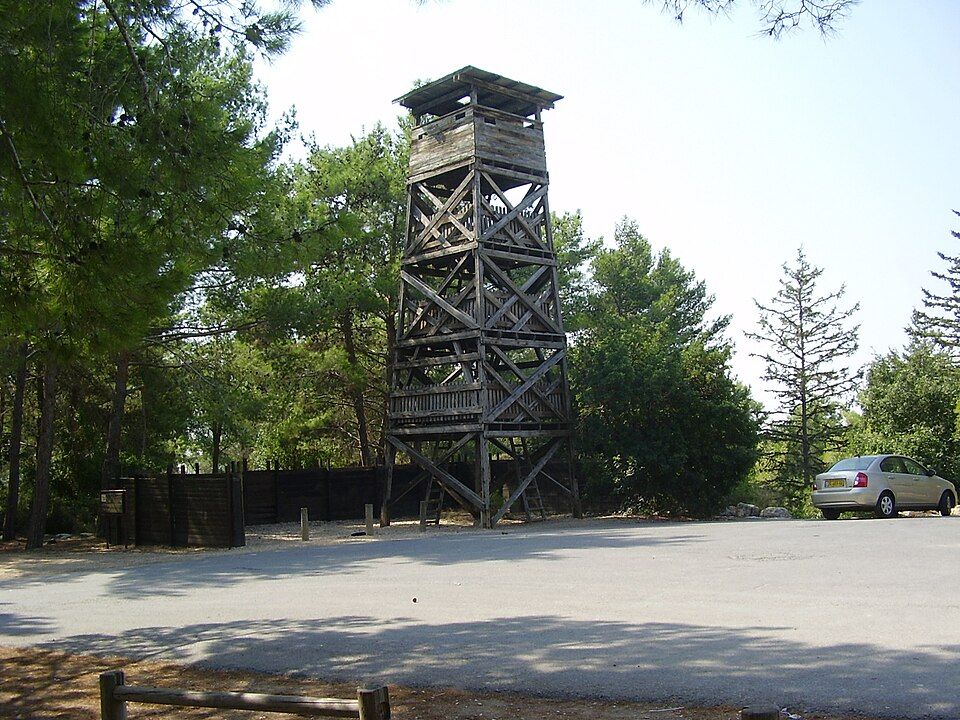
The kibbutz that grew from that night is still there, perched on the hilltop with views across the western Galilee to the Mediterranean Sea. The original watchtower, reconstructed on the same spot where it was raised in March 1938, stands as a monument to the founding. The settlement museum tells the full story of the Tower and Stockade movement, from the Ottoman legal loophole that made it possible to the network of settlements that exploited it. Photographs, artifacts, and firsthand accounts bring the founding night to life. Hanita is Israel’s most northwestern kibbutz, sitting on the Lebanese border where visitors can see what the founders saw in 1938: a border that did not yet exist.
The kibbutz today is a quiet community on the Lebanese border, surrounded by forest and orchards. Its location at the far northwestern corner of Israel gives it a frontier atmosphere that has not entirely faded. The original wooden watchtower, reconstructed and preserved in the kibbutz grounds, remains the most powerful physical symbol of the Tower and Stockade era. Visitors can stand inside it and look north toward Lebanon, understanding immediately why this hilltop mattered so much in 1938 and why it still matters in the story of how Israel drew its borders.
Visit with Hoshen Tours
A visit to Kibbutz Hanita pairs beautifully with nearby destinations along your route. Consider combining it with a stop at Rosh HaNikra or Yehiam Fortress, both just a short drive away. Many travelers also enjoy exploring Keshet Cave and Akko on the same day, while Nahal Taninim offers another worthwhile addition to your itinerary. Your Hoshen Tours guide will craft a seamless route that brings each destination to life with expert commentary and insider knowledge.
Ready to experience Israel in true colors?
Plan Your TourPrivate tours designed around your interests, schedule, and pace.