



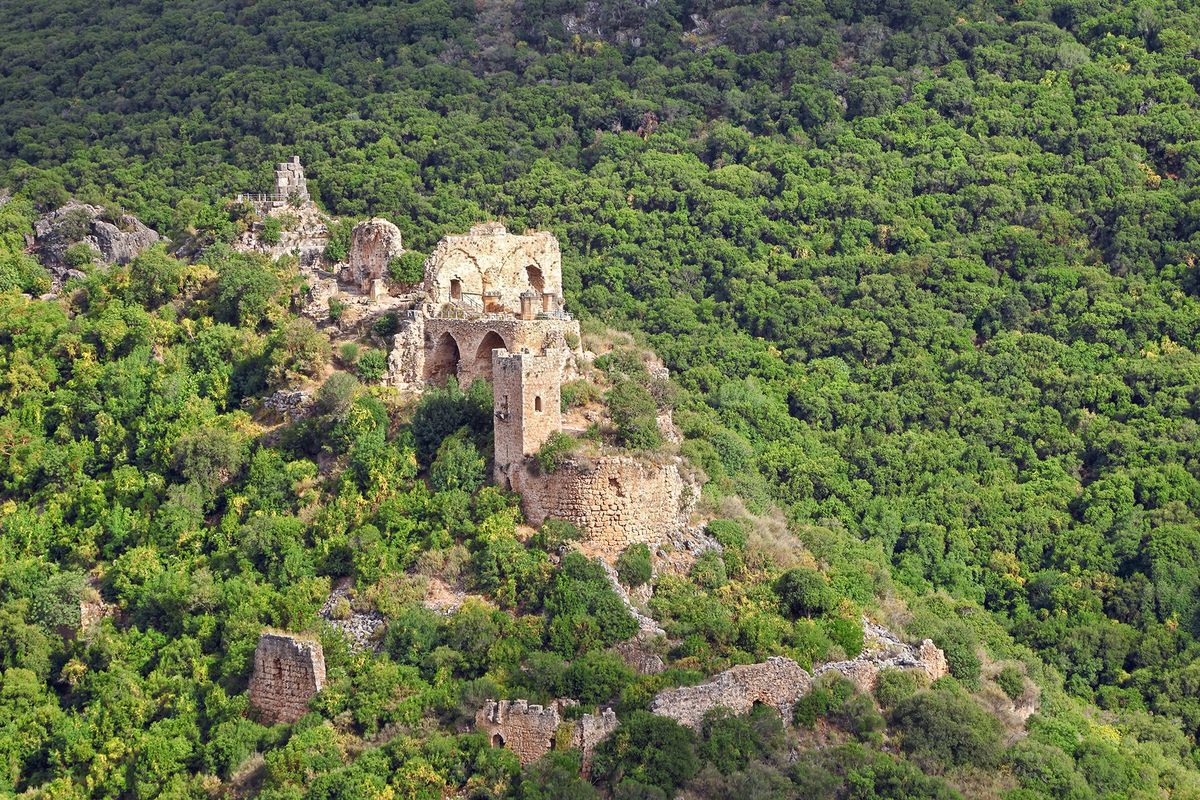
Deep in the forest of Nahal Kziv in the western Galilee, on a narrow ridge above a wooded gorge, stand the ruins of Montfort Castle Israel. Built by Crusader nobles in the 12th century and later sold to the Teutonic Knights, Montfort is one of the most atmospheric castle ruins in Israel. Getting there requires a hike through some of the most beautiful woodland in the country, which means the castle rewards effort and discourages tour buses. That is part of its appeal.
The de Milly Family and the Origins of Montfort
The castle was built in the mid-12th century by the de Milly family, Crusader nobles who held extensive lands in the Galilee. The name “Montfort” means “strong mountain” in Old French, the German-speaking Teutonic Knights who later took possession of it called it “Starkenberg,” which means exactly the same thing. The site was chosen for reasons that are immediately obvious to anyone who stands there: the narrow ridge above the Nahal Kziv gorge is almost impossible to approach from below, and the thick forest that surrounds it provides natural concealment. The castle controlled the road from Akko into the Upper Galilee interior, a strategically vital route for the Crusader presence in the north. In the hands of the de Milly family, Montfort served as a fortified estate and military strongpoint guarding that road.
Teutonic Knights’ Headquarters
Montfort was purchased by the Teutonic Knights in 1220 and became their administrative headquarters in the Holy Land. The Teutonic Knights were a German military order founded during the Third Crusade, originally to care for German pilgrims and wounded soldiers. Unlike the coastal fortresses that were designed for military domination, Montfort served the order as a retreat, a place where they stored their archives, treasury, and administrative records away from the political intrigues of Akko. The Teutonic Knights needed distance from the Hospitallers and Templars, who dominated Akko, and Montfort gave them exactly that: a castle in the forest, far from the competition. They expanded and reinforced the original de Milly structure, adding a great hall, residential quarters, and a chapel appropriate to a major headquarters of a military-religious order.
Fall of the Castle
The castle fell to the Mamluk sultan Baybars in 1271 after a siege that lasted several days. Baybars, the most formidable military leader of his era, who had already destroyed Crusader strongholds across Syria and Palestine, brought his forces against Montfort in the summer of that year. The Teutonic Knights inside resisted, but the walls eventually began to give way under sustained assault. Unlike many Crusader defeats that ended in massacre, this one concluded with a negotiated surrender: the Teutonic Knights were allowed to leave with their archives and treasury intact. Baybars partially destroyed the fortifications afterward to prevent any future garrison from reusing them, and the castle was never rebuilt. The forest slowly reclaimed it, and for centuries Montfort sat forgotten on its ridge, known only to local villagers.
After the fall of Acre in 1291, the Teutonic Knights relocated their headquarters to Venice, and then northward into Prussia and the Baltic, where they became a major political and military power during the medieval period. Their legacy in the north of Europe, the Teutonic state, the Hanseatic connections, the Baltic campaigns, grew from roots that included their years at this forested castle in the Galilee.
Hiking to Montfort
Reaching Montfort requires a hike of about 45 minutes through the Nahal Kziv nature reserve, one of the most beautiful river gorge trails in Israel. The trail descends into the gorge and climbs to the castle ridge, passing through Mediterranean forest of oak, carob, and pine. The stream below runs year-round, making the lower section of the trail green even in summer. The descent is easy; the climb back up is the price you pay. But the reward, emerging from the trees to find a ruined Crusader castle on a ridge above a wooded valley, is one of the best moments in Israeli hiking.
Exploring the Ruins
The castle ruins include the main keep at the eastern end of the ridge, a large vaulted hall that served as the knights’ main gathering and administrative space, the remains of a chapel, and sections of the curtain wall. The keep is the most impressive surviving element, rising several stories above the ridge and giving a clear sense of the castle’s original height and mass. The vaulted hall, with its Gothic arches still standing, conveys something of the architectural ambition the Teutonic Knights brought to this remote hillside. From the upper parts of the ruin, the views extend across the Nahal Kziv gorge and the green hills of the western Galilee. The combination of medieval stone, wild forest, and the sound of the stream below creates an atmosphere that feels almost entirely removed from the modern world.
Visit with Hoshen Tours
Montfort combines beautifully with Yehi’am Fortress and Akko for a Crusader-themed day in the western Galilee. Hoshen Tours knows the trails and the stories that bring these stones to life.
Visitors exploring the upper Galilee often combine Montfort Castle with nearby destinations such as Nahal Amud, Gush Halav, and Har Adir, each offering its own distinctive perspective on the region’s layered history and landscape. A broader itinerary might also include Rosh Pina and Talking Walls of Shtula, both within easy reach and rich in their own right.
Every Hoshen Tours itinerary is private and fully customizable. Contact us to begin planning your journey through the upper Galilee.
Explore Our Tour Collection
Ready to experience Israel in true colors?
Plan Your TourPrivate tours designed around your interests, schedule, and pace.