



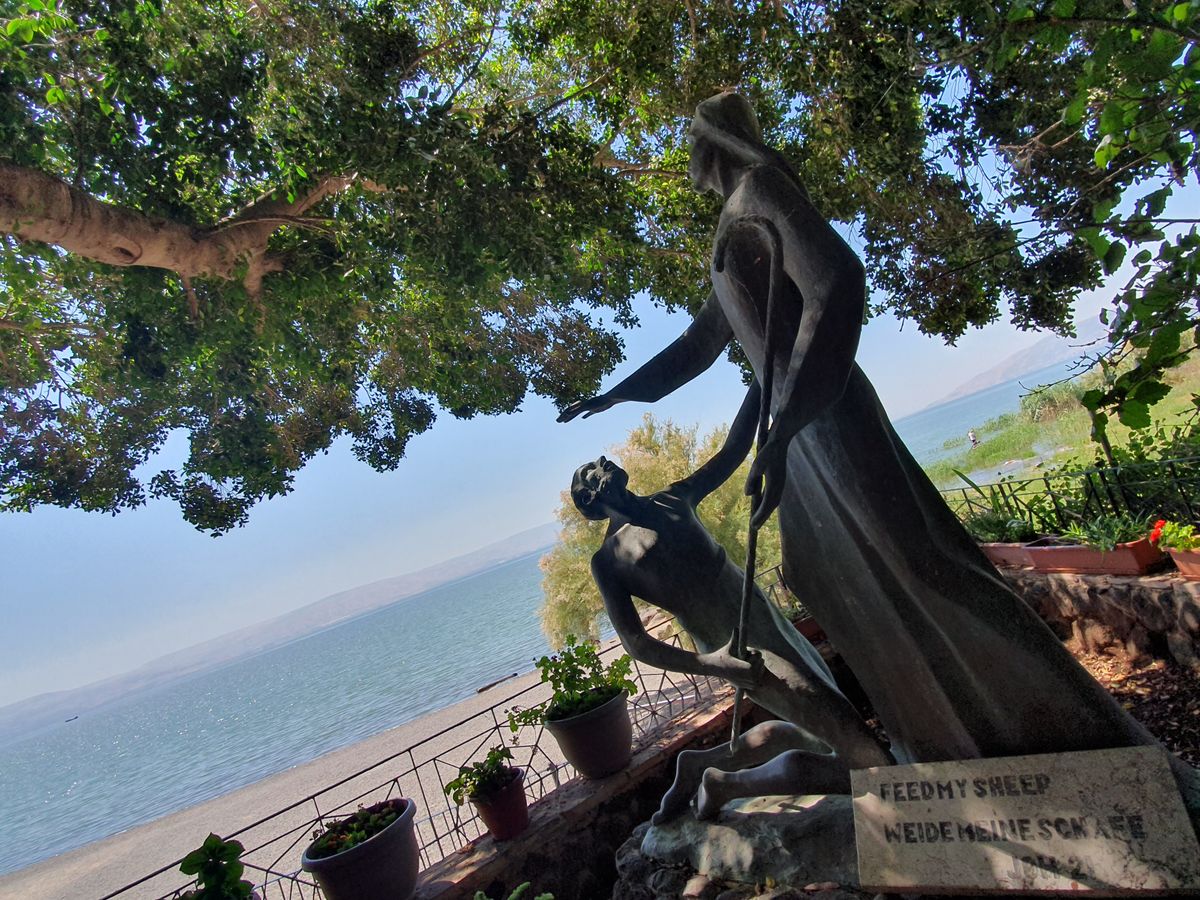
The Church of the Primacy of Peter Israel sits on the shore of the Sea of Galilee at Tabgha, marking the place where, tradition holds, the risen Jesus appeared to his disciples on the beach, cooked them breakfast over a charcoal fire, and restored Peter after his triple denial. The scene described in John 21:1-19 is one of the most layered and emotionally resonant passages in the New Testament, a story of recognition, failure, forgiveness, and commissioning, set on the same shore where Peter first answered the call to follow.
The Appearance on the Shore
John 21 describes the scene with unusual detail. Seven disciples, Peter, Thomas, Nathanael, the sons of Zebedee, and two others, have returned to the Sea of Galilee after the Resurrection and gone back to what they knew: fishing. They fish through the night and catch nothing. As dawn breaks, a figure appears on the shore and calls out to ask if they have any fish. When they say no, the figure tells them to cast the net on the right side of the boat. They do, and the net immediately fills with fish. The beloved disciple says to Peter: “It is the Lord.” Peter, who was stripped for work, pulls on his outer garment and throws himself into the water to swim to shore, while the others bring the boat in, dragging the net heavy with 153 large fish. The number 153 has generated centuries of commentary; whatever its symbolic resonance, John records it with the precision of a man who was there.
Breakfast on the Beach
When the disciples reach the shore, Jesus has already prepared a charcoal fire with fish on it, and bread beside it. He tells them to bring some of the fish they have just caught, and then says simply: “Come and have breakfast.” None of the disciples dared to ask who he was. They knew it was the Lord. Jesus took the bread and gave it to them, and the fish as well. John notes that this was the third time Jesus appeared to the disciples as a group after the Resurrection. The meal on the beach, fish cooked over coals at the water’s edge, shared in the early morning light, has a quietness that contrasts with the drama of the empty tomb. It is an intimate scene, almost domestic. The Risen Lord feeds his friends breakfast by the lake.
“Do You Love Me?”
After the meal, Jesus turns to Peter and asks three times: “Simon son of John, do you love me?” Three times Peter affirms his love, with increasing distress at the repetition, and three times Jesus commissions him: “Feed my lambs,” “Tend my sheep,” “Feed my sheep” (John 21:15–17). The triple question is not an accident. John uses the same rare Greek word (anthrakia, charcoal fire) to describe the fire on the beach as he used for the fire in the high priest’s courtyard where Peter stood warming himself on the night of the arrest and three times denied knowing Jesus (John 18:15–27). It is the only two times this precise word appears in the entire New Testament. The repetition is deliberate: the reader is meant to hear the echo. tradition holds that Peter denied Jesus three times at a charcoal fire. Jesus restores him three times at a charcoal fire. Each affirmation of love cancels one denial; each commission to shepherd the flock replaces one act of abandonment. The passage functions as a formal restoration and a formal appointment, the man who had failed most publicly is the one chosen to lead most visibly.
Mensa Christi
Inside the small chapel, a large flat limestone rock protrudes from the floor in front of the altar. This is the Mensa Christi, the Table of Christ, traditionally identified as the rock on which Jesus prepared the breakfast of bread and fish for his disciples that morning. The rock is unworked and natural, worn smooth by centuries of veneration. It is one of the few objects in the Holy Land that is simultaneously an identified site from the Gospel narrative, an object of continuous Christian devotion, and a piece of the actual Galilean landscape, the same stone, in the same location, at the same shoreline where the account is set.
The Franciscan Chapel on the Shore
The current chapel is a small Franciscan structure built in 1933 of local black basalt, on the foundations of a 4th-century Byzantine church. It is deliberately modest, a single room with an apse, minimal ornament, letting the setting carry the weight of the story. One wall opens directly toward the lake, so the water of the Sea of Galilee is literally at the church’s threshold. Outside the chapel, rock steps cut into the natural basalt of the shoreline, sometimes called the “Throne of Christ” or the “Steps of the Apostles” in pilgrim tradition, descend to the water’s edge. The Franciscan Custody of the Holy Land has maintained the site continuously since the early 20th century, and the simplicity of the chapel reflects the Franciscan preference for modest, prayerful spaces over monumental architecture.
Peter’s Journey
The arc of Peter’s story reaches its resolution on this beach. He was a fisherman on this lake when a stranger told him to cast his nets in a different spot and they filled beyond capacity, and he left everything and followed. He walked on water and then sank in fear. He declared Jesus the Messiah at Caesarea Philippi. He fell asleep in Gethsemane. He cut off the ear of a servant in the garden and then, an hour later, denied three times in a courtyard that he even knew the man he had tried to defend. He hid behind locked doors after the crucifixion. And then he swam to this shore, and had breakfast, and heard his name called three times, and answered three times, and was given a charge that would define the rest of his life.
The Catholic tradition sees in this passage the formal establishment of Peter’s primacy: the authority to lead and guide the Church, granted not in a palace or a temple but over grilled fish at a lakeside fire. For Protestant readers, the emphasis falls differently, on grace, on the God who seeks out the one who failed and restores him to usefulness. Either way, it happens here, on this rock, by this water, in the early light of a Galilean morning.
Visit with Hoshen Tours
The Church of the Primacy of Peter is where the story of Peter’s failure becomes the story of his restoration and his commission. Hoshen Tours visits the chapel, the Mensa Christi, and the shoreline, reading the full text of John 21 at the water’s edge, connecting the charcoal fire where tradition holds that Peter denied to the charcoal fire where he was forgiven, and the nets cast at Jesus’ command to the question that would echo through the rest of Peter’s life: “Do you love me?”
Visitors exploring the Galilee often combine Church of the Primacy of Peter with nearby destinations such as Capernaum, Tabgha, and Church of the Loaves and Fishes, each offering its own distinctive perspective on the region’s layered history and landscape. A broader itinerary might also include Sea of Galilee and Twelve Apostles, both within easy reach and rich in their own right.
Every Hoshen Tours itinerary is private and fully customizable. Contact us to begin planning your journey through the Galilee.
Ready to experience Israel in true colors?
Plan Your TourPrivate tours designed around your interests, schedule, and pace.