



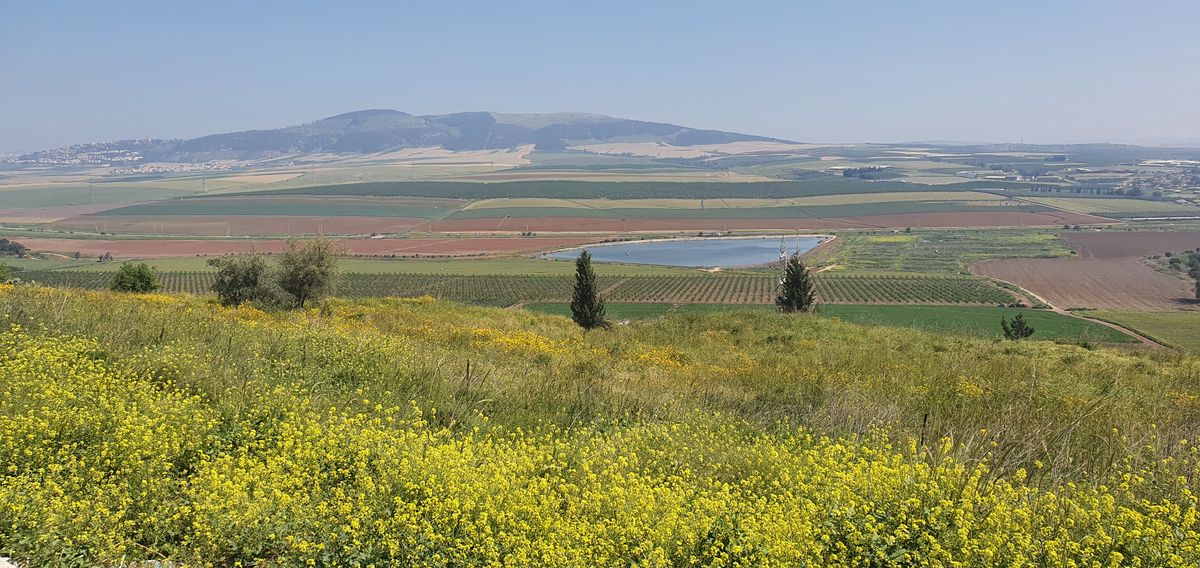
Tel Jezreel and the spring at its base sit at the edge of the valley that bears their name, overlooking the breadbasket of ancient Israel. The name Jezreel (Yizre’el) means “God sows” in Hebrew, and the valley is the most fertile agricultural region in the country. The perennial spring that flows from the base of the tell was the reason settlements were built here from the earliest periods, water in this quantity, flowing year-round, was the foundation of life in the ancient Near East. In the Bible, Jezreel was the winter palace of King Ahab and Queen Jezebel, and the site of some of the most dramatic stories in the Book of Kings.
Naboth’s Vineyard at Tel Jezreel
Tel Jezreel is the setting of one of the Bible’s most powerful stories about justice, power, and divine retribution. King Ahab wanted a vineyard that belonged to a man named Naboth, adjacent to his palace: “Let me have your vineyard to use for a vegetable garden, since it is close to my palace. In exchange I will give you a better vineyard, or, if you prefer, I will pay you whatever it is worth.” But Naboth refused: “The Lord forbid that I should give you the inheritance of my ancestors” (1 Kings 21:2–3). Naboth was not being stubborn. Under Israelite law, ancestral land was a divine trust that could not be permanently sold (Leviticus 25:23).
Ahab went home and sulked. His wife Jezebel, the Phoenician queen who had no understanding of or respect for Israelite land law, arranged for Naboth to be falsely accused of blasphemy and stoned to death. Ahab then took possession of the vineyard. But the prophet Elijah met him in the vineyard with a devastating message: “Have you not murdered a man and seized his property?… In the place where dogs licked up Naboth’s blood, dogs will lick up your blood” (1 Kings 21:19). The prophecy was fulfilled: Ahab died in battle, and when his chariot was washed at the pool of Samaria, “the dogs licked up his blood, as the word of the Lord had declared” (1 Kings 22:38).
The story of Naboth’s vineyard is the Bible’s clearest statement that no king is above the law, and that the land belongs to God, not to the powerful.
Jezebel’s End
Years after Naboth’s murder, the general Jehu staged a bloody coup against the house of Ahab. He rode to Jezreel, and Jezebel, knowing what was coming, painted her eyes, arranged her hair, and looked out the window, meeting her death with defiance rather than submission. At Jehu’s command, her own servants threw her from the window. When they went to bury her, they found that the dogs had eaten her body, fulfilling Elijah’s prophecy: “On the plot of ground at Jezreel dogs will devour Jezebel’s flesh” (2 Kings 9:36). The scene is one of the most vivid and disturbing in all of scripture.
Ein Jezreel: The Spring at the Foot of the Tell
Ein Jezreel, the powerful spring at the base of the tell, flows year-round into a large pool surrounded by ancient trees. This was the water source that made Jezreel possible, the reason Ahab built his palace here, and the reason armies gathered at this spot for thousands of years. A perennial spring of this size in the Jezreel Valley was a strategic asset of the first order: whoever held it could water an entire army.
It was at this spring that the Israelite army assembled before the fateful battle against the Philistines described in 1 Samuel 29. “And Israel was encamped by the spring which is in Jezreel” (1 Samuel 29:1). The Philistines had gathered their forces at Shunem, across the valley to the north, and Saul positioned his men on the slopes of Mount Gilboa to the south, with the spring of Jezreel as their water source and rallying point. It was from this encampment that Saul, desperate and abandoned by God, slipped away at night to consult the witch of Endor, and it was to these slopes that he returned to face the battle he knew he would not survive. The next day, his sons were killed and Saul fell on his own sword on Mount Gilboa, ending Israel’s first monarchy.
The spring connects the natural landscape to the full sweep of Jezreel’s history. Pharaoh Thutmose III passed through here on his way to the Battle of Megiddo in 1457 BCE. Canaanites, Israelites, Egyptians, Assyrians, Crusaders, and Ottomans all fought for control of this valley, and the spring at Jezreel was always part of the prize.
The Archaeological Site
Excavations at Tel Jezreel have uncovered fortifications and a deep rock-cut moat from the Iron Age, consistent with a royal compound of the 9th century BCE, the period of Ahab and Jezebel. The tel is not heavily developed as a tourist site, but the view from the top, across the valley to Mount Gilboa and Givat HaMoreh, connects the biblical stories to a real and breathtaking landscape.
Visit with Hoshen Tours
Tel Jezreel brings the stories of Ahab, Jezebel, and Naboth’s vineyard to life. Hoshen Tours pairs it with Mount Gilboa, the village of Nain, the Witch of Endor at Ein Dor, the spring at Ma’ayan Harod, and the last camp at Mount Saul.
Ready to experience Israel in true colors?
Plan Your TourPrivate tours designed around your interests, schedule, and pace.