



Sde Boker is a small kibbutz in the Negev desert, known to every Israeli as the place where David Ben-Gurion, the founder and first prime minister of Israel, chose to live after leaving politics. Ben-Gurion believed that the future of Israel lay in settling the Negev, and he put his conviction into practice by moving to Sde Boker in 1953, living in a simple wooden hut on the edge of the desert. He came here not as a refugee from politics but as a man on a mission, and understanding that mission is what makes Sde Boker so much more than a memorial site.
Why He Came to the Desert
Ben-Gurion was haunted by a vision drawn from the Hebrew prophets. Isaiah had written of the desert blooming, of rivers in the wilderness, of a transformed land. The Psalms spoke of God’s presence in the wild places. Ben-Gurion, who was not conventionally religious but read scripture with the intensity of a scholar, believed that settling the Negev was both a practical Zionist imperative and something deeper: a fulfillment of the ancient promise, a demonstration that the Jewish people had returned not just to build cities but to reclaim and renew the whole land.
He said it plainly and often. The Negev would be Israel’s future. The real test of whether a Jewish state could survive and thrive would be answered in the desert, not in Tel Aviv. And so he moved there himself, in his late sixties, after serving as prime minister and defense minister during the founding years and the first wars of the state. He did not go to a comfortable retirement. He went to a tent, then a wooden hut, and he worked in the desert like the other kibbutz members.
Ben-Gurion’s Hut
The hut where Ben-Gurion and his wife Paula lived has been preserved as a museum, with the original furniture, books, and personal items. The library is the most striking feature: 5,000 books in multiple languages that reveal the intellectual world of a leader who read as voraciously as he governed. Ben-Gurion taught himself ancient Greek to read Plato in the original. He studied Buddhist philosophy. He read scientific journals. He corresponded with philosophers, generals, and poets.
His desk, his reading chair, and the thousands of books that lined the walls create a portrait of a leader who believed that governing a nation required understanding the world in its entirety. But the hut itself also tells a story. It is tiny. It is simple. The rooms are modest, the furniture is plain, the kitchen is small. This was a man who was prime minister of a country, who led a nation through its birth and its first wars, and he chose to live like a kibbutznik on the edge of the desert. The gap between the scale of his historical significance and the modesty of his home is deeply moving.
Paula Ben-Gurion is often overlooked in the telling of this story, but she deserves her own moment. Paula was a nurse from New York who married the young labor organizer David Gruen before he became Ben-Gurion. She managed their home with fierce practicality, protected his time and energy, and followed him to Sde Boker when she would certainly have preferred a more comfortable retirement. Visitors who look at the kitchen and the modest bedroom often find themselves thinking of Paula.
The Grave
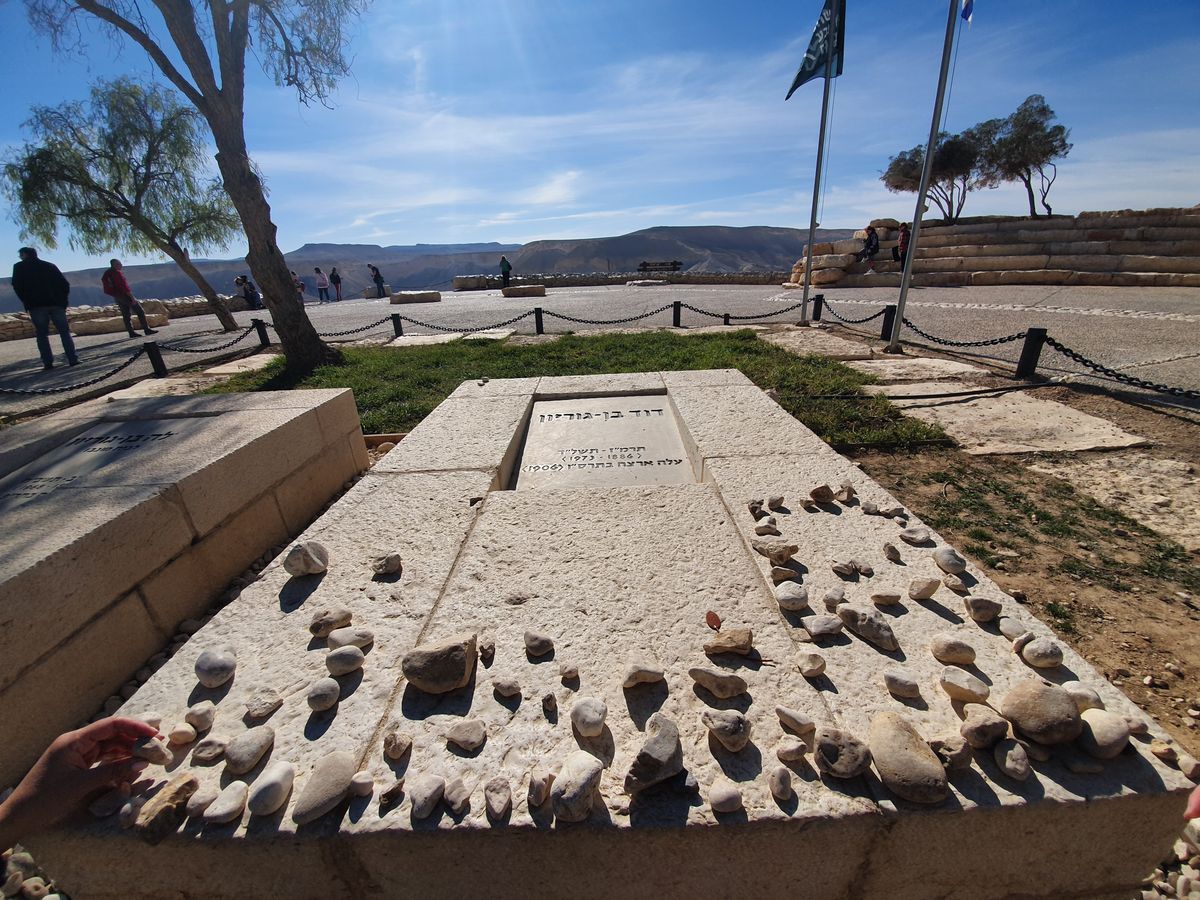
Ben-Gurion and Paula are buried on the rim of the Zin Valley, a short walk from the hut. The grave site is one of the most dramatically situated in the world. The ground at your feet drops away into a canyon carved by the Zin River, hundreds of meters deep, with white chalk cliffs, dark desert varnish, and the occasional flash of a spring-fed stream far below. The wilderness stretches south toward the horizon without interruption.
The grave itself is simple, almost severe: two flat stones with names and dates, set in a terrace of desert rock, with no monument, no arch, no dome. Just the man and his wife and the desert he loved, and the view he believed Israel would one day make bloom. The contrast between the simplicity of the grave and the grandeur of the landscape is quintessentially Ben-Gurion: a man of enormous historical consequence who chose modesty for himself and majesty for his nation. Most visitors stand at the grave for a long time without saying anything.
Midreshet Ben-Gurion
Adjacent to the kibbutz, the Midreshet Ben-Gurion campus of Ben-Gurion University houses research institutes focused on desert agriculture, water technology, and solar energy, fulfilling Ben-Gurion’s vision of the Negev as a frontier of innovation. The campus sits on the rim of the Zin Valley, and the view from the campus across the canyon is spectacular. The Vidor Center on the campus is a visitor center with a multimedia exhibition that tells Ben-Gurion’s story from his childhood in Poland to the Declaration of Independence to his decision to move to the desert. It is a well-designed space and a good place to start before visiting the hut and the grave.
Visit with Hoshen Tours
Sde Boker is where David Ben-Gurion lived out his desert vision, and Hoshen Tours pairs it with the canyon of Ein Avdat, the Nabatean city of Avdat, the the Negev Brigade Memorial, and the craters of the Makhteshim. A full day in the central Negev tells a story from antiquity to statehood.
Explore Our Tour Collection
Ready to experience Israel in true colors?
Plan Your TourPrivate tours designed around your interests, schedule, and pace.