



Tel Rehov is a large archaeological mound in the Jordan Valley, south of Beit She’an, one of the most important Iron Age sites in Israel. Covering approximately 100 dunams, it was a major city in the period of the Israelite monarchy, and its excavations have produced finds that illuminate daily life, administration, and religion in biblical Israel.
The Rehov Inscription
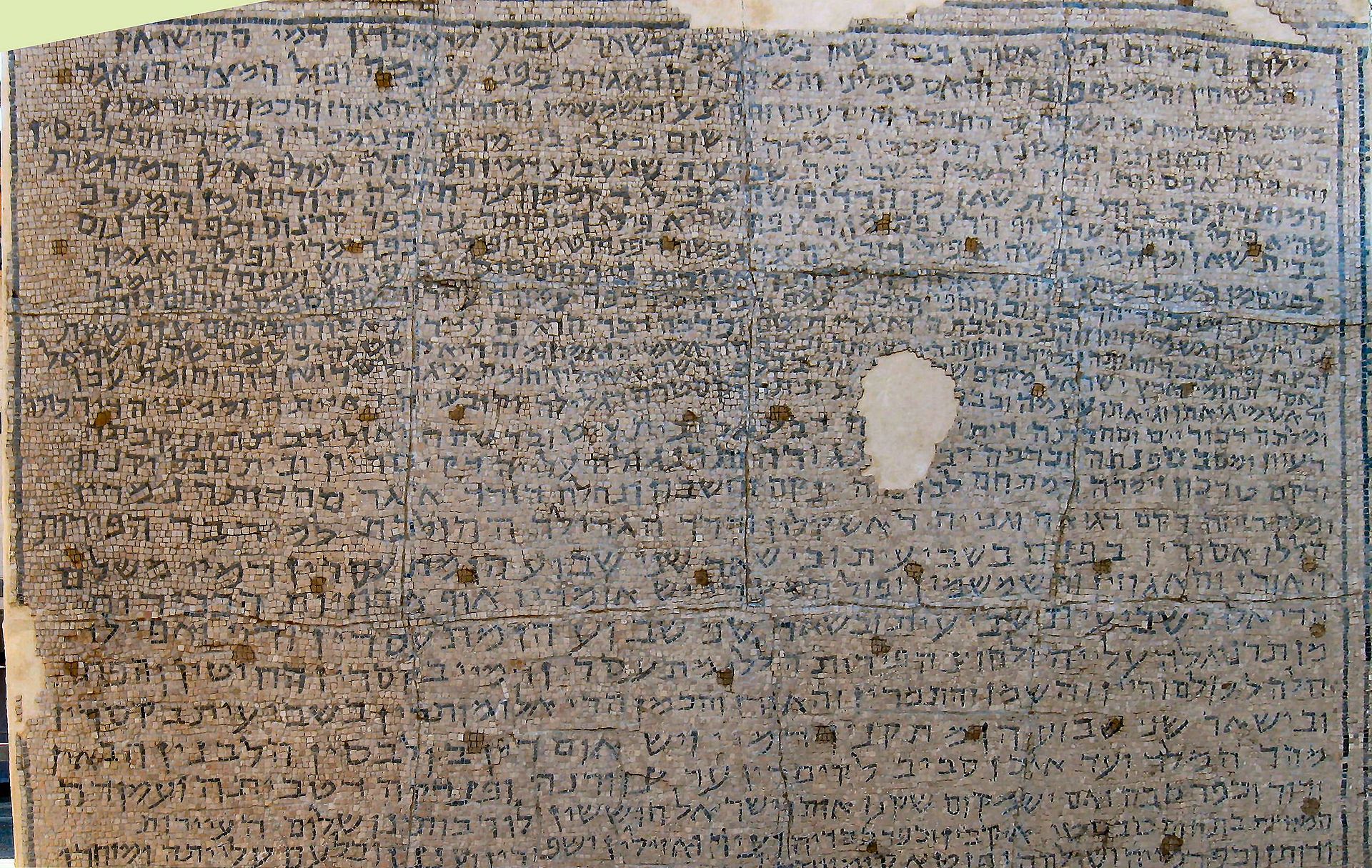
Near Tel Rehov, a Byzantine-era synagogue (dated to the 5th, 6th century CE) was discovered containing one of the most remarkable inscriptions ever found in the Land of Israel. The Rehov Inscription is a mosaic floor text of 29 lines, written in late Mishnaic Hebrew, the longest ancient Hebrew inscription ever found in a synagogue. It deals with a question that was central to Jewish agricultural life: which areas of the Land of Israel are subject to the obligations of shemitah (the sabbatical year), tithes, and priestly offerings, and which are not.
The inscription lists specific towns in the Beit She’an Valley and distinguishes between those that bear these obligations and those that are exempt. The underlying issue was a matter of considerable halakhic debate: did the returning exiles from Babylon reconquer and sanctify the Beit She’an area when they returned to the land, or did they not? If the area was not part of the “holiness of the Land” as defined by the returnees, then its produce was exempt from tithes and sabbatical-year restrictions. The Rehov Inscription records a practical ruling on this question, publicly displayed on the synagogue floor for the entire community to see.
What makes the inscription extraordinary is that its content closely parallels discussions found in the Jerusalem Talmud (Tractate Demai), providing physical, archaeological evidence that rabbinic halakhah was not merely a scholarly abstraction but was practiced and publicly posted in synagogues during the Byzantine period. The inscription is now displayed in the Israel Museum in Jerusalem.
The Ancient City of Tel Rehov
Tel Rehov was a large and prosperous city in the Iron Age, identified by some scholars with the biblical Abel-meholah, the hometown of the prophet Elisha: “Elijah went from there and found Elisha son of Shaphat. He was plowing with twelve yoke of oxen” (1 Kings 19:19). The tel covers approximately 100 dunams, making it one of the largest ancient sites in the Jordan Valley.
The City of Beehives
In 2007, archaeologist Amihai Mazar of Hebrew University uncovered something no one had expected to find in an archaeological excavation: an industrial-scale apiary, a beekeeping facility, dating to the 10th, 9th century BCE, right in the heart of the Iron Age city. Nothing like it had ever been found anywhere in the ancient Near East. The apiary consisted of at least 75 intact clay cylinders, roughly 80 centimeters long and 40 centimeters wide, stacked in neat rows inside a dedicated mudbrick structure. Each cylinder was a beehive, with a small hole at one end for the bees to enter and a removable lid at the other for the beekeeper to extract the honeycombs. The facility could have housed over a million bees and produced an estimated half a ton of honey per year.
The Site Today
But the real surprise came from the bees themselves. DNA analysis of the organic residue inside the hives revealed that the bees were not the local Apis mellifera syriaca, the aggressive native bee of the Levant, but rather Apis mellifera anatoliaca, a gentler subspecies from Anatolia (modern Turkey), hundreds of kilometers to the north. This means the inhabitants of Tel Rehov were deliberately importing a foreign bee breed, presumably because it was easier to manage and produced more honey. This is the earliest known evidence of selective beekeeping with imported stock in the ancient world, a level of agricultural sophistication that scholars had not imagined existed this early.
The discovery transformed our understanding of the biblical phrase “a land flowing with milk and honey.” Scholars had long debated whether the “honey” in this expression referred to bee honey or to date syrup (silan), which was more common in the region. Tel Rehov proved that industrial-scale bee honey production was a reality in ancient Israel, the biblical reference may well have been literal, not metaphorical. The apiary also helps explain the city’s wealth: honey, beeswax, and propolis were valuable trade commodities in the ancient world, used in food, medicine, cosmetics, and religious ritual. A city that controlled honey production on this scale would have held significant economic power in the region.
The apiary has given Tel Rehov a nickname that captures the wonder of the discovery: the City of Beehives.
Visit with Hoshen Tours
Tel Rehov brings the biblical phrase “a land of milk and honey” to life through its extraordinary discovery of an industrial-scale apiary from the Iron Age. Hoshen Tours tells the full beehive story on site, explaining how the discovery of over 100 clay hives changed our understanding of ancient Israelite agriculture. The site pairs naturally with the mosaics at Beit Alpha, the pioneering story at Sde Eliyahu, and the springs at Gan HaShlosha for a rich Jordan Valley day.
Explore Our Tour Collection
Ready to experience Israel in true colors?
Plan Your TourPrivate tours designed around your interests, schedule, and pace.