



Maresha (Tel Maresha, Tell Sandahanna) is an ancient city in the Judean Shephelah, part of the Beit Guvrin-Maresha National Park and UNESCO World Heritage Site. Maresha is the older of the two cities, a Hellenistic-era settlement whose extraordinary underground cave system, with over 3,500 chambers, is unmatched anywhere in the ancient world.
Cosmopolitan City
Maresha was an important city in the Kingdom of Judah, fortified by King Rehoboam: “Rehoboam lived in Jerusalem and built up towns for defense in Judah… Maresha, Ziph, Adoraim, Lachish, Azekah” (2 Chronicles 11:5-9). After the Babylonian exile, the city was settled by Edomites (Idumeans) who had moved northward from their homeland south of the Dead Sea. In the Hellenistic period (3rd-1st century BCE), Maresha became a thriving multicultural city with Edomean, Phoenician, and Greek inhabitants, and it is this Hellenistic city that produced the extraordinary underground remains.
Birthplace of the Herodian Dynasty
The Edomean (Idumean) population of Maresha is directly connected to one of the most important events in Jewish history. Around 112 BCE, the Hasmonean ruler John Hyrcanus I (ruled 134-104 BCE) conquered the Idumean cities of the southern Shephelah, including Maresha, and forced the Edomean population to convert to Judaism. The forced conversion was controversial (the Edomeans were given the choice of circumcision and Jewish law or exile), but it was effective: within two generations, the Edomean-Jewish family of Antipater of Idumea had risen to become the most powerful political dynasty in Judea. Antipater’s son was Herod the Great, the king who rebuilt the Temple in Jerusalem, built Caesarea, Masada, and Herodium, and shaped the Land of Israel more than any other ruler in ancient history. The Herodian dynasty’s roots lie in the converted Edomean community of the southern Shephelah, and Maresha is one of the cities where that community lived. The greatest builder in Jewish history came from a family that was Jewish by coercion, not by birth.
Underground Caves
Over 3,500 underground chambers have been identified beneath Maresha, carved into the soft chalk bedrock. The caves served every function imaginable: olive presses, columbaria (dovecotes), water cisterns, quarries, storage rooms, workshops, burial caves, and hiding complexes. The density of underground activity is staggering: virtually every house in Maresha had a cave or cave system beneath it, and the underground city may have been as extensive as the surface city above.
Columbarium Caves
The largest columbarium cave at Maresha contains over 2,000 individual niches arranged in neat rows from floor to ceiling. Each niche is approximately 25 centimeters wide and 30 centimeters deep, just large enough for a pigeon to nest. The niches are carved with remarkable precision, and the regularity of the rows gives the caves a modern, almost industrial appearance. The scale suggests that tens of thousands of pigeons were raised simultaneously across the multiple columbarium caves in the area.
Pigeons were raised for three purposes in antiquity. First, as food: pigeon meat (squab) was a common source of protein in the ancient Mediterranean. Second, as fertilizer: pigeon droppings (guano) are rich in nitrogen and were used to fertilize the fields and vineyards of the Shephelah. And third, possibly for religious sacrifice: pigeons and doves were the most affordable sacrificial offerings in the Temple, prescribed for those who could not afford a lamb: “If she cannot afford a lamb, she is to bring two doves or two young pigeons” (Leviticus 12:8). The proximity of the Shephelah to Jerusalem suggests that the Maresha columbaria may have supplied the Temple market.
The caves were carved from the soft chalk beneath the city, using techniques that the inhabitants of Maresha had perfected over centuries. The temperature inside the caves is constant, providing ideal conditions for pigeon breeding. Feeding troughs, water channels, and perching ledges are carved into the rock alongside the niches, showing a sophisticated understanding of aviculture.
Olive Press Caves
Underground olive oil production was a major industry at Maresha. The cave-based olive presses maintained a constant temperature ideal for oil production, and the scale of the installations, with multiple pressing rooms, collection vats, and storage areas, suggests industrial-level output. The olive oil of the Shephelah was exported across the Mediterranean, and the Maresha presses were among the most productive in the region.
Painted Tombs
The Sidonian burial caves are the jewel of Maresha’s underground. These elaborate tombs, belonging to Phoenician (Sidonian) families who lived in the city, feature painted frescoes of animals, mythological figures, hunting scenes, and inscriptions in Greek. The paintings include roosters, eagles, fish, a rhinoceros, a leopard, and elaborate garland decorations, rendered in vivid colors that are remarkably preserved. The tombs reveal the multicultural character of Hellenistic Maresha: Greek language, Phoenician burial customs, and local artistic traditions all in a single cave.
Bell Caves
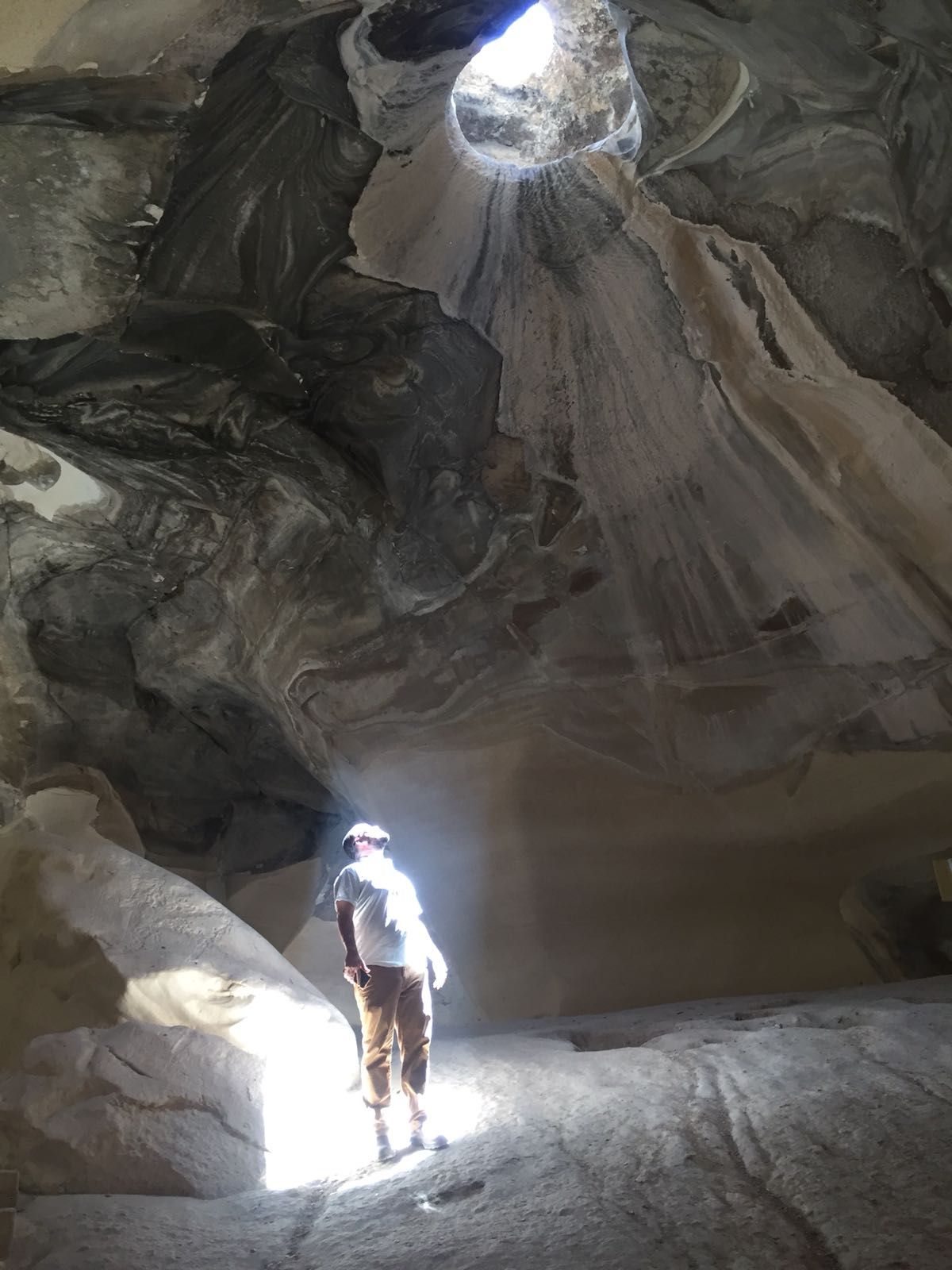
The Bell Caves are underground quarries carved from the soft chalk beneath the city, dating primarily to the Byzantine and early Islamic periods (4th-10th century CE). Each cave was quarried from a small opening in the surface: the quarriers cut through the hard surface crust and then worked downward and outward through the softer chalk beneath, creating the expanding bell shape. The caves soar to heights of 25 meters, and light enters through the small opening at the top, illuminating the vast space below in a single dramatic shaft. Over 800 Bell Caves have been identified in the area, and the largest are big enough to hold a concert (which some have).
More Caves to Explore
Beyond the main caves, Maresha offers additional underground experiences. The Polish Cave is a Hellenistic-period cistern that also served as a columbarium and quarry over the centuries. It received its name from Polish soldiers of General Władysław Anders’ army, who were stationed in Palestine during World War II. The soldiers visited the cave and carved “Warsaw, Poland,” the Polish Eagle, and the year 1943 into one of its pillars, a striking connection between an ancient underground chamber and the upheavals of the twentieth century. The Labyrinth (Maze Cave) is a vast network of twisting corridors and chambers that gives a visceral sense of the scale of underground Maresha.
Maresha was destroyed by the Parthians in 40 BCE and never rebuilt. The population shifted to nearby Beit Guvrin, which became the major city of the region in the Roman and Byzantine periods. The abandonment of Maresha preserved the Hellenistic city in a remarkable state: because no one built on top of it, the caves, the street plan, and the artifacts remained undisturbed for over 2,000 years.
Visit with Hoshen Tours
Maresha’s painted tombs and underground olive presses reveal a sophisticated Hellenistic city. Hoshen Tours pairs it with the caves of Beit Guvrin, hands-on archaeology at Dig for a Day, the mosaics at Beit Loya, and the Philistine city at Tel Miqne (Ekron).
Ready to experience Israel in true colors?
Plan Your TourPrivate tours designed around your interests, schedule, and pace.