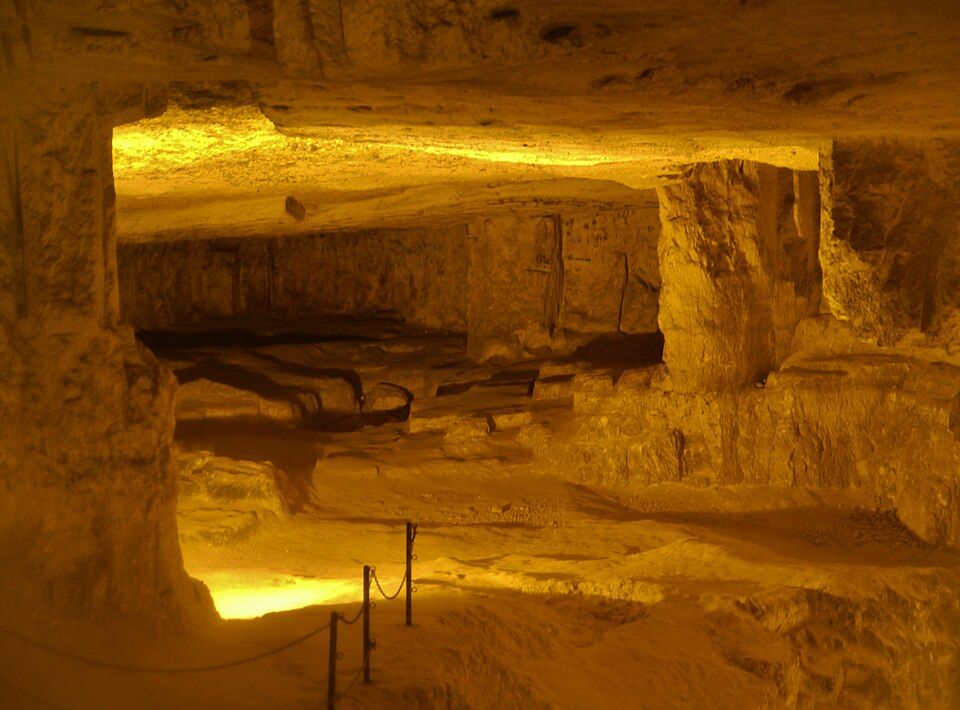
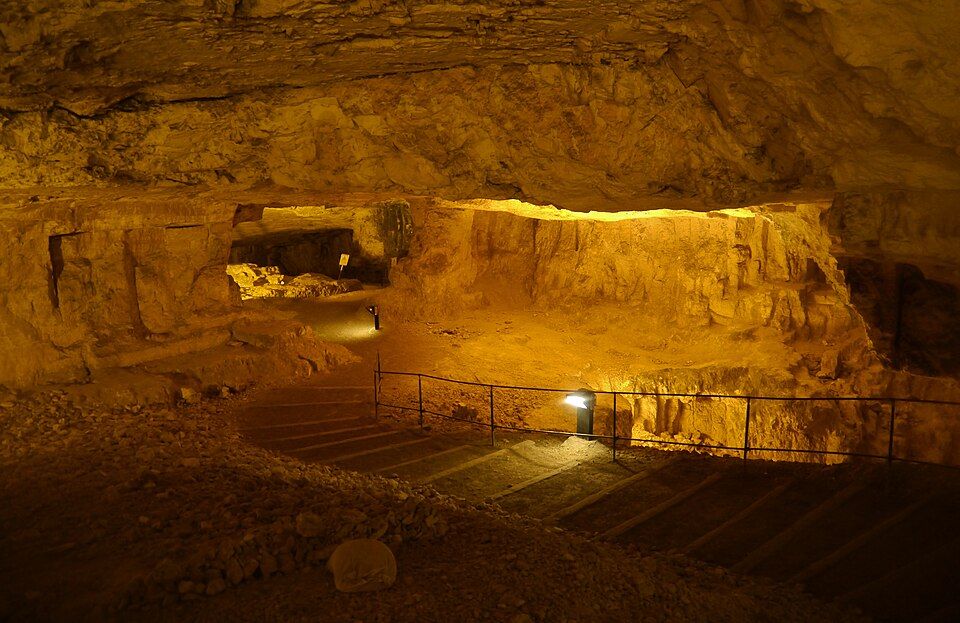
Beneath the northern wall of Jerusalem’s Old City, between Damascus Gate and Herod’s Gate, a vast underground quarry known as Zedekiah’s Cave stretches for over 200 meters into the rock beneath the Muslim Quarter. Known as Zedekiah’s Cave or Solomon’s Quarries, this is the largest quarry cave in Israel and one of Jerusalem’s most unexpected sites. The cavern covers approximately five acres, its ceilings rising up to 15 meters in places, supported by massive pillars of uncut stone left standing by the ancient quarrymen. For centuries, the cave has carried two powerful traditions: that King Solomon quarried the stones for the First Temple here, and that King Zedekiah fled through this underground passage when Babylon destroyed Jerusalem in 586 BCE. Neither tradition has been confirmed by archaeology, but both have given this remarkable space a hold on the imagination that transcends what can be proven.
The Quarry at Zedekiah’s Cave: Solomon’s Quarries Beneath Jerusalem’s Walls
The cave is carved from meleke limestone, a high-quality stone whose name derives from the Hebrew and Arabic word for “royal.” Meleke limestone is strong, resistant to erosion, and well-suited for monumental construction. The quarry shows clear evidence of systematic stone extraction: quarrymen cut channels around rectangular blocks, then drove wooden wedges into slots at the base, soaking the wood until it expanded and split the stone free. The technique left characteristic marks still visible on the walls and ceiling. Thick quadrangular pillars were left in place throughout the cave to prevent the ceiling from collapsing, a method that demonstrates sophisticated engineering knowledge. Archaeological evidence indicates that the quarry was most intensively used during the late Second Temple period, particularly during Herod the Great’s massive building projects in the 1st century BCE. Blocks cut here are believed to have been used in the construction of the Temple Mount retaining walls, including the stones of the Western Wall.
Solomon’s Quarries
The tradition that Solomon quarried stones here for the First Temple is ancient and deeply rooted, though no archaeological evidence confirms it. The Book of Kings describes Solomon’s vast construction workforce: “Solomon had seventy thousand carriers and eighty thousand stonecutters in the hills” (1 Kings 5:15). The tradition holds that the stones were shaped underground, in silence, so that “no hammer, chisel, or any other iron tool was heard at the temple site while it was being built” (1 Kings 6:7). The cave’s acoustics and the marks of ancient quarrying lent credibility to this tradition, even though modern archaeology dates the primary quarrying activity to the Herodian period, roughly a thousand years after Solomon. The name “Solomon’s Quarries” persists because the tradition is powerful, the setting is convincing, and the connection between this underground stone and the Temple above is, if not provable, at least imaginatively irresistible.
Zedekiah’s Cave and the Tears of the King
The cave’s other name comes from a tradition about the last king of Judah. In 586 BCE, the Babylonian army under Nebuchadnezzar breached the walls of Jerusalem after a long siege. According to 2 Kings 25:4 and Jeremiah 39:4, King Zedekiah and his soldiers fled the city at night through a gate near the royal garden. The 11th-century commentator Rashi wrote that “there was a cave from the palace of Zedekiah to the plain of Jericho, and he fled through the cave.” The tradition identifies this quarry as that escape route. Zedekiah was captured near Jericho, brought before Nebuchadnezzar, forced to watch his sons executed, then blinded and taken in chains to Babylon, the last king of Judah to sit on David’s throne.
In the deepest, innermost part of the cave, water droplets trickle steadily from the ceiling. For at least a thousand years, these have been called the “Tears of Zedekiah”, tradition holding that the rock itself weeps for the king who lost everything, for the city that fell, and for the Temple that was destroyed. The droplets are a natural spring, but their location in the darkness at the cave’s farthest point makes the metaphor feel less like legend and more like something the stone remembers.
The Freemason Connection
Zedekiah’s Cave holds special significance for Freemasons worldwide. Masonic tradition identifies Solomon’s Temple as the symbolic origin of the fraternity, and the legendary master builder Hiram Abiff, who according to Masonic lore directed the Temple’s construction, is a central figure in Masonic ritual. The cave’s association with Solomon’s building projects makes it, for Freemasons, a kind of origin site. Since the mid-19th century, Masonic lodges from England and Israel have held ceremonial meetings inside the cave. A ceremonial stone mallet inscribed with “King Solomon” and Masonic markings was reportedly found within the quarry. The annual Masonic gatherings in the cave are among the more unusual recurring events in Jerusalem, a city where unusual events are the norm.
Rediscovery
The cave’s entrance had been sealed and forgotten for centuries when it was rediscovered in 1854 by James Turner Barclay, an American missionary living in Jerusalem. The story goes that Barclay’s dog chased a fox along the base of the Old City wall, and the fox disappeared through a gap in the dirt. Barclay investigated and found the cave entrance. He returned at night with his two sons and became the first modern explorers to enter and document the vast underground space. The rediscovery created a sensation in 19th-century Jerusalem, reigniting debates about the cave’s connection to Solomon and Zedekiah that continue to this day.
Visit with Hoshen Tours
Zedekiah’s Cave stretches beneath the Old City walls for over 200 meters, a vast limestone quarry with connections to both King Solomon and Freemason tradition. Hoshen Tours leads visitors into the cavern, explaining how the stones cut here may have built the First Temple. The cave entrance sits just outside Damascus Gate, connecting to the Musrara neighborhood, the HaNeviim Street consular district, and the Russian Compound nearby.
Explore Our Tour Collection
Ready to experience Israel in true colors?
Plan Your TourPrivate tours designed around your interests, schedule, and pace.