



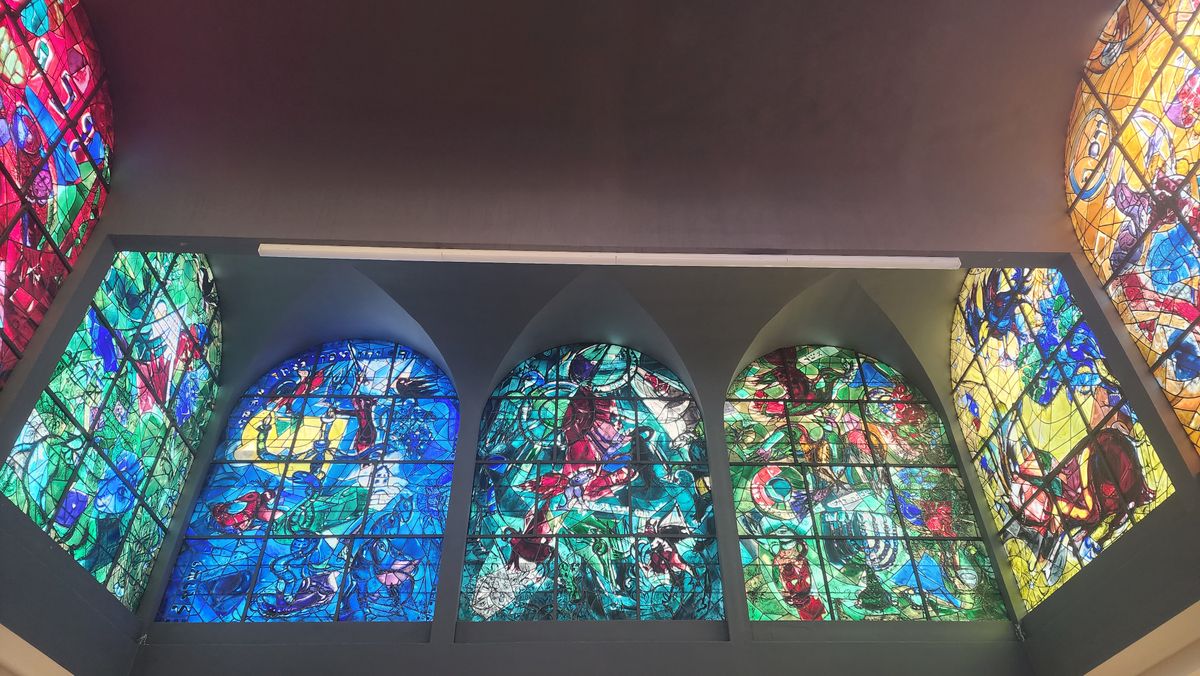
Between 1960 and 1961, the renowned artist Marc Chagall created twelve magnificent stained glass windows for the synagogue at Hadassah Medical Center in Ein Karem, Jerusalem. Each window represents one of the twelve tribes of Israel, drawing on Jacob’s blessings in Genesis 49 and Moses’ blessings in Deuteronomy 33. The windows were installed in February 1962 and immediately became one of the most celebrated works of modern religious art in Israel. Chagall considered the commission one of the most important of his career, viewing it as a deeply personal contribution to the Jewish people and the young state.
Twelve Tribes in Light and Color
Each of the twelve windows is dominated by a distinct color palette, bathing the synagogue interior in shifting hues as sunlight moves through the day. Reuben glows in red, Simeon in blue, Levi in yellow, and Judah in a rich combination of red and gold. The remaining tribes fill out a complete spectrum: greens, violets, and deep blues create an immersive environment of color. Respecting the Jewish tradition against graven images, Chagall used no human figures in any of the windows. Instead, he filled them with animals, fish, birds, flowers, and abstract symbols drawn from the biblical texts. Lions, deer, serpents, eagles, and fish appear alongside Stars of David, menorahs, and Torah scrolls, each composition dense with layered meaning and visual energy.
Hadassah, the Windows, and the War
During the Six-Day War in June 1967, Jordanian shelling struck the Hadassah Ein Karem campus and several of the windows were damaged by shell fragments and shrapnel. Chagall, by then seventy-nine years old and living in France, insisted on repairing the windows himself. He reportedly said he would make them even more beautiful than before. The restored windows bear faint traces of their repair, which Chagall chose to leave visible as a quiet testament to the conflict and survival. The restoration was completed and the windows returned to their place in the synagogue, where they have remained undisturbed since.
The Hadassah synagogue is a small, intimate space, roughly square in plan with the twelve windows arranged on all four walls, three per side. Visitors standing in the center are completely surrounded by colored light, an effect that shifts constantly with the time of day and the season. The modest scale of the room intensifies the experience. Unlike a large cathedral where stained glass sits far above, here the windows are close and enveloping. The architecture was designed specifically to showcase the glass, with white walls and a simple interior that lets the windows command full attention.
Who Was Marc Chagall?
Marc Chagall was born in 1887 in Vitebsk, in what is now Belarus, into a Hasidic Jewish family. Throughout his long career, which spanned nearly a century until his death in 1985, Jewish themes, symbols, and memories of shtetl life remained central to his art. The Hadassah windows represent a culmination of that lifelong engagement with Jewish identity. Chagall spoke of the project as a way to honor his roots and contribute something lasting to the spiritual life of Israel. The windows stand alongside his work at the Paris Opera and the United Nations as among his greatest monumental commissions.
The synagogue is located inside the Hadassah Ein Karem medical campus in the hills west of Jerusalem’s Old City. Visitors should be aware that access requires arranging entry through the hospital’s visitor services, as the synagogue is within the medical complex. The Ein Karem neighborhood itself is a beautiful area rich with history and tradition, home to several significant pilgrimage churches and ancient springs.
Visit with Hoshen Tours
A visit to the Chagall Windows pairs naturally with other sites in the Ein Karem area. The neighborhood is traditionally associated with the birthplace of John the Baptist and the visit of Mary to Elizabeth. Hoshen Tours can combine the Hadassah synagogue with nearby landmarks for a full morning or afternoon exploring this peaceful corner of Jerusalem. Nearby sites worth combining include the Church of John the Baptist, built over the traditional site of his birth, and the Church of the Visitation, commemorating Mary’s visit to her cousin Elizabeth as described in Luke’s Gospel. Hoshen Tours often combines this site with Tomb of Lazarus, Rachels Tomb, and Gvilei Haesh for a memorable day exploring the region.
Explore Our Tour Collection
Ready to experience Israel in true colors?
Plan Your TourPrivate tours designed around your interests, schedule, and pace.