



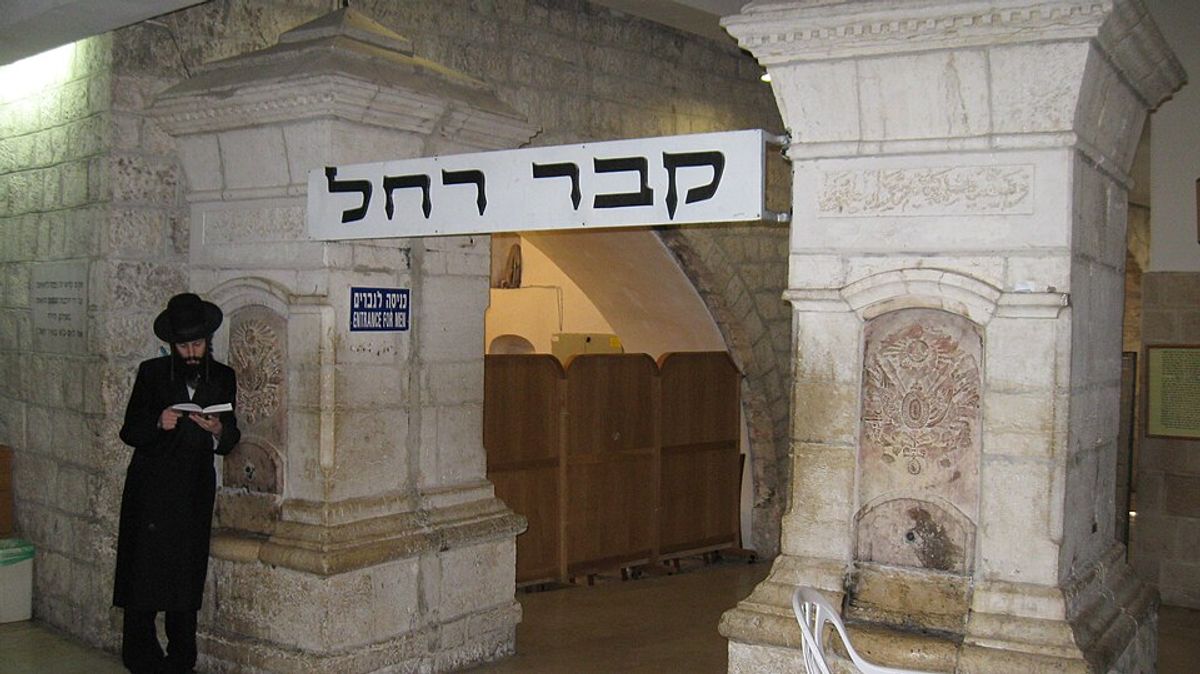
Rachel’s Tomb stands on the ancient road from Jerusalem to Hebron, at the northern edge of Bethlehem. It is one of the oldest continuously venerated sites in the Holy Land. For Jews, it is the burial place of the matriarch Rachel, wife of Jacob, mother of Joseph and Benjamin, who died in childbirth; tradition places her tomb on this road more than three thousand years ago. For Christians, Rachel’s story connects to the Nativity narrative through the prophecy of Jeremiah. For Muslims, the site served for centuries as a place of prayer alongside a historic cemetery. The small domed structure that marks the tomb today has been rebuilt, renovated, and fought over for centuries, yet the core tradition, a mother buried on the road, weeping for her children, has endured across all three faiths and remains one of the most emotionally powerful images in the Bible.
Rachel in the Bible at Rachel’s Tomb (Kever Rachel)
Rachel enters the biblical narrative in Genesis 29, when Jacob arrives at a well near Haran and sees her approaching with her father’s flock. He rolls the stone from the well’s mouth, waters her sheep, kisses her, and weeps. Jacob works seven years for her father Laban in exchange for her hand, “and they seemed to him but a few days because of the love he had for her” (Genesis 29:20). On the wedding night, Laban substitutes Rachel’s older sister Leah, forcing Jacob to work another seven years for Rachel. The story establishes Rachel as the beloved wife: chosen, waited for, and never forgotten.
Jewish History and Tradition
Rachel struggles with infertility while Leah bears son after son. Her anguished cry to Jacob, “Give me children, or I shall die” (Genesis 30:1), has echoed through centuries of Jewish prayer at this site. She eventually gives birth to Joseph, and later, on the road from Bethel to Ephrath, she goes into difficult labor with her second son. The midwife tells her not to fear, for she has another son, but Rachel is dying. With her last breath she names the child Ben-Oni, “son of my suffering.” Jacob renames him Benjamin, “son of the right hand.” Genesis 35:19-20 records: “So Rachel died and was buried on the way to Ephrath (that is, Bethlehem). Jacob set up a pillar over her grave, and to this day that pillar marks Rachel’s tomb.”
Centuries later, the prophet Jeremiah invoked Rachel’s memory in one of the most haunting passages in Scripture: “A voice is heard in Ramah, mourning and great weeping, Rachel weeping for her children and refusing to be comforted, because they are no more” (Jeremiah 31:15). Jewish tradition understands this as Rachel crying out for the Israelites as they passed her tomb on the road to exile in Babylon. The passage continues with God’s reply: “Restrain your voice from weeping and your eyes from tears, for your work will be rewarded… they will return from the land of the enemy” (Jeremiah 31:16-17). In the Gospel of Matthew (2:18), this prophecy is applied to Herod’s massacre of the children of Bethlehem. Rachel thus becomes a figure of maternal grief that transcends any single tradition.
The Location of Rachel’s Tomb
The tomb stands approximately two kilometers north of Bethlehem’s old city, along the historic road that connected Jerusalem to Hebron. Genesis places Rachel’s death “on the way to Ephrath, that is, Bethlehem” (Genesis 35:19), and this identification has been accepted by Jewish, Christian, and Muslim tradition since at least the 4th century CE. The site appears on the 6th-century Madaba Map, the oldest surviving cartographic depiction of the Holy Land, confirming that Byzantine Christians recognized this location. It is worth noting that 1 Samuel 10:2 places Rachel’s tomb “in the border of Benjamin,” which some scholars locate farther north, near Ramah. The two biblical traditions may reflect different periods or different understandings of tribal boundaries, but the site near Bethlehem is the one that has been venerated continuously for at least 1,700 years and is the location recognized by all three Abrahamic faiths.
History of the Structure
The earliest physical marker at the site was the pillar that Jacob set up according to Genesis 35:20. No trace of this original monument survives, but the memory of it anchored the tradition to this spot. In the 4th century, St. Jerome, who lived and worked in nearby Bethlehem, referenced the tomb in his biblical commentaries. The Christian pilgrim Arculf, visiting in the late 7th century, described a tomb “of crude workmanship, without any adornment, surrounded by a stone coping” and marked with the name Rachel.
During the Crusader period in the 12th century, a more substantial structure was built: a square building with four pillars supporting arches and a dome. The Jewish traveler Benjamin of Tudela, who visited between 1169 and 1173, described a monument of eleven stones topped with a cupola resting on four columns. He noted that Jewish pilgrims carved their names on the surrounding stones: a practice that connected the eleven stones to the tribes of Israel (excluding Benjamin, who was born at this spot).
In 1622, the Ottoman governor Muhammad Pasha made significant changes to the structure, walling off the four Crusader pillars and filling in the arches, giving the building its characteristic enclosed appearance. The following year, the site was formally entrusted to the Jewish community. After the devastating earthquake of 1837 severely damaged the structure, the British Jewish philanthropist Sir Moses Montefiore obtained a permit from the Ottoman authorities to restore it. In 1841, Montefiore renovated the building, reconstructed the iconic white dome, and added an antechamber on the eastern side that included a mihrab (prayer niche) for Muslim use: a deliberate gesture of shared access. Further renovations in 1845 extended the building with a vaulted room.
A Place of Prayer
Rachel’s Tomb holds a unique place in Jewish devotion. Because Rachel died on the road, not in a city, not in a family tomb, but on the way, Jewish tradition teaches that she was buried there deliberately by divine will, so that she would be present to pray for her children as they passed into exile. The midrash explains that when the Israelites were led as captives to Babylon, they passed Rachel’s tomb, and she rose from her grave to weep and intercede on their behalf. God heard her prayer and promised that her children would return.
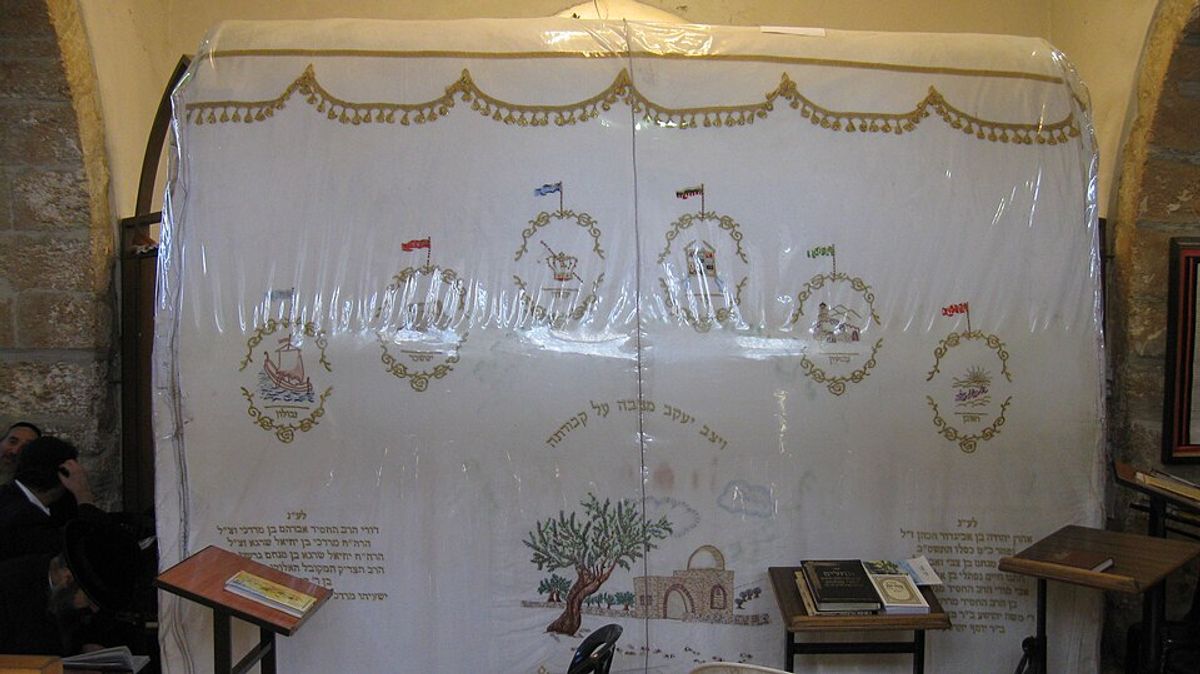
This tradition has made the tomb an especially powerful destination for women’s prayer. For centuries, Jewish women have come here to pray for fertility, for safe childbirth, for the health of their children, and for the welfare of the Jewish people. The 11th of Cheshvan, observed as Rachel’s yahrzeit (the anniversary of her death, since Benjamin was traditionally born on that date), draws thousands of pilgrims, making it the busiest day of the year at the site. The atmosphere on that day is one of intense, personal prayer, women pressing their hands against the velvet-draped cenotaph, reading psalms, whispering names of the sick and the childless.
For Christians, Rachel’s story resonates through the Christmas narrative. Matthew’s Gospel applies Jeremiah’s prophecy directly to Bethlehem: when Herod orders the slaughter of the innocents, the evangelist writes, “Then what was said through the prophet Jeremiah was fulfilled: A voice is heard in Ramah, weeping and great mourning, Rachel weeping for her children” (Matthew 2:17-18). Rachel becomes a figure not only of ancient grief but of the suffering that surrounded the birth of Jesus in her own town.
The Tomb Today
The interior of the tomb is divided into men’s and women’s prayer sections. The cenotaph, a symbolic marker, not the actual burial, stands at the center, draped in embroidered fabric. Bookshelves along the walls hold volumes of Psalms and prayer books. The atmosphere is quiet and intense, very different from the large public spaces of the Western Wall or the Church of the Holy Sepulchre. This is a place of intimate, personal prayer, where visitors speak to Rachel as if she can hear them.
The building visible today retains the basic form shaped by the Crusader pillars, the Ottoman walls, and Montefiore’s dome, though it has been significantly fortified and enclosed by security infrastructure since the early 2000s. The site is accessible from Jerusalem through a dedicated road and checkpoint. Men’s and women’s sections are separated, and the tomb is open for prayer throughout the week except on the Jewish Sabbath (Saturday).
Visit with Hoshen Tours
Rachel’s Tomb is one of the most emotionally resonant sites in the Holy Land. Hoshen Tours includes it in itineraries that explore the Bethlehem area, combining the visit with the Church of the Nativity, the Shepherds’ Fields, and Herodium. Standing at Rachel’s tomb, visitors encounter the same grief, the same hope, and the same promise of return that have drawn pilgrims to this roadside grave for thousands of years.
Explore Our Tour Collection
Ready to experience Israel in true colors?
Plan Your TourPrivate tours designed around your interests, schedule, and pace.