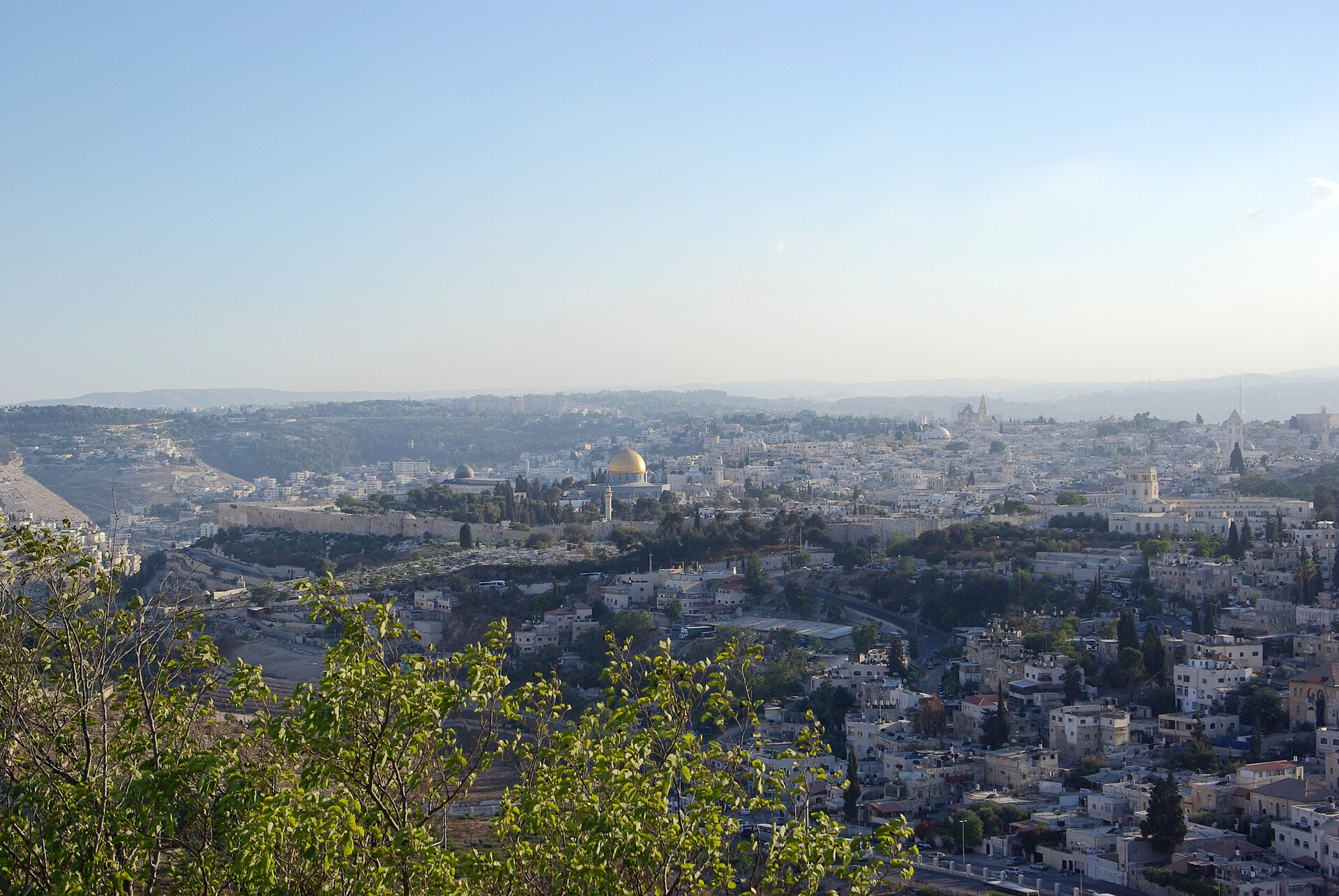
Mount Scopus (Har HaTzofim, the Mountain of the Watchmen) is the ridge northeast of the Old City that has served as a strategic observation point for every army that has approached Jerusalem. The name comes from the Greek word “skopeo” (to look), and from the summit, the entire city is spread out below. The Roman general Titus camped here before his assault on the city in 70 CE. The British general Allenby viewed the city from here before his entry in 1917. And the Hebrew University, founded on the mountaintop in 1925, became an island of Israeli sovereignty behind Jordanian lines after 1948. Today, Mount Scopus is also home to the British War Cemetery, where Commonwealth soldiers who fell during World War I in the battles for the Holy Land are buried in rows of white headstones overlooking the Judean Desert, a solemn reminder of another chapter in Jerusalem’s layered military history.
The First Glimpse of the Holy City
The name Scopus comes from the Greek skopeo, meaning “to look out” or “to watch,” and in Hebrew the mountain is called Har HaTzofim — the Mountain of Those Who Look Out. The name is not accidental. For thousands of years, most pilgrims approaching Jerusalem came from the east, climbing up from the Jordan Valley through the Judean Desert. After hours or days of walking through barren, rocky wilderness, Mount Scopus was the first point from which they could see the Holy City spread out before them. The moment of that first sighting — Jerusalem’s walls, the Temple Mount, the golden glow of the city against the sky — was one of the most emotionally charged moments of any pilgrimage. Tradition records that pilgrims would tear their garments upon seeing the city, a sign of both awe and mourning for the destroyed Temple.
That view is still there today. Standing on the Mount Scopus observation point, you see the Old City, the Dome of the Rock, the Mount of Olives, and the sweep of the Judean Desert falling away to the east toward the Dead Sea. It is one of the finest panoramic views in all of Jerusalem, and it gives a visceral sense of what ancient pilgrims experienced when they reached this ridge after their long climb from the valley below.
The Hebrew University
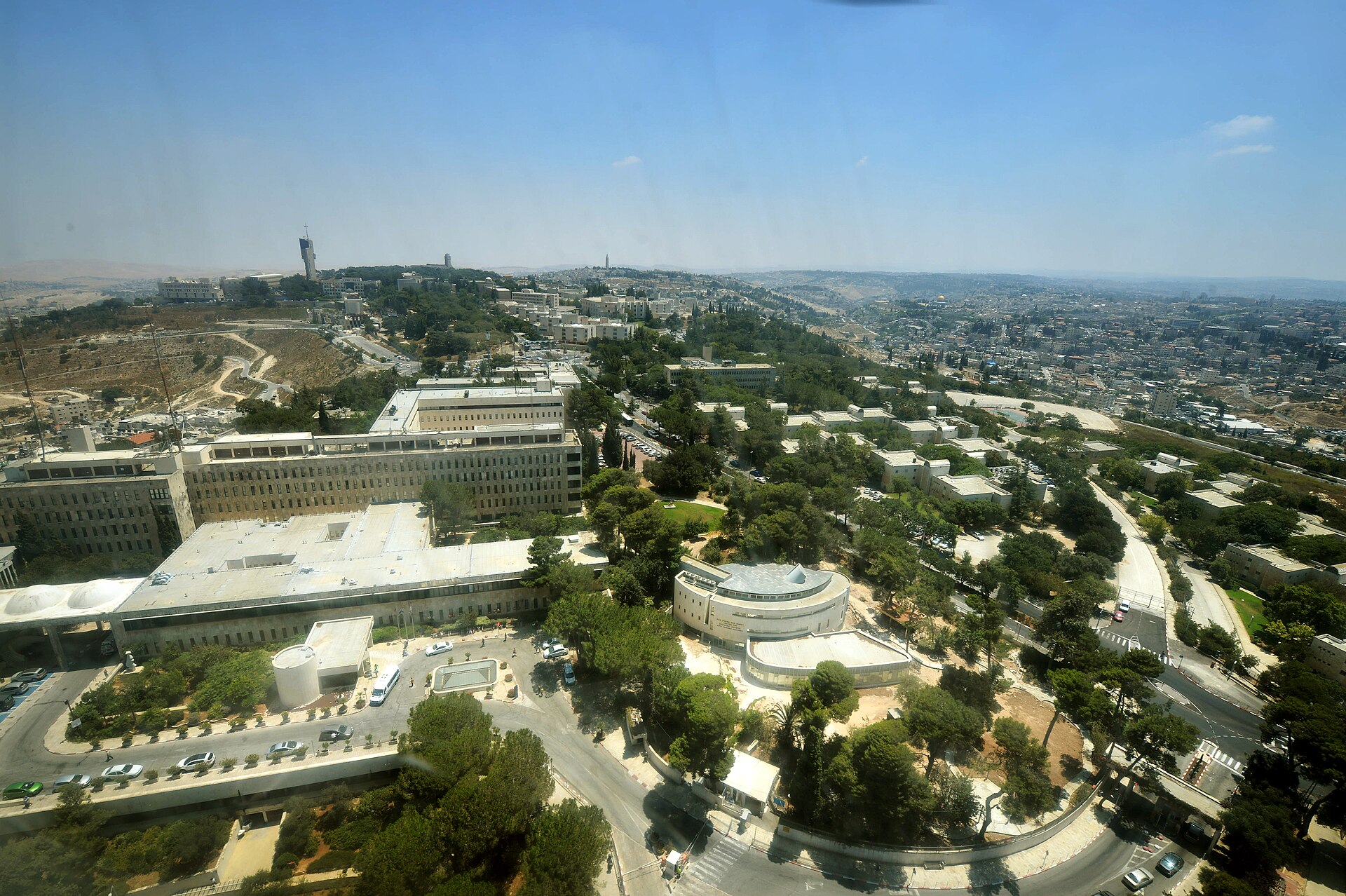
The Hebrew University of Jerusalem was founded on Mount Scopus in 1925, with Albert Einstein, Sigmund Freud, and Martin Buber among its early supporters. Einstein delivered a landmark scientific lecture on the future campus in 1923, two years before the formal opening ceremony in 1925, delivering a speech in French on the state of physics, a moment that symbolized the blending of European intellectual tradition with the Zionist aspiration to build a center of learning in the Jewish homeland. The original campus was designed as a bold architectural and cultural statement: a Jewish university on a hilltop overlooking the city of David, combining ancient heritage with modern scholarship. The Hadassah Hospital was also established on Mount Scopus during this period, becoming the premier medical institution in the region and serving both Jewish and Arab patients. Together, the university and the hospital represented the highest aspirations of the Yishuv, the pre-state Jewish community, to build institutions of excellence in the land of Israel.
The 1948 Convoy
After the 1948 war, Mount Scopus became an Israeli exclave within Jordanian-controlled territory. The university and Hadassah Hospital, both on the summit, were cut off from the rest of Israeli Jerusalem. On April 13, 1948, a convoy of doctors, nurses, patients, and university staff heading to Mount Scopus was ambushed by Arab forces near Sheikh Jarrah in one of the most devastating events of the entire 1948 war. The convoy, which included armored buses and ambulances, was pinned down under relentless gunfire and firebombs for hours. British forces stationed nearby were aware of the attack but failed to intervene in time, arriving only after the massacre was essentially over. 78 people were killed, including Dr. Haim Yassky, the director of Hadassah Hospital, and many of the finest medical professionals and academics in the country. Among the dead were surgeons, nurses, researchers, and a patient being transferred for care, people who had dedicated their lives to healing, not fighting. The massacre sent shockwaves through the Jewish community and remains one of the most painful memories of the war.
The wreckage of the armored buses, riddled with bullet holes, is displayed along the road as a memorial.
After the war, Mount Scopus became a tiny island of Israeli sovereignty surrounded entirely by Jordanian-controlled territory, accessible only by a fortnightly UN-escorted convoy that brought supplies and rotated the small Israeli garrison that maintained a symbolic presence on the hilltop. For nineteen years, from 1948 to 1967, the campus stood empty and silent, its buildings deteriorating, while the university operated from a temporary campus in western Jerusalem. It was only after the Six-Day War in 1967, when Israel reunified Jerusalem, that the Mount Scopus campus was reclaimed and a massive expansion began, transforming it into the sprawling modern university campus that stands today.
The Open-Air Theatre and Its View of Jerusalem
The university’s open-air theatre offers what many consider the finest view of Jerusalem. The Old City, the Dome of the Rock, the Mount of Olives, and the Judean Desert are all visible in a single panorama. On a clear day, the view stretches eastward all the way to the mountains of Moab across the Jordan Valley, and on rare occasions the shimmering surface of the Dead Sea, the lowest point on earth, is visible in the distance. The view at sunset, when the limestone of the Old City glows gold, is extraordinary. The theatre itself is used for graduation ceremonies and public events, and sitting in its stone seats, one feels the full sweep of Jerusalem’s geography and history laid out like a living map.
The British War Cemetery
On the northern slope of Mount Scopus lies the Jerusalem War Cemetery, one of the most moving and least visited sites in the city. Maintained by the Commonwealth War Graves Commission, the cemetery holds the graves of more than 2,500 soldiers from the British Empire who fell during the campaigns in Palestine and the broader Middle East during World War I. Neat rows of white headstones stretch across the manicured grounds, marking the resting places of soldiers from Britain, Australia, New Zealand, India, and other Commonwealth nations who fought in General Allenby’s campaign to capture Palestine from the Ottoman Empire in 1917–1918.
The cemetery also contains graves from World War II, including soldiers who served in the region during the North Africa and Middle East campaigns. A Stone of Remembrance and a Cross of Sacrifice stand at the center, and the views from the grounds toward the Old City and the Judean Desert add a layer of quiet solemnity. For visitors with a connection to Commonwealth military history, or for anyone who appreciates the weight of sacrifice that has shaped this land, the cemetery is a powerful and contemplative stop.
Second Temple Burial Caves
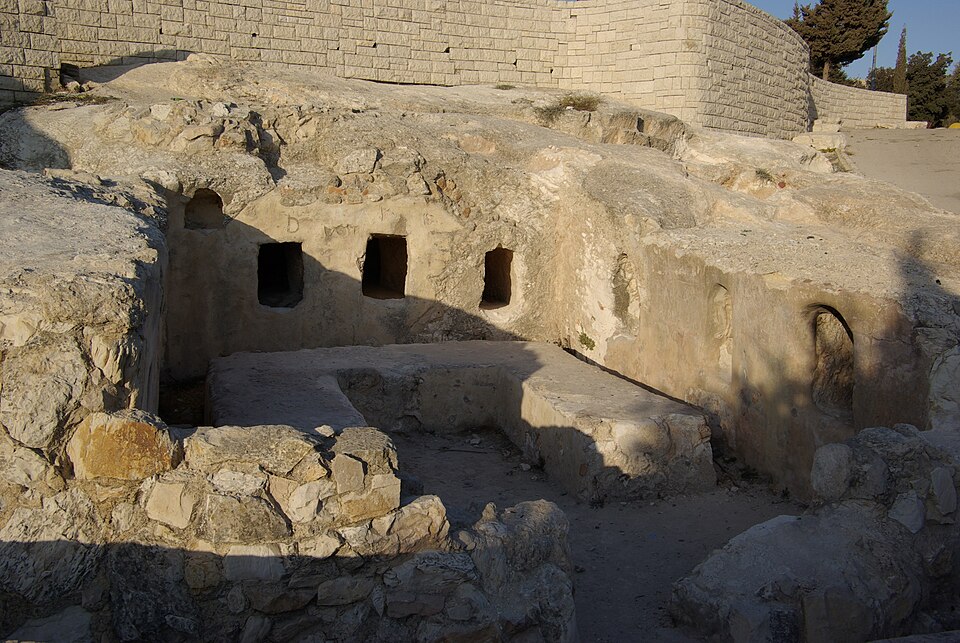
The slopes of Mount Scopus hold some of the most important burial sites from the Second Temple period in Jerusalem. Elaborate rock-cut tombs discovered on the mountain’s western and southern flanks reveal the wealth and status of the families who chose to be buried here, within sight of the Temple Mount. The tombs feature carved facades, rolling stone doors, and interior chambers with burial niches (kokhim) cut into the rock — the standard Jewish burial practice of the first century BCE and first century CE.
Among the most notable discoveries is the so-called Tomb of Nicanor, identified by a Greek inscription naming Nicanor of Alexandria, who according to the Talmud donated the magnificent bronze gates for the Temple courtyard. The ossuary bearing his name was found here in 1902 and is now in the British Museum. Other tombs on Mount Scopus have yielded ossuaries, pottery, and inscriptions that shed light on the diverse population of Jerusalem in the decades before the Roman destruction of 70 CE. For visitors with an interest in archaeology, these caves offer a tangible connection to the people who lived, worshipped, and died in Jerusalem during the time of the Second Temple.
Visit with Hoshen Tours
Mount Scopus offers views, university history, and the story of the 1948 convoy. Hoshen Tours visits the theatre and tells the story of the mountaintop university that became a symbol of Israeli resilience, from Einstein’s opening lecture in 1925, through the trauma of the convoy massacre and the nineteen years of isolation, to the joyous return after 1967.
Explore Our Tour Collection
Ready to experience Israel in true colors?
Plan Your TourPrivate tours designed around your interests, schedule, and pace.