



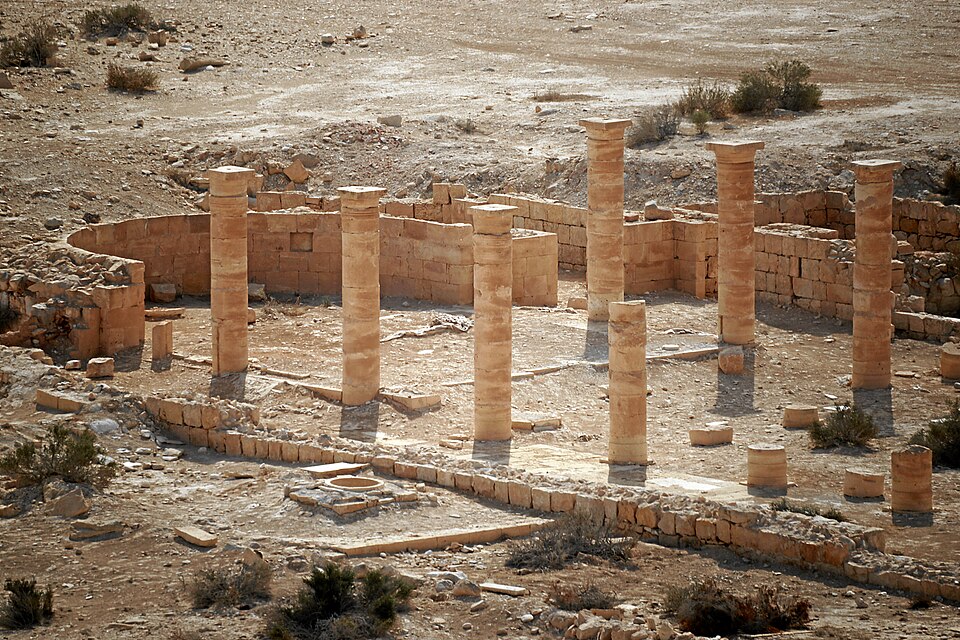
Nitzana is a remote archaeological site on the Egyptian border in the western Negev, a Nabatean and Byzantine settlement that sits at the crossroads of the desert trade routes between Egypt, the Negev, and the Mediterranean. The site’s isolation, its well-preserved Byzantine churches, and its border location make it one of the most atmospheric sites in the Negev. Unlike the more visited Incense Route cities to the east, Nitzana occupies a solitary position in the flat desert landscape, with nothing but sand and low hills stretching in every direction.
A Way Station Between Empires
Nitzana was a way station on the route from the Sinai to the Negev, serving travelers and merchants moving between Egypt and the cities of the Incense Route. The Nabateans established the settlement as a caravan stop, and it grew steadily during the Roman and Byzantine periods into a prosperous town with churches, administrative buildings, and a military garrison. The ruins include two large Byzantine churches, a fortress, residential buildings, and a unique collection of papyrus documents (the Nitzana Papyri) that were found in the ruins and provide detailed information about daily life in the Byzantine Negev: tax records, legal documents, letters, and even a school exercise book. These papyri, discovered in the 1930s by the Colt Expedition, are among the most important documentary finds from the Byzantine Middle East, offering a window into the daily concerns of ordinary people living on the empire’s desert frontier.
The Nitzana Negev Papyri
The papyrus collection from Nitzana includes documents in Greek and Arabic spanning the 6th and 7th centuries, covering the transition from Byzantine to early Islamic rule. Among the most fascinating finds are tax receipts, military correspondence, property sales, and personal letters that reveal the concerns of a small desert community managing its affairs under changing rulers. One document records the sale of a house; another lists the provisions required for a military garrison. A school text preserves exercises in Greek grammar. Together, these documents paint a remarkably detailed portrait of life in a settlement that most maps of the ancient world would overlook entirely. The papyri are now held in museum collections, but the ruins where they were found still stand, and walking through the site with knowledge of what was written here brings the stones to life.
Outpost on the Egyptian Border
Nitzana sits directly on the Israel-Egypt border, and the border fence is visible from the archaeological site. The contrast between the ancient trade route, which connected Egypt to the Levant for millennia, and the modern political border that now divides the same landscape is a reminder of how boundaries have shifted across the centuries. In antiquity, this was not a border but a corridor, and the caravans that passed through Nitzana carried goods and ideas between civilizations. Standing among the ruins, with Egypt visible to the west and the Negev stretching east, the site’s role as a hinge between worlds becomes immediately clear.
Visit with Hoshen Tours
Nitzana sits at the edge of the desert on the Egyptian border, a quiet outpost of the Nabatean world. Hoshen Tours pairs it with Haluza, the the Incense Route, the ruins at Avdat, and the wider story of the Nabateans. Hoshen Tours often combines this site with Red Canyon, Mitzpe Ramon, and Ein Avdat for a memorable day exploring the region.
Explore Our Tour Collection
Ready to experience Israel in true colors?
Plan Your TourPrivate tours designed around your interests, schedule, and pace.