



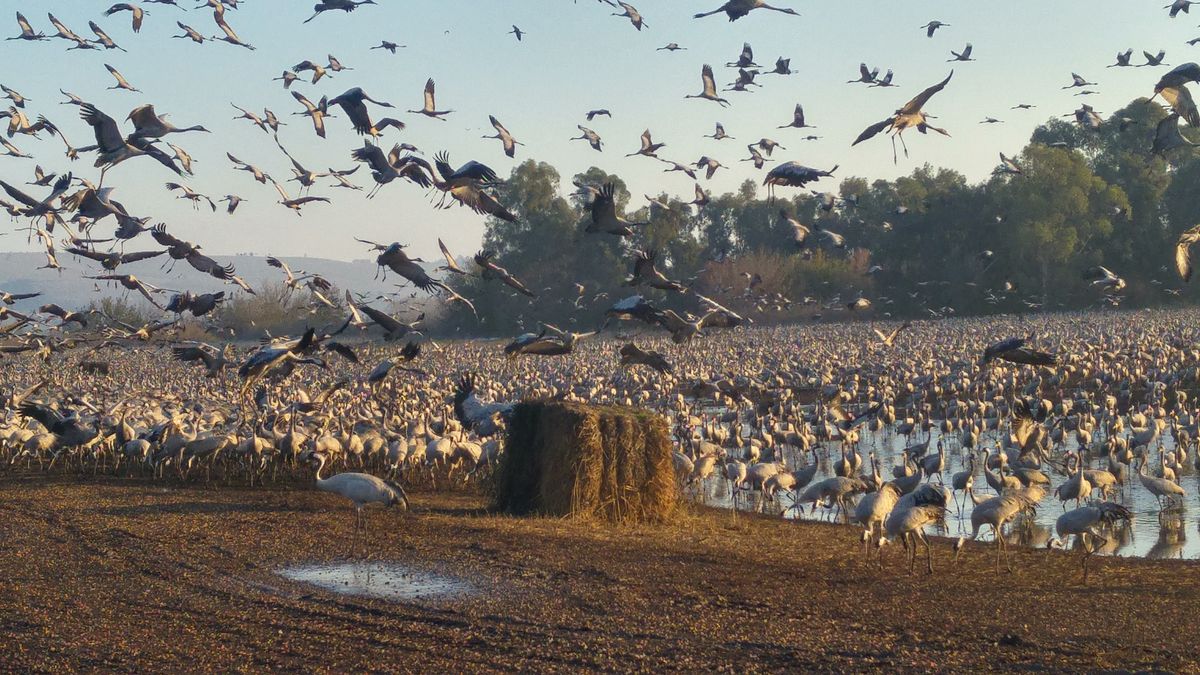
Twice a year, over 500 million birds fly through Israeli airspace on their migration between Europe, Asia, and Africa. Israel sits on one of the busiest bird migration corridors in the world, and the Hula Valley, a restored wetland in the upper Galilee, is where many of them stop to rest, feed, and stage one of the greatest wildlife spectacles on the planet.
Draining the Hula Swamps – Hula Valley and Bird Migration in
For centuries, the Hula Valley was a vast marshland, a sprawling expanse of swamps, papyrus thickets, and a shallow lake that covered the northern end of the valley. The wetlands were beautiful but deadly. Malaria was endemic, carried by mosquitoes that bred in the stagnant waters, and the disease made the valley nearly uninhabitable. Early Jewish settlers in the region, including the pioneers who founded Yesod HaMa’ala in the 1880s, suffered terribly from malaria, and many abandoned the settlements or died.
In the 1950s, the young State of Israel undertook one of its most ambitious infrastructure projects: the complete draining of the Hula Lake and its surrounding marshes. The goal was twofold, to eliminate malaria and to create productive agricultural land from the drained swampbed. The project was celebrated as a triumph of Zionist engineering, a symbol of the new state’s ability to tame the land and make the desert (or in this case, the swamp) bloom.
The draining succeeded in eliminating malaria, but the ecological consequences were severe and unexpected. The soil beneath the swamps was peat, dark, organic, and rich in nutrients, but also highly unstable once exposed to air. Farmers called it admat hakabul (kabul soil), a thick, heavy black earth that behaved unpredictably. In dry conditions, the exposed peat caught fire spontaneously, burning underground in smoldering fires that were nearly impossible to extinguish. The soil shrank, compacted, and sank, sometimes by meters. Nutrients washed into the Sea of Galilee, threatening the water quality of the entire national water system. Dust storms from the dried peat darkened the skies over the valley. Within decades, it became clear that the draining of the Hula had created as many problems as it solved.
Restoration
In the 1990s, Israel took the unusual step of partially reversing one of its most celebrated national projects. A portion of the drained valley was reflooded, creating the Agamon HaHula, a man-made lake surrounded by shallow marshes that quickly became one of the most important bird habitats in the Middle East. The restoration was not a return to the original swamp; it was a carefully engineered compromise between agriculture, ecology, and water management. The Agamon stabilized the peat soil, filtered nutrients before they reached the Sea of Galilee, and provided a habitat for the hundreds of millions of migratory birds that pass through the valley every year.
The Hula restoration is now considered one of Israel’s greatest environmental success stories, a lesson in the consequences of ignoring ecology, and a model for how to correct course when things go wrong.
Why the Hula Matters
Israel sits at the junction of three continents, and the Hula Valley is the bottleneck. Every bird migrating between Europe, Asia, and Africa must pass through this narrow corridor between the Mediterranean Sea and the Syrian desert. There is no alternative route. This geographical accident makes Israel one of the most important bird migration corridors in the world, and the Hula Valley, with its restored wetlands, warm climate, and abundant food, is where the birds stop to rest and refuel.
The restoration of the Hula wetlands in the 1990s was not just an ecological project. It was also an economic calculation. The cranes that stop in the valley were eating the crops of local farmers, causing millions of shekels in damage each year. The solution was elegant: restore a portion of the wetland as a nature reserve, and feed the cranes there with tons of corn provided by the farmers themselves. The cranes get fed, the crops get saved, and hundreds of thousands of visitors come each year to watch the spectacle. Everyone wins.
The Birds
The numbers are staggering. Over 400 species have been recorded in the Hula Valley. In autumn, tens of thousands of cranes arrive from Europe, fed daily with tons of corn by local farmers who discovered that feeding the cranes is cheaper than replacing the crops they eat. The sight of thousands of cranes taking flight at sunrise, their calls echoing across the valley with Mount Hermon in the background, is one of the most unforgettable wildlife experiences in the world.
Pelicans, storks, herons, raptors, and hundreds of smaller species pass through seasonally. The Hula is a birdwatcher’s paradise, but you do not need to be a birder to be moved by the spectacle. Standing at the observation point at dawn, watching tens of thousands of cranes lift off the fields in waves, their calls echoing across the valley with Mount Hermon glowing pink in the background, is one of those moments that makes you understand why people travel halfway around the world for this.
A Birding Site of Global Importance
The Hula Valley is recognized internationally as one of the most important bird migration sites in the world. Over 500 million birds pass through the valley twice a year, and more than 400 species have been recorded here. Birdwatchers from around the world come to the Hula, and the valley has been designated a site of global importance by BirdLife International.
The cranes are the headline act. Approximately 35,000 common cranes spend the winter in the Hula Valley, arriving in late October and staying through February. Originally, the cranes were passing through on their way south to Africa, but the abundance of food in the restored wetlands convinced many of them to stop migrating altogether. Why fly to Africa when the Hula Valley feeds you corn every morning? The cranes that stay through the winter have become one of the defining wildlife spectacles of Israel, and their daily routine of feeding in the fields, flying to the lake to drink, and roosting in the shallow water at dusk draws visitors by the hundreds of thousands.
Beyond the cranes, the Hula hosts pelicans, storks, herons, eagles, harriers, and hundreds of species of songbirds and waders. During peak migration in autumn and spring, the skies above the valley are filled with birds from dawn to dusk.
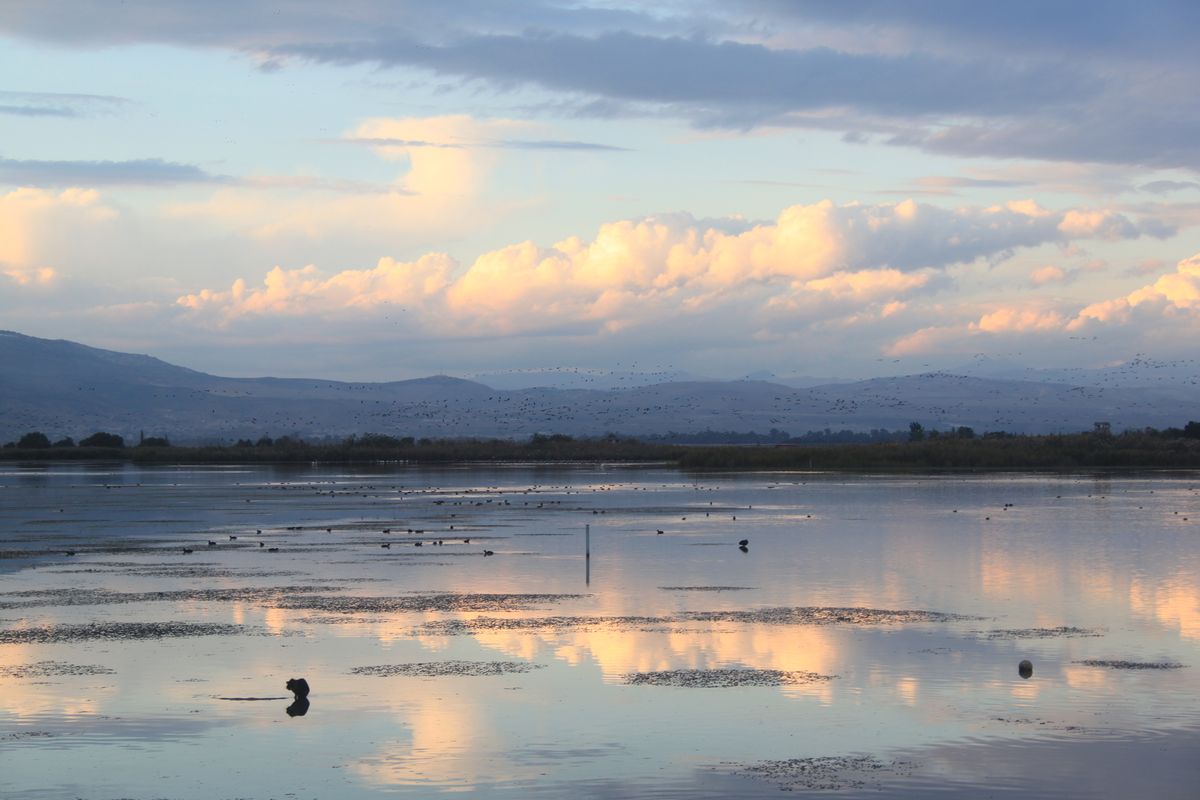
The Agamon HaHula offers cycling paths, tractor-drawn wagon tours, and walking trails around the restored lake. Observation hides are positioned at key points, and the visitor center provides information on which species are present at any given time.
Sunrise Experience
The most powerful way to experience the Hula is at sunrise during the crane season (November through February). Guided tractor-drawn wagon tours leave before dawn and take visitors into the heart of the feeding areas, where the cranes gather by the tens of thousands. As the sun rises over the Golan Heights and the first light hits the valley, the cranes begin their morning departure, thousands of birds lifting off in formation against the sky. The sound alone is unforgettable.
Biblical Landscape
The Hula Valley has been a crossroads of civilization since antiquity. The ancient Via Maris, the international highway connecting Egypt to Mesopotamia, passed through the valley, and the biblical cities of Hazor, Dan, and Kedesh guarded its approaches. The draining of the Hula swamp in the 1950s was one of the most ambitious environmental projects of the young State of Israel, transforming a malaria-ridden marshland into productive farmland. Part of the swamp was later reflooded as a nature reserve when scientists realized the ecological importance of the wetland, and today the Hula is one of the most important bird migration sites in the world: over 500 million birds pass through every autumn and spring, making it a birdwatcher’s paradise.
The Cranes
The most spectacular visitors to the Hula Valley are the common cranes (Grus grus), approximately 35,000 of which spend the winter in the valley between November and March. The cranes, tall gray birds with a wingspan of over two meters, were originally passing through on their way to Africa, but the combination of agricultural fields (providing grain), fishponds (providing warmth), and active feeding programs by the Israel Nature and Parks Authority convinced many of them to stop for the winter rather than continue south. The daily routine of the cranes, rising from the fishponds at dawn to feed in the fields and returning at sunset, is one of the great wildlife spectacles in Israel. Observation hides and tractor-drawn wagons allow visitors to watch the cranes at close range without disturbing them.
Visit with Hoshen Tours
Hoshen Tours includes the Hula Valley in upper Galilee itineraries with Tel Dan, Safed, and Rosh Pina. The best months for migration are October-November and March-April.
Visitors exploring the upper Galilee often combine Hula Valley with nearby destinations such as Rosh Pina, Tel Hai, and Yesod HaMaala, each offering its own distinctive perspective on the region’s layered history and landscape. A broader itinerary might also include Banias and Mount Hermon, both within easy reach and rich in their own right.
Every Hoshen Tours itinerary is private and fully customizable. Contact us to begin planning your journey through the upper Galilee.
Explore Our Tour Collection
Explore this site and 65 more in Sacred Steps in the Holy Land
225 pages · The Life, World, and Footsteps of Jesus · Maps, photos, and Scripture references
Ready to experience Israel in true colors?
Plan Your TourPrivate tours designed around your interests, schedule, and pace.