


Call us today!
+1-917-9055850

Magazine
The Prophet Isaiah: His Prophecies, the Great Isaiah Scroll, and Where to See It
If you have ever heard the phrase “beating swords into plowshares,” you have already encountered the words attributed to the Prophet Isaiah. Nearly three thousand years later, his vision of a world without war still moves people. And remarkably, you can stand just a few feet away from his words — written on ancient parchment — at the Israel Museum in Jerusalem.
Isaiah (in Hebrew, Yeshayahu, meaning “God is salvation”) is described in the biblical text as a prophet who lived in Jerusalem during the 8th century BCE — roughly 2,700 years ago. According to the Book of Isaiah, he was active during the reigns of four kings of Judah (Isaiah 1:1), placing his career between approximately 740 and 700 BCE. This was one of the most turbulent periods in the history of the ancient Near East. The Assyrian Empire, the superpower of the age, was expanding relentlessly, conquering city after city and deporting entire populations. The northern Kingdom of Israel fell to the Assyrians in 722 BCE. Its ten tribes were scattered and never returned. The southern Kingdom of Judah, with Jerusalem as its capital, stood alone.
Isaiah operated at the very center of this crisis. Unlike some biblical prophets who came from humble backgrounds, the text indicates he was a man of education and standing, with direct access to the royal court. He walked into throne rooms and spoke to kings face to face — sometimes with comfort, sometimes with devastating bluntness. The Book of Isaiah describes his wife as “the prophetess” and names two of his sons, both given symbolic names that carried prophetic messages to the nation.
His most dramatic moment, according to the biblical account, came during the Assyrian siege of Jerusalem in 701 BCE. King Sennacherib had already conquered 46 cities in Judah and now stood at the gates of Jerusalem with an overwhelming army. King Hezekiah turned to Isaiah in desperation. The prophet’s response was unequivocal: hold firm, do not surrender, God will defend this city. According to the text, the Assyrian army withdrew — one of the great turning points in biblical history. Whether one reads this as divine intervention or geopolitical fortune, the city’s survival cemented his reputation in the biblical narrative.
The Book of Isaiah spans 66 chapters — the longest prophetic book in the Hebrew Bible. From stern warnings to breathtaking visions of peace, it contains some of the most quoted words in all of scripture.
“They shall beat their swords into plowshares, and their spears into pruning hooks: nation shall not lift up sword against nation, neither shall they learn war any more.” (Isaiah 2:4)
This vision inspired the bronze sculpture that stands in the garden of the United Nations in New York — a gift from the Soviet Union, presented December 4, 1959. The idea that instruments of destruction could be transformed into tools of life has never stopped resonating.
“He is despised and rejected of men; a man of sorrows, and acquainted with grief… he was wounded for our transgressions, he was bruised for our iniquities.” (Isaiah 53:3-5)
Who is the suffering servant? This question has been at the heart of Jewish-Christian dialogue for centuries. In Jewish tradition, the servant is most commonly understood as a representation of the people of Israel collectively. In Christian theology, the passage is understood as a prophecy of Jesus. Both interpretations reflect the profound depth of a text that speaks across faith traditions.
“Therefore the Lord himself shall give you a sign; Behold, a virgin shall conceive, and bear a son, and shall call his name Immanuel.” (Isaiah 7:14)
One of the most debated verses in all of scripture. The Hebrew word almah means “young woman,” but the Greek translation used parthenos — “virgin.” For Christians, this became a foundational prophecy of the birth of Jesus. For Jewish readers, the passage refers to events in Isaiah’s own time. The tension between these readings has shaped two thousand years of theological dialogue.
“For unto us a child is born, unto us a son is given: and the government shall be upon his shoulder: and his name shall be called Wonderful, Counsellor, The mighty God, The everlasting Father, The Prince of Peace.” (Isaiah 9:6)
These words, immortalized by Handel’s Messiah, describe a future king who will bring an era of peace. Jewish tradition understands this as a reference to King Hezekiah or a future messianic figure. Christian tradition reads it as a prophecy of Jesus. Either way, the imagery of a ruler defined not by military power but by peace has lost none of its power.
“The wolf also shall dwell with the lamb, and the leopard shall lie down with the kid; and the calf and the young lion and the fatling together; and a little child shall lead them.” (Isaiah 11:6)
Isaiah’s vision of a world where the natural order itself is transformed — where predator and prey live in peace — remains one of the most beautiful images in all of literature. It speaks to a longing that transcends any single faith.
“Comfort ye, comfort ye my people, saith your God. Speak ye comfortably to Jerusalem, and cry unto her, that her warfare is accomplished.” (Isaiah 40:1-2)
The opening words of what scholars call “Second Isaiah” mark a dramatic shift in tone — from warning to consolation. These words are read in synagogues during the seven weeks of comfort after Tisha B’Av, and they form the opening of Handel’s Messiah. The voice crying “in the wilderness, prepare ye the way of the Lord” (Isaiah 40:3) became, in Christian tradition, a reference to John the Baptist.
Already covered above — but worth noting that Isaiah 53 is the single most discussed chapter in Jewish-Christian dialogue, and one of the most emotionally powerful passages in all of scripture.
“Is not this the fast that I have chosen? to loose the bands of wickedness, to undo the heavy burdens, and to let the oppressed go free?” (Isaiah 58:6)
Isaiah’s fierce insistence that worship without justice is meaningless has influenced ethical thought for millennia. It remains a cornerstone of Jewish social teaching and resonates far beyond any single tradition.
For Christians, no Old Testament prophet matters more. The Immanuel prophecy, the suffering servant, and the words that according to Luke 4:16-21 Jesus reads aloud in the synagogue at Nazareth — Isaiah is woven into the very foundation of Christian theology. For Jewish communities, his words are read in synagogues more than any other prophet’s.
Between late 1946 and early 1947, a young Bedouin shepherd named Muhammad edh-Dhib was searching for a lost goat among the cliffs near the Dead Sea. He threw a stone into a cave and heard the sound of breaking pottery. Inside, he and his cousin Jum’a Muhammad found tall clay jars containing ancient scrolls wrapped in linen.
It was one of the greatest archaeological finds of the 20th century: the Dead Sea Scrolls.
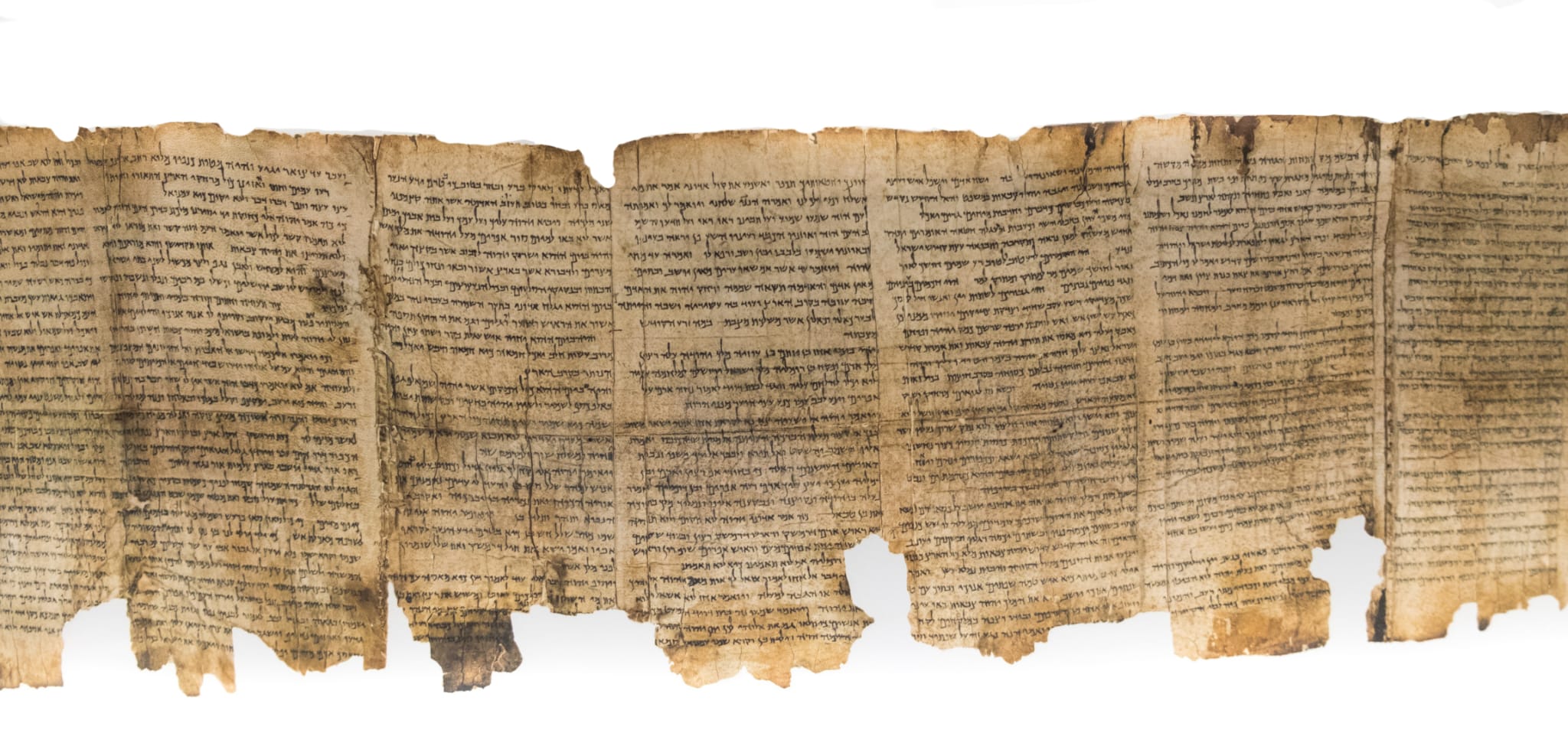
Among the scrolls recovered from Qumran Cave 1 was the Great Isaiah Scroll. It is the oldest complete copy of any book of the Hebrew Bible, dating to approximately 125 BCE. Seventeen sheets of parchment sewn together, stretching 7.34 meters — about 24 feet — containing all 66 chapters in 54 columns of Hebrew text.
When scholars compared it with the standard Hebrew text that had been copied by Jewish scribes through the Middle Ages, they found astonishing consistency. Despite a gap of more than a thousand years, the content was virtually identical. Minor spelling variations, occasional word differences, but the message was the same. The scribes had done their job with extraordinary faithfulness.
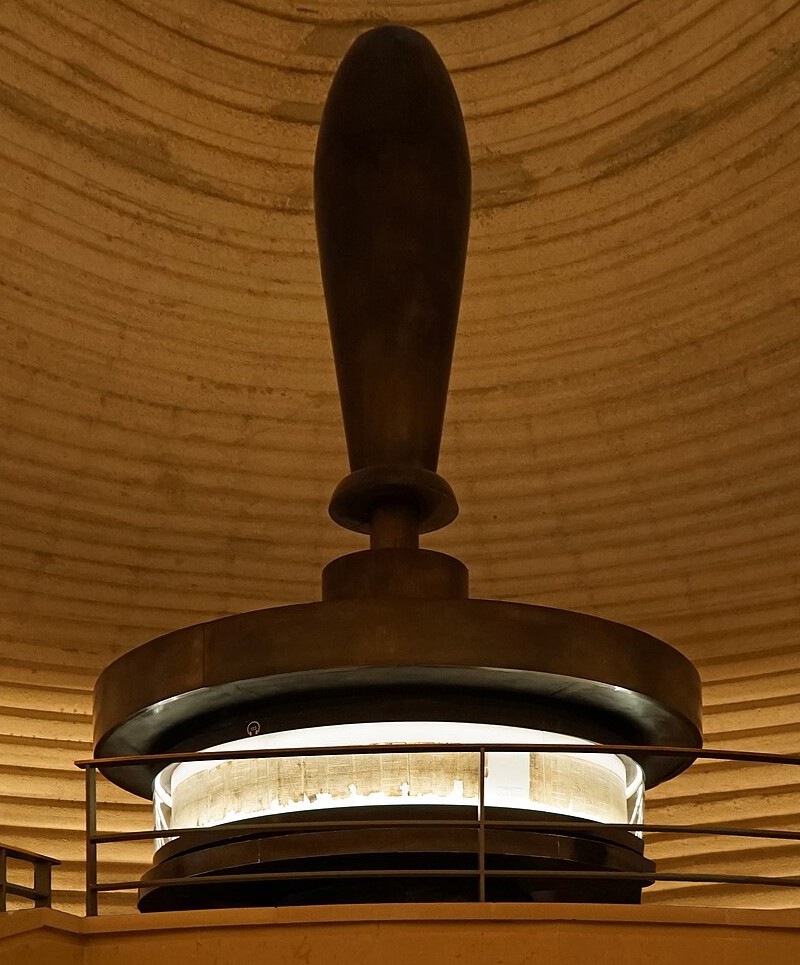
Today, the Great Isaiah Scroll is the centerpiece of the Shrine of the Book at the Israel Museum in Jerusalem. The building itself tells a story. Designed by architects Armand Bartos and Frederick Kiesler and opened in 1965, its white dome — shaped like the lid of the clay jars where the scrolls were found — rises against a black basalt wall. White and black: the “Sons of Light” against the “Sons of Darkness,” as described in another Dead Sea Scroll.
Inside, the lighting is kept low. The scroll sits in a circular case beneath the dome. You walk around it slowly, and there they are — Hebrew letters written by hand more than 2,100 years ago. The same alphabet used in Israel today. The prophet’s vision of peace, of justice, of comfort for the afflicted, right there on ancient parchment in front of you.
It is one of those moments in Israel where the distance between past and present collapses entirely.
The Israel Museum and the Shrine of the Book are highlights of our Jerusalem itineraries. Our guides bring the story of Isaiah and the Dead Sea Scrolls to life in a way that stays with you — connecting the ancient text to the city where tradition holds the prophet walked and spoke.
Whether you are a pilgrim, a history enthusiast, or a first-time visitor looking for meaningful experiences, we would love to help you plan your journey.
Contact us to start planning your trip today.
Contact Us
Related articles
Tours and Activities

Water Desalination in Israel: How a Desert Nation Became a Global Water Superpower
From Water Crisis to Water SecurityIsrael is one of the driest countries on earth. Over 60% of its territory is…

The Dead Sea Is Disappearing: What's Happening and Can It Be Saved?
The Lowest Place on Earth Is Getting LowerThe Dead Sea — the lowest point on the surface of the earth,…
The Desert Kingdom That Was Never Desolate: Israel and Egypt Through the Ages
The Desert Kingdom That Was Never Desolate: Israel and Egypt Through the Ages Egypt is often imagined as an endless…