



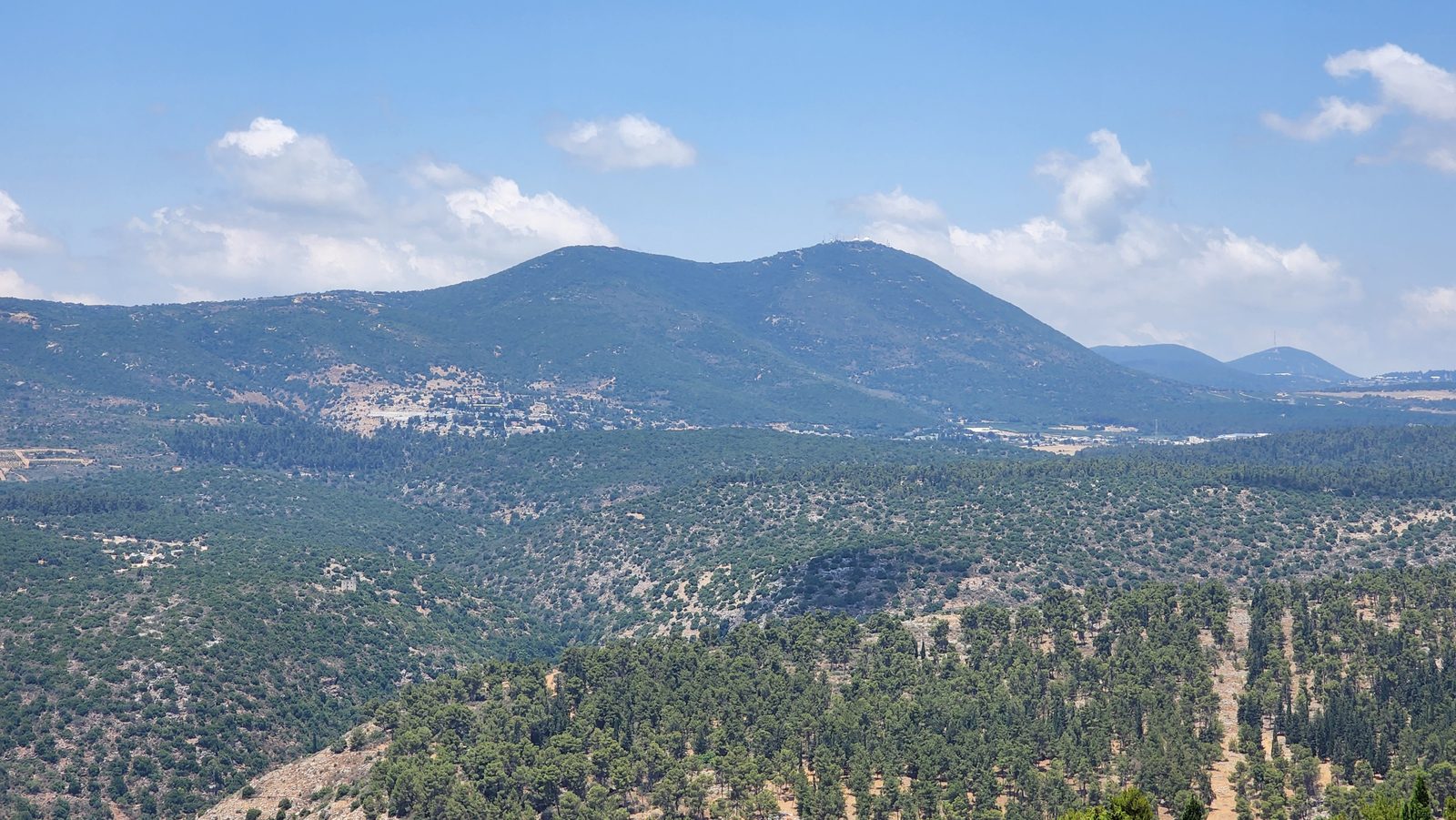
Mount Meron, at 1,208 meters above sea level, is the highest peak within Israel’s pre-1967 borders, the highest point in the Galilee and in Israel proper, excluding Mount Hermon in the north. The mountain sits at the eastern end of a ridge that includes three major summits: Har Adir (1,008m) to the west, Har Hiram (1,048m) in the center, and Meron itself at the eastern end. Together these peaks form the backbone of the upper Galilee, and the summit trail at Meron offers one of the finest short hikes in northern Israel.
Geography and Landscape
At 1,208 meters, Mount Meron stands apart from the rest of the Galilee in climate as well as altitude. The mountain receives significantly more rainfall than the surrounding lowlands, sometimes exceeding 1,000 millimeters per year, and the higher slopes occasionally see snow in winter. This extra moisture, combined with the elevation, creates ecological conditions found nowhere else in Israel. The vegetation transitions from the dense Mediterranean scrub of the lower slopes through a true montane forest near the upper ridgeline, a transition that botanical researchers consider unique within the country. The summit itself is an IDF military installation and is not open to the public, but a viewpoint just below the peak is accessible via marked hiking trails and provides a full panorama in every direction.
Flora: Israel’s Richest Botanical Area
The Har Meron Nature Reserve is recognized by botanists as the richest concentration of plant species in Israel. More than 800 plant species have been recorded within the reserve. The forest is dominated by Tabor oak and Atlantic pistachio, with ancient specimens that have stood for centuries on the upper slopes. In spring, the forest floor erupts with cyclamens, anemones, and rare orchids. One of the most celebrated residents is the Nazareth iris (Iris bismarckiana), found in only a handful of locations worldwide and at Meron in particular abundance. The mountain is the only place in Israel with a genuinely montane forest, a high-altitude woodland that feels more like the green mountains of Lebanon or Turkey than anything in the Israeli lowlands.
Fauna
The reserve supports a broader range of wildlife than most areas in northern Israel. Roe deer, reintroduced to the Galilee after a long absence, have re-established themselves on the forested slopes of Meron and can occasionally be spotted at dawn or dusk on the quieter trails. Wild boar are common throughout the forest. Wolves have been documented in the area, part of a wider recovery of the species across the Galilee. The Persian squirrel, the only squirrel species native to Israel, is a regular presence in the oak forests. Above the tree line, the thermal currents rising from the valleys make Meron an excellent site for raptors: short-toed snake eagles, honey buzzards, and Bonelli’s eagles have all been recorded in the reserve, and during migration seasons the skies above the summit can fill with soaring birds of prey.
Nature Reserve
The Har Meron Nature Reserve protects the largest continuous Mediterranean forest in Israel. The slopes are covered with ancient oak, Atlantic pistachio, and laurel trees, and in spring the forest floor erupts with wildflowers, including rare orchids and cyclamens. The reserve is managed by the Israel Nature and Parks Authority, which maintains the trail network and enforces protections on the endemic plant species. Entry to the reserve is free, and the trail infrastructure is well maintained year-round, though the upper trails can be muddy after winter rains and require appropriate footwear.
Hiking Trails and Best Seasons
Several marked trails pass through the reserve, ranging from easy forest walks to full-day ridge hikes. The summit trail is the most popular: a moderately challenging ascent of roughly 90 minutes through dense forest, emerging at a viewpoint just below the military installation at the peak. For a longer outing, the Nahal Meron trail descends into the stream valley below the western slopes, passing through some of the most impressive stretches of old-growth oak forest in the country. Meron also connects to the Nahal Amud trail system to the south, opening up multi-day possibilities that link the summit to Safed and eventually down to the Sea of Galilee. Spring is the best season for wildflowers, particularly March through May when the Meron iris blooms and the forest floor is carpeted in color. Autumn brings clear skies and the best long-distance visibility from the summit. Summer is manageable at altitude but hot on exposed sections. Winter hiking is possible on mild days but the upper trails can be icy.
The Views from the Summit
The panorama from the viewpoint near the Meron summit is one of the most comprehensive in Israel. On a clear day, most common in autumn and after winter rain, the view extends east across the Hula Valley to the Golan Heights and the dark profile of Mount Hermon rising above the plateau. To the south, the Sea of Galilee appears as a glittering blue oval set in its basin. To the west, on exceptional days, the Mediterranean coast is visible. The ridgeline of the Lebanese mountains is visible to the north. Safed sits on its hilltop to the southeast, close enough to make out the blue-domed buildings of the artists’ quarter. Few viewpoints in Israel compress so much geography into a single sight line.
Rabbi Shimon bar Yochai and Lag Ba’Omer
At the foot of Mount Meron lies the tomb of Rabbi Shimon bar Yochai (Rashbi), the 2nd-century sage to whom the Zohar, the foundational text of Kabbalah, is traditionally attributed. Each year on Lag Ba’Omer (the 33rd day of the Omer count between Passover and Shavuot), hundreds of thousands of pilgrims gather at the tomb for the largest annual pilgrimage event in Israel. Bonfires are lit on the mountainside, three-year-old boys receive their first haircuts in the traditional chalakah ceremony, and the singing and dancing continue through the night. The tradition holds that Lag Ba’Omer marks the anniversary of Rashbi’s passing, and the celebration reflects the Kabbalistic belief that his death was not a moment of mourning but of spiritual illumination. The nature reserve and the religious site are adjacent to one another, and many visitors combine a morning hike on the mountain with a visit to the tomb complex at Meron.
Visit with Hoshen Tours
Mount Meron combines naturally with the tomb of Rashbi, Safed, and the upper Galilee forests. Hoshen Tours includes it in hiking itineraries that showcase the natural beauty of Israel’s north, and in Kabbalah-themed programs that move between the mystical city of Safed, the tomb of Rashbi below the mountain, and the forest trails above.
Visitors exploring the upper Galilee often combine Mount Meron with nearby destinations such as Safed, Gush Halav, and Baram Synagogue, each offering its own distinctive perspective on the region’s layered history and landscape. A broader itinerary might also include The Ari – Rabbi Isaac Luria and Nahal Amud, both within easy reach and rich in their own right.
Every Hoshen Tours itinerary is private and fully customizable. Contact us to begin planning your journey through the upper Galilee.
Explore Our Tour Collection
Ready to experience Israel in true colors?
Plan Your TourPrivate tours designed around your interests, schedule, and pace.