



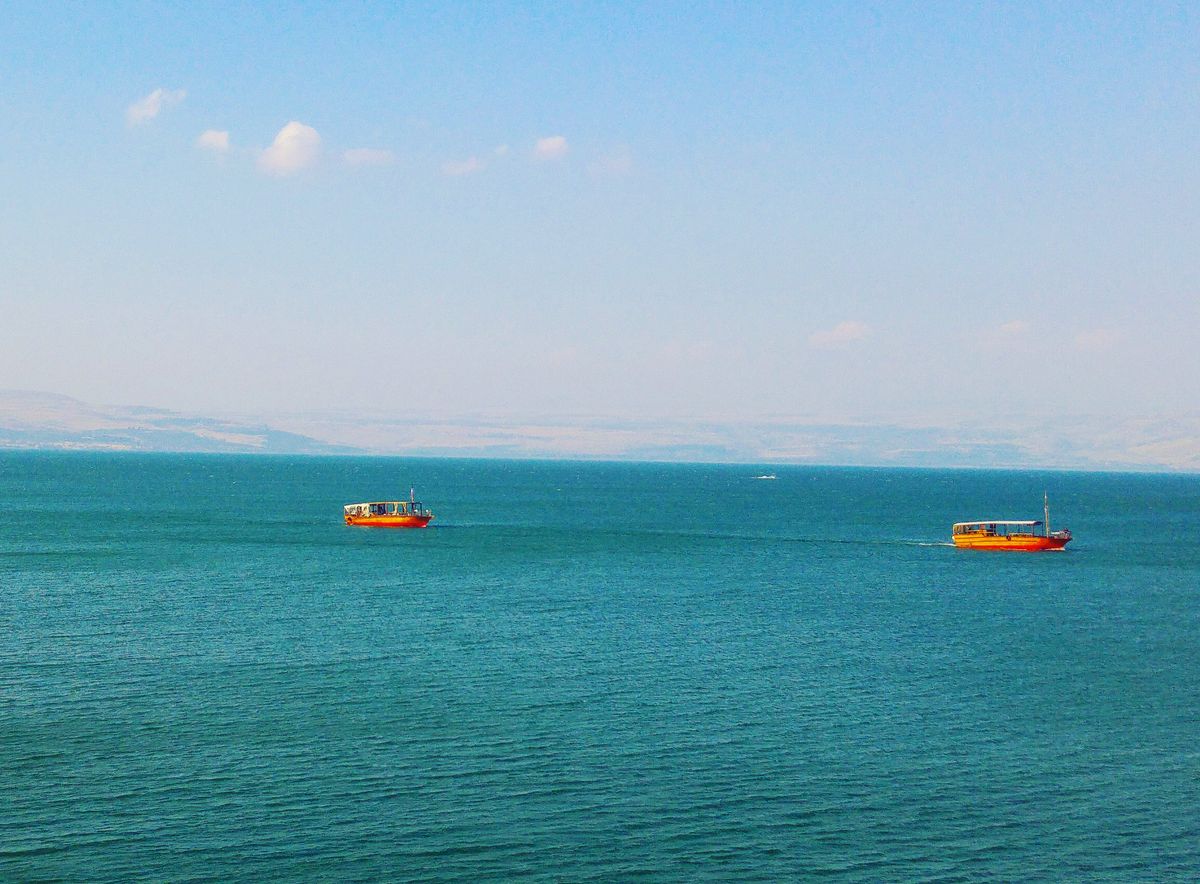
The Yigal Allon Center at Kibbutz Ginosar, on the northwestern shore of the Sea of Galilee, houses one of the most remarkable archaeological discoveries in Israel: a 2,000-year-old fishing boat found in the mud of the lake in 1986. The boat, dating to the 1st century CE, the time of Jesus and his fishermen disciples, is the only surviving vessel from the period when the Gospels describe Jesus calming the storm, walking on water, and calling fishermen to follow him. Sometimes known as the “Jesus Boat,” it offers an extraordinarily concrete link between the landscape of the Gospels and the world that produced them.
The Discovery of the Ancient Galilee Boat
In January 1986, a severe drought had lowered the water level of the Sea of Galilee to its lowest point in decades, exposing stretches of lakebed that had been submerged for centuries. Two brothers from Kibbutz Ginosar, Moshe and Yuval Lufan, were walking the newly exposed shoreline near the kibbutz when they noticed a shape in the mud that did not look natural. The brothers were amateur archaeologists who had spent years exploring the shoreline, and they recognized immediately that they were looking at the outline of an ancient boat. They reported the find to the Israel Antiquities Authority, and excavation began within days.
What followed was an extraordinary eleven-day rescue operation. The boat’s waterlogged wood was so fragile after two millennia in the mud that it could not be lifted directly. Archaeologists and volunteers from the kibbutz worked around the clock in the shallow water, carefully clearing the surrounding mud by hand while keeping the wood constantly wet. The hull was encased in a framework of steel pipes and fiberglass foam to hold it rigid, then flooded so it could be floated on a raft of buoyancy tanks to the museum just a few hundred meters away. At one point, rising lake levels threatened to swamp the operation entirely before the boat could be moved. The extraction was completed just in time.
The Jesus Boat
The media quickly dubbed the vessel the “Jesus Boat,” though there is no evidence connecting it to Jesus specifically. What is certain is that the boat dates to the 1st century CE, that it was used for fishing on the Sea of Galilee, and that it is exactly the kind of vessel described in the Gospels. Carbon-14 dating and analysis of pottery found in the mud alongside the hull placed its construction between roughly 100 BCE and 70 CE, squarely within the period of the New Testament. When Jesus said to Simon Peter and Andrew, “Come, follow me, and I will send you out to fish for people” (Matthew 4:19), they left boats like this one behind on the shore. According to the Gospels, when Jesus slept in the stern during a storm and the disciples woke him in terror, “He got up, rebuked the wind and said to the waves, ‘Quiet! Be still!’” (Mark 4:39), the boat that pitched in the waves was this size, this shape, this kind of vessel.
Twelve Types of Wood
Analysis of the boat revealed that it was built using twelve different types of wood, cedar, oak, jujube, hawthorn, willow, and others, suggesting that the builder used whatever materials were available, possibly recycling timber from older boats. This patchwork of wood types is itself a historical detail: it speaks to the modest means of Galilean fishermen and to the long working life a boat of this kind was expected to have, repaired again and again rather than replaced. The construction technique, using mortise-and-tenon joints, is consistent with Mediterranean boat-building traditions of the period. The boat could have been rowed by four oarsmen and carried a small sail, and had a capacity of approximately fifteen people, consistent with Jesus and his twelve disciples on the lake crossings the Gospels describe.
Conservation and the Museum
After extraction, the boat spent seven years undergoing conservation before it could be put on permanent display. The waterlogged wood was immersed in a large tank filled with a solution of polyethylene glycol (PEG), a wax-like polymer that slowly replaces the water in the cell walls of the wood and stabilizes the fibers as it hardens. The process required careful monitoring over years to ensure the wood dried without cracking or collapsing. When conservation was complete, the boat was moved to a purpose-built climate-controlled gallery at the Yigal Allon Centre at Kibbutz Ginosar, where it remains today. The museum also houses exhibits on the life of ancient Galilean fishermen and the history of the lake.
Visiting the Ancient Galilee Boat
The Ancient Galilee Boat is one of the most tangible connections to the Gospel world available anywhere in Israel. Visitors stand a few feet from a hull that working fishermen built and repaired by hand in the first century, on the same lake where the Gospels are set. Hoshen Tours visits the museum at Ginosar and tells the full story: the drought and the discovery, the eleven-day rescue, the years of conservation, and what the boat reveals about the lives of the men Jesus called from their nets. Seeing the vessel in person gives the lake crossings, the storms, and the fishing scenes of the Gospels a physical reality that no amount of reading can fully provide.
Visit with Hoshen Tours
Hoshen Tours includes the Ancient Galilee Boat Museum at Ginosar on Sea of Galilee itineraries, where a guide explains how this 2,000-year-old fishing vessel was discovered in the lake mud and what it reveals about daily life in the time of Jesus. Seeing the boat in person gives the Gospel accounts of lake crossings and fishing a physical reality that no reading can match. The museum pairs naturally with visits to Capernaum, Magdala, and the Mount of Beatitudes for a full day along the Gospel shore.
Visitors exploring the Galilee often combine Yigal Allon Museum with nearby destinations such as Sea of Galilee, Kinneret Cemetery, and Tabgha, each offering its own distinctive perspective on the region’s layered history and landscape. A broader itinerary might also include Capernaum and Tiberias, both within easy reach and rich in their own right.
Every Hoshen Tours itinerary is private and fully customizable. Contact us to begin planning your journey through the Galilee.
Explore Our Tour Collection
Ready to experience Israel in true colors?
Plan Your TourPrivate tours designed around your interests, schedule, and pace.