



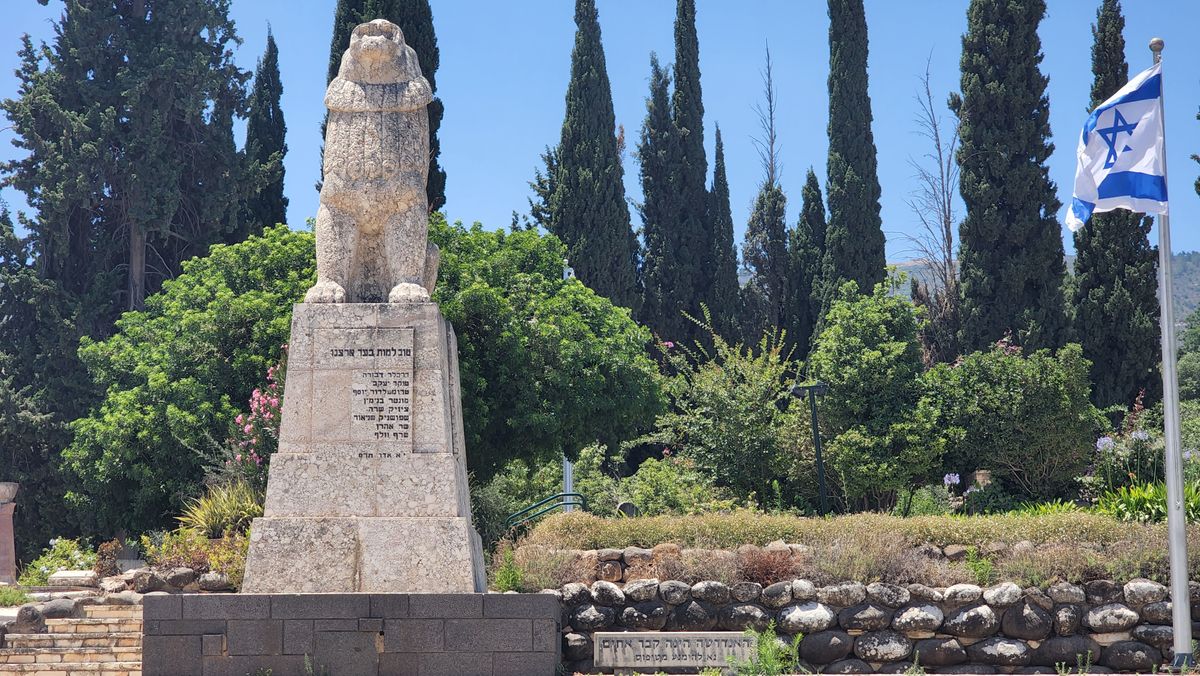
On March 1, 1920, eight Jewish defenders were killed at Tel Hai, a small agricultural outpost in the far north of the Galilee. The battle lasted only a few hours. The settlement was abandoned the next day. But what happened at Tel Hai reverberated far beyond its courtyard walls, shaping the way an entire generation thought about land, sacrifice, and the cost of building a state. The eight who died there are buried under a roaring stone lion that still looks out over the Hula Valley.
The Finger of the Galilee in 1920
The northern tip of the Galilee, known as the “finger of the Galilee,” was one of the most contested strips of land in the post-World War I Middle East. France and Britain were dividing the region between them as the Ottoman Empire collapsed, drawing borders with little regard for who lived there. The settlements of Tel Hai, Kfar Giladi, and Metula sat at the northernmost edge of this zone, isolated from the main body of Jewish settlement to the south, caught between French-administered Syria and the British Mandate taking shape to the south.
These communities were effectively on their own. Supply lines were uncertain, and neither the French nor the British could guarantee their security. The settlers debated whether to stay or evacuate. Into this situation came Yosef Trumpeldor, who had traveled north specifically to organize their defense.
Yosef Trumpeldor
Trumpeldor was already a legend before he arrived at Tel Hai. Born in Russia in 1880, he served in the Russian Imperial Army and fought in the siege of Port Arthur during the Russo-Japanese War of 1904 to 1905. He lost his left arm in combat there and, despite the wound, refused evacuation and continued to fight, earning the Cross of St. George and becoming one of the few Jews to hold officer rank in the Tsarist army.
After the war he became a committed Zionist, immigrated to Palestine, and helped organize the Zion Mule Corps that served with the British at Gallipoli. He returned briefly to Russia before making his way back in 1919. When reports reached him that the upper Galilee settlements were under pressure, he traveled north. He was thirty-nine years old when he arrived at Tel Hai.
March 1, 1920: The Battle
On the morning of March 1, 1920, a group of armed Arabs entered the Tel Hai courtyard, saying they were searching for French soldiers believed to be hiding in the settlement. The residents allowed them in. What happened next is disputed: a shot was fired, and within moments the courtyard became a firefight. Trumpeldor commanded the defense, continuing even after being shot in the hand. He was then shot in the stomach and carried to Kfar Giladi, where he died that evening. Eight defenders were killed. The survivors evacuated the following day.
The phrase attributed to Trumpeldor as his last words became the most famous sentence in Zionist history: “Tov lamut be’ad artzeinu” — “It is good to die for our country.” Whether he actually said this is debated; some accounts suggest his final words were a Russian curse. But repeated in memorial ceremonies for generations, the phrase took on a life of its own, becoming the motto of a movement that was building a state and understood that people would die doing so.
The Roaring Lion
In 1934, a monument was unveiled at the Tel Hai cemetery where the eight defenders are buried. The sculptor Avraham Melnikov created a large stone lion, approximately three meters tall, its mouth open and its gaze fixed across the Hula Valley. The image draws on the ancient symbol of the Lion of Judah, but the particular power of this monument comes from its placement: it stands over the graves of eight specific people who died defending a specific piece of ground, and visitors can read their names on the stones below. The Roaring Lion has become one of the most recognized national monuments in Israel, reproduced on stamps, textbooks, and commemorative items for generations.
The Courtyard Museum
The buildings of Tel Hai have been reconstructed and now house a museum dedicated to the battle and to the story of Jewish pioneering settlement in the upper Galilee. The original courtyard layout is preserved, and the exhibits include weapons, photographs, personal documents, and objects belonging to the defenders. The museum situates the battle within the post-World War I context of competing Mandatory powers, explaining how the fate of a few dozen settlers in a remote courtyard intersected with the redrawing of the entire Middle East.
Kfar Giladi
Directly adjacent to Tel Hai stands Kfar Giladi, a kibbutz founded in 1916 that survives to this day. It was to Kfar Giladi that the wounded Trumpeldor was carried after the battle, and it was the Kfar Giladi community that buried him and the other fallen defenders in the cemetery where the Roaring Lion now stands. The kibbutz maintained continuity through the violence of 1920 and the upheavals of the decades that followed. Visiting Tel Hai alongside Kfar Giladi makes clear that the story did not end with the battle: the settlement held, the community persisted, and the finger of the Galilee remained part of the country those eight defenders believed they were dying for.
Yom Tel Hai
The 11th of Adar is observed annually in Israel as Yom Tel Hai, a day of commemoration for the fallen of Tel Hai and for those who gave their lives in defense of the country before the establishment of the state. Schools hold ceremonies, youth movements march to the monument, and the Roaring Lion is decorated with wreaths and flags. The town of Kiryat Shmona, a few kilometers to the south, takes its name from the Hebrew word for eight, a reference to the eight who fell in 1920.
Visit with Hoshen Tours
Tel Hai is a powerful stop on any upper Galilee itinerary. Hoshen Tours pairs it with Metula, Tel Dan, and the pioneering story of the north.
Visitors exploring the upper Galilee often combine Tel Hai with nearby destinations such as Rosh Pina, Hula Valley, and Yesod HaMaala, each offering its own distinctive perspective on the region’s layered history and landscape. A broader itinerary might also include Metzudat Koach and Safed, both within easy reach and rich in their own right.
Every Hoshen Tours itinerary is private and fully customizable. Contact us to begin planning your journey through the upper Galilee.
Explore Our Tour Collection
Ready to experience Israel in true colors?
Plan Your TourPrivate tours designed around your interests, schedule, and pace.