



Sebastia (ancient Samaria, modern Sebastiyeh) was the capital of the Northern Kingdom of Israel for approximately 160 years, from the time of King Omri (880 BCE) until the Assyrian conquest in 722 BCE. The city, built on a commanding hilltop in the Samarian mountains, was one of the most magnificent royal cities in the ancient Near East, and its ruins span the Israelite, Hellenistic, and Roman periods.
The Biblical City: Capital, Prophets, and Conquest
King Omri, the founder of one of the most powerful Israelite dynasties, purchased the hill of Samaria and built his capital there: “He bought the hill of Samaria from Shemer for two talents of silver, and he built a city on the hill, calling it Samaria, after Shemer, the name of the former owner” (1 Kings 16:24). The hilltop location offered natural defenses on all sides and a commanding view of the surrounding valleys, making it an ideal site for a royal capital.
Omri’s son Ahab, who married the Phoenician princess Jezebel, expanded the city significantly and built the infamous “ivory house,” a palace decorated with carved ivory inlays: “As for the other events of Ahab’s reign, including all he did, the palace he built and adorned with ivory…” (1 Kings 22:39). Hundreds of ivory fragments were found in the excavations, confirming the biblical description. Archaeologists also uncovered the casemate walls of the Israelite acropolis, ashlar masonry of remarkable quality, and storage rooms containing ostraca (inscribed pottery) that shed light on the kingdom’s administration.
The Temple Connection
Samaria was the setting for the confrontation between the prophet Elijah and King Ahab over the worship of Baal. It was in Samaria that Jezebel established her temple to Baal, and it was from Samaria that Elijah challenged the king to the contest at Muhraka on Mount Carmel. The story of Naboth’s vineyard, in which Ahab and Jezebel murdered a man to steal his property, took place in nearby Jezreel (1 Kings 21:1): “Ahab said to Naboth, ‘Let me have your vineyard…’ But Naboth replied, ‘The Lord forbid that I should give you the inheritance of my ancestors’” (1 Kings 21:2-3). The prophets Elijah and later Elisha were active throughout the region of Samaria, making the city central to the prophetic narratives of the Books of Kings.
In 722 BCE, after a three-year siege, the Assyrians under Sargon II captured Samaria and exiled the population: “The king of Assyria captured Samaria and deported the Israelites to Assyria” (2 Kings 17:6). Sargon’s own inscriptions claim he deported 27,290 inhabitants. The Assyrians brought in foreign populations from Babylon, Cuthah, and other lands to replace the exiled Israelites, and the mixing of these populations with the remaining Israelites gave rise to the Samaritans. The fall of Samaria marked the end of the Northern Kingdom and became a defining moment in Israelite history.
Roman City
Herod the Great rebuilt Samaria as a Roman city and renamed it Sebastia (the Greek equivalent of Augustus, honoring the Roman emperor). His most ambitious project here was a massive temple dedicated to Augustus, set on a high podium at the western end of the acropolis. A broad monumental staircase led up to the temple platform, and portions of the steps, the podium walls, and column fragments are still visible today. The temple would have dominated the skyline, signaling Herod’s loyalty to Rome from miles away.
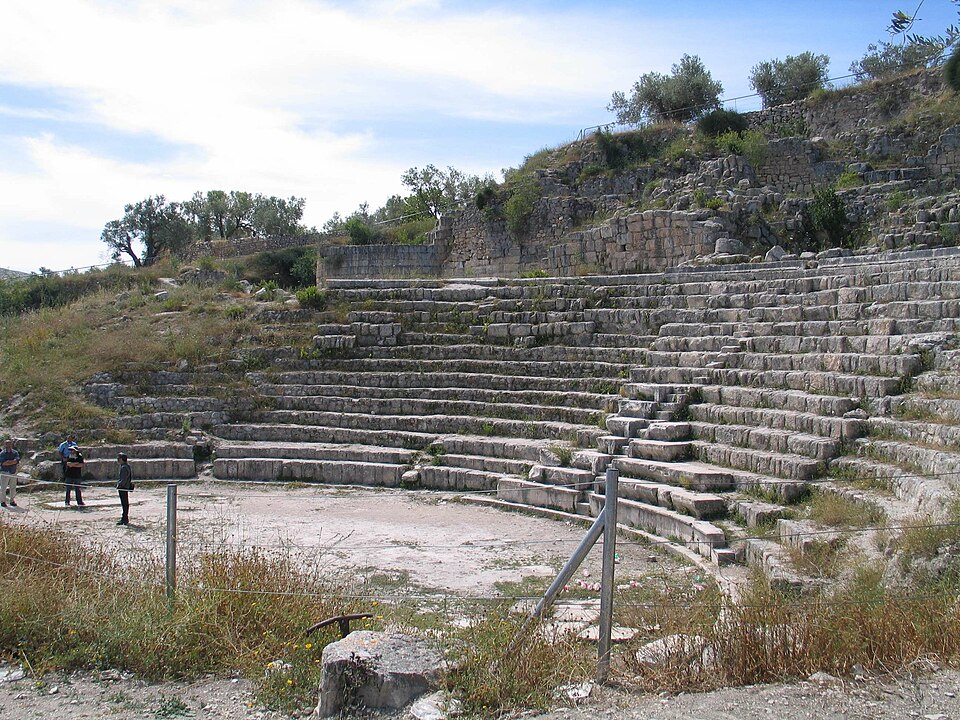
Below the acropolis, Herod laid out a colonnaded street stretching roughly 800 meters through the heart of the city. Dozens of columns still stand along portions of this street, giving visitors a vivid sense of the city’s Roman grandeur. At the center of the city stood a forum for commerce and public life, and the remains of a theater and a hippodrome (stadium) have been identified on the slopes below. Herod also surrounded the city with a new defensive wall punctuated by round towers, parts of which survive along the lower hillside. The Roman-era remains are the most visible features at the site today.
Sebastia was also the site of one of the most notorious acts in Herod’s reign. According to Josephus, Herod had his own sons Alexander and Aristobulus, the sons of his Hasmonean wife Mariamne, brought to Sebastia and strangled there after a trial for treason. The choice of Sebastia was deliberate: it was the city where Herod had married Mariamne years earlier, and the execution of her sons in the same city was a grim closing of the circle. The murder of his own children horrified even the Roman emperor Augustus, who reportedly said, “I would rather be Herod’s pig than his son.”
Sebastia in the New Testament
A Christian tradition dating to at least the 4th century holds that John the Baptist was buried at Sebastia. The historian Josephus records that Herod Antipas executed John at Machaerus, his fortress east of the Dead Sea (Antiquities 18.5.2), and the Gospels describe the execution at Herod’s banquet where Salome danced (Mark 6:17-29). However, early Christian writers reported that John’s disciples took his body and buried it in Samaria. By the Byzantine period, a church commemorating the burial stood at the site.
The Crusaders built a large cathedral here in the 12th century, dedicated to St. John the Baptist. The cathedral featured a nave with thick pillars, a semicircular apse at the eastern end, and fine Romanesque stonework typical of Crusader churches in the Holy Land. Today the ruins remain one of the most striking features of the village. During the Mamluk period, parts of the cathedral were incorporated into a mosque, and the minaret that now rises above the structure marks this transformation. Beneath the mosque, a crypt with a vaulted ceiling is still identified by local tradition as the place where John was buried. For Christian pilgrims, the combination of the Baptist tradition with the Old Testament stories of Elijah and Ahab makes Sebastia a site where the prophetic tradition spans both testaments.
Christian Heritage
After the stoning of Stephen in Jerusalem, the early Christians scattered throughout Judea and Samaria. The Book of Acts records that Philip, one of the seven deacons, “went down to a city in Samaria and proclaimed the Messiah there” (Acts 8:5). The city is traditionally identified with Sebastia. Philip performed healings and exorcisms, and “there was great joy in that city” (Acts 8:8). Among those who listened was Simon, a local magician who had amazed the Samaritans with his powers. Simon believed and was baptized, but when the apostles Peter and John arrived from Jerusalem and laid hands on the new believers, Simon offered them money to give him the same power. Peter rebuked him sharply: “May your money perish with you, because you thought you could buy the gift of God with money” (Acts 8:20). The word “simony,” meaning the buying or selling of religious privileges, comes from this story. For Christian pilgrims, Sebastia is the place where the Gospel first crossed the ethnic boundary between Jews and Samaritans, a turning point in the expansion of the early Church.
The Palestinian village of Sebastiyeh sits on and around the ancient hill, its stone houses built among the ruins. An archaeological park covers the upper portion of the site, where visitors walk among Israelite-era walls, Roman columns, and Crusader arches. From the hilltop, the view extends across the rolling Samarian hills in every direction, with terraced olive groves and agricultural fields filling the valleys below. On a clear day, the landscape stretches westward toward the coastal plain. The setting helps visitors understand why Omri chose this hill: it commands the surrounding terrain and controls the routes linking Shechem to the north with the roads leading to Shiloh and Beit El to the south.
The Site Today and Visiting with Hoshen Tours
Sebastia tells the story of a capital that rivaled Jerusalem. Hoshen Tours visits the Israelite acropolis, the Roman colonnades, and the Crusader cathedral ruins, connecting the stories of Omri, Ahab, Jezebel, and Elijah with the tradition of John the Baptist that has drawn Christian pilgrims here for centuries. Walking among the columns and ancient walls, with the Samarian landscape spread out below, brings 3,000 years of history to life in a single visit. Sebastia pairs naturally with nearby sites in the Samarian highlands, offering a full day of exploration in one of the most historically layered regions of the Holy Land.
Explore Our Tour Collection
Ready to experience Israel in true colors?
Plan Your TourPrivate tours designed around your interests, schedule, and pace.