



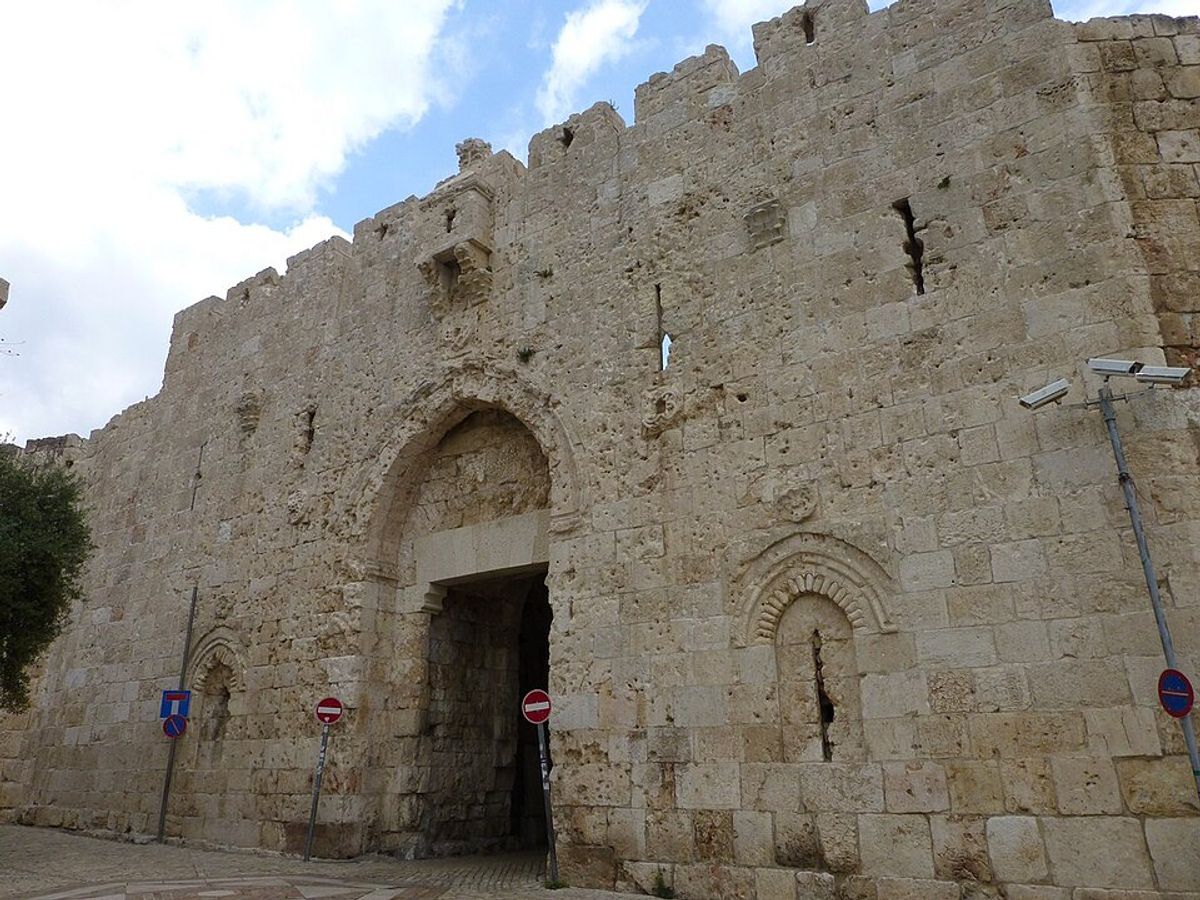
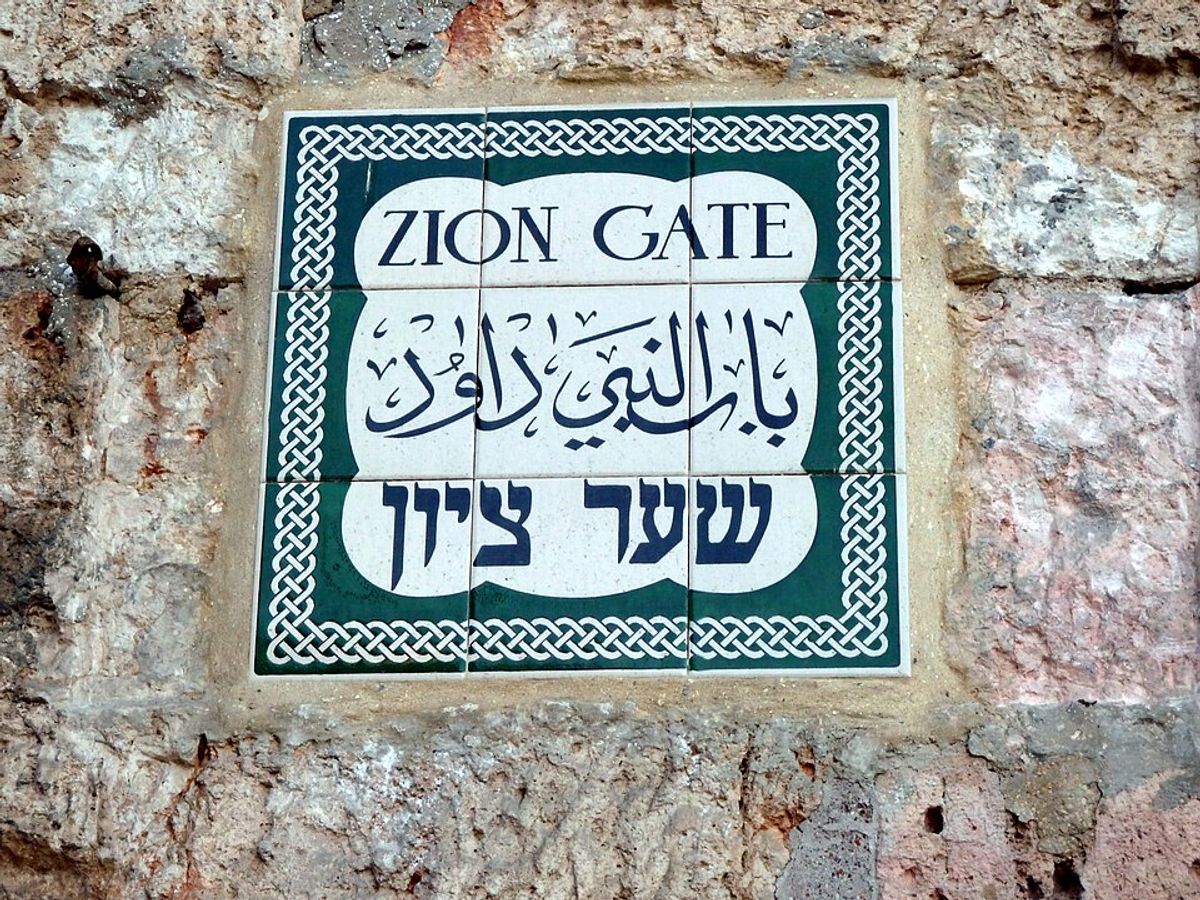
Zion Gate stands in the southern wall of Jerusalem’s Old City, connecting Mount Zion to the Armenian Quarter and the Jewish Quarter within. Built by Sultan Suleiman the Magnificent in 1540, it is one of seven open gates in the Old City walls. Its Arabic name, Bab an-Nabi Daud, means “Gate of the Prophet David,” reflecting the tradition of David’s Tomb on Mount Zion just outside. Its Hebrew name, Sha’ar Tzion, connects it to the hill that has carried the name Zion for over two thousand years. What makes this gate unlike any other in Jerusalem is its facade: the stone is pockmarked with hundreds of bullet holes and shell scars from the fierce battles of 1948, intentionally preserved as a silent memorial to one of the most dramatic and heartbreaking chapters in Jerusalem’s modern history.
Ottoman Construction
The current gate was completed in July 1540 as part of Suleiman the Magnificent’s comprehensive reconstruction of Jerusalem’s walls, a project that gave the Old City essentially the form it retains today. The gate was built slightly west of a medieval predecessor that had served as the southern terminus of the ancient Cardo Maximus during the Fatimid, Crusader, and Ayyubid periods. Like other Ottoman gates, Zion Gate features an L-shaped entrance passage, a defensive design that forced attackers to slow down and turn, exposing their unshielded side to defenders positioned above. An Arabic inscription above the pointed arch praises Sultan Suleiman and marks the year of construction. Above the entrance, a defensive balcony with arrow slits and embrasures allowed defenders to pour boiling oil or fire down on anyone attempting to force the gate.
The Gate Between Two Worlds
Zion Gate occupies a unique position in the geography of Jerusalem’s holy sites. Stepping through the gate from outside the walls, you leave Mount Zion, home to the Cenacle (the traditional site of the Last Supper), the Tomb of King David, and the Dormition Abbey, and enter the Armenian Quarter, with the Jewish Quarter a short walk beyond. This makes Zion Gate the hinge between two of Jerusalem’s most important sacred landscapes. For Christian pilgrims, it is the natural passage from the Upper Room to the Old City. For Jewish visitors, it is the gateway from King David’s traditional tomb to the Western Wall and the Jewish Quarter. The gate’s dual names capture this perfectly: Christians and Jews associate it with Zion, Muslims with the Prophet David.
The Battle for the Jewish Quarter, 1948
The story written on Zion Gate’s walls in bullet holes is the story of the battle for Jerusalem’s Jewish Quarter in May 1948. When the British withdrew on May 14, approximately 1,700 Jewish residents and 150 fighters were trapped inside the Old City, surrounded by Jordanian Arab Legion forces and irregular fighters. The Jewish Quarter was under siege, running out of food, water, and ammunition.
On the night of May 17–18, 1948, the Palmach launched Operation Shfifon (“Operation Viper”), a desperate attempt to break through Zion Gate and relieve the besieged quarter. The operation was commanded by David “Dado” Elazar, who would later become the IDF’s ninth Chief of Staff, with Uzi Narkiss leading a diversionary force. At 2:40 AM, two combat engineers detonated 40 kilograms of explosives against the massive iron gate. The blast was so powerful that witnesses reported the sky turning red over the Old City. The gate collapsed, and Palmach fighters surged through the breach into the Jewish Quarter.
For a few hours, the connection held. Supplies were rushed in and wounded evacuated out. But the fighters who had taken positions near the gate were so exhausted that some fell asleep at their posts despite the ongoing battle. Promised reinforcements never arrived. By morning, Narkiss informed the Jerusalem district commander David Shaltiel that the Palmach could not hold the position and would have to withdraw. Zion Gate fell back into Arab Legion hands.
Nine days later, on May 28, 1948, the Jewish Quarter surrendered. Approximately 1,200 Jewish residents were escorted out of the Old City by Jordanian legionnaires, the end of one of the longest continuous Jewish presences in the Old City, stretching back nearly two thousand years. For the next nineteen years, under Jordanian rule, Zion Gate remained closed, and no Jew could enter the Old City.
1967 and the Return
On June 7, 1967, during the Six-Day War, Israeli paratroopers entered the Old City primarily through the Lions’ Gate on the eastern wall. But Zion Gate, too, saw action that day, and additional bullet holes and shell marks were added to its already scarred facade. The gate was reopened, and for the first time in nineteen years, Jews could once again pass through it into the Jewish Quarter. Uzi Narkiss, who had been forced to retreat from this very gate as a young Palmach officer in 1948, returned in 1967 as the general commanding the Central Command. He later described the 1948 withdrawal as the deepest regret of his life.
The Wounded Gate
Zion Gate is sometimes called the “Wounded Gate.” The bullet holes and shell scars that cover its exterior have been intentionally preserved through every restoration. Some bullets remain lodged in the stone. The pockmarked facade serves as a physical memorial that requires no plaque and no explanation, the stones themselves tell the story of the battle, the loss, and the return. For visitors who have just seen the Cenacle and David’s Tomb on Mount Zion, passing through Zion Gate’s battle-scarred arch into the Old City is a passage through history itself: from the ancient traditions of the Last Supper and Israel’s greatest king, through the bullet-riddled testimony of a modern war, and into the living Old City beyond.
Visit with Hoshen Tours
Zion Gate, with its bullet-scarred stones from the 1948 battle for the Jewish Quarter, is the gateway between Mount Zion and the Old City. Hoshen Tours pauses here to tell the story of the Palmach fighters who broke through these walls, then continues to the Cenacle and Dormition Abbey outside the gate, or into the Jewish Quarter within. Below, the Valley of Hinnom drops away, and the Holocaust Chamber sits just steps from the gate on Mount Zion.
Explore Our Tour Collection
Ready to experience Israel in true colors?
Plan Your TourPrivate tours designed around your interests, schedule, and pace.