



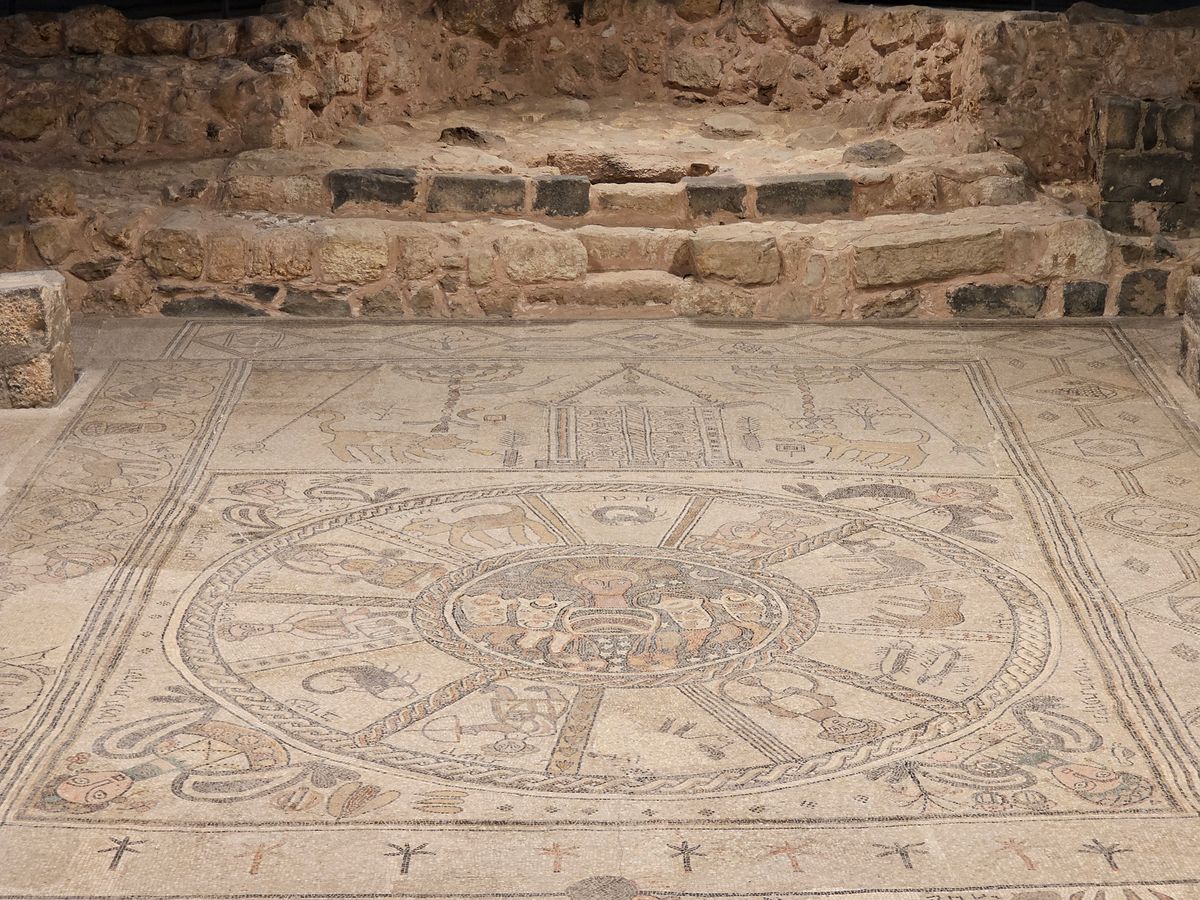
The ancient synagogue at Beit Alpha, at the foot of Mount Gilboa in the Jordan Valley, contains one of the most famous mosaic floors in Israel: a large, colorful zodiac wheel surrounded by the four seasons, with the sun god Helios at the center driving a chariot pulled by four horses. The mosaic, dating to the 6th century CE, shocked the archaeological world when it was discovered in 1928, because it appeared to violate the biblical prohibition against graven images. It remains one of the most important and most debated works of art from the ancient Jewish world.
The 1928 Discovery by Kibbutz Heftziba – Beit Alpha Synagogue
The synagogue was discovered in 1928 by members of Kibbutz Heftziba while digging an irrigation channel. The mosaic floor, remarkably well preserved, was excavated by the archaeologist Eleazar Sukenik (the father of Yigael Yadin, who would later excavate Masada). The discovery transformed understanding of ancient Jewish art and worship, demonstrating that Jewish communities in the Byzantine period were far more comfortable with figurative art than previously assumed.
Three Panels
The mosaic floor is divided into three panels, each telling a different story:
The Binding of Isaac (bottom panel): Abraham holds a knife, Isaac is bound on the altar, the ram is caught in the thicket, and a hand reaches from heaven with the command “Do not lay a hand on the boy” (Genesis 22:12). The scene is labeled in Hebrew, and the naive, almost childlike style of the figures gives the mosaic its distinctive charm. Two young men hold the donkey that Abraham rode to Mount Moriah. The fire for the sacrifice burns beside the altar. The entire scene is rendered with a directness that makes it immediately readable, even after 1,500 years.
The Zodiac Wheel (central panel): The twelve signs of the zodiac are arranged in a circle around Helios (the Greek sun god), who drives a chariot pulled by four horses. Each zodiac sign is labeled in Hebrew. The four seasons (depicted as women) occupy the corners, each labeled with the Hebrew name of the season. This is the most controversial element of the mosaic: a pagan sun god in the center of a Jewish synagogue floor.
The Torah Ark (top panel): Nearest to where the actual Torah ark stood, the mosaic depicts a Torah ark flanked by two seven-branched menorot (candelabra), shofars (ram’s horns), lulavim (palm branches), etrogim (citrons), and incense shovels. This panel is purely Jewish in its symbolism, with no pagan elements, and it represents the sacred objects of Jewish worship.
Figurative Art in Ancient Synagogues
How could a Jewish synagogue contain images of Helios, zodiac signs, and human figures? By the Byzantine period (4th-7th century CE), the ancient threat of paganism had faded. Jewish communities reinterpreted these images through their own lens: the zodiac became a representation of the Hebrew calendar and the agricultural seasons, and Helios at the center symbolized God’s power over nature rather than a pagan deity. Figurative art in synagogues was a way for prosperous Jewish communities to express their culture and their faith in visual form. This openness did not last forever, but the mosaics at Beit Alpha, Maon, Zippori, and Huqoq are windows into a period when Judaism expressed itself visually with a freedom that would surprise most modern observers.
A Synagogue Beneath a Kibbutz Field
The synagogue at Beit Alpha is built in the basilica plan, the standard architectural form for synagogues (and churches) in the Byzantine period. The building consists of a central nave flanked by two side aisles, separated by rows of columns. The entrance is from the north, and the Torah ark niche is in the southern wall, oriented toward Jerusalem. The basilica design, borrowed from Roman public architecture, gave the synagogue a sense of grandeur and formality, with the mosaic floor as the visual centerpiece of the central nave. The same basilica plan was used by Christian churches throughout the Byzantine world, and the fact that both Jews and Christians adopted the same architectural form for their houses of worship reflects the shared cultural world they inhabited.
Folk Art, Not Fine Art
The Beit Alpha mosaic is famous not only for its content but for its style. Unlike the refined, naturalistic mosaics at Zippori, the Beit Alpha mosaic is executed in a flat, folk-art style that is closer to children’s illustration than to classical art. The figures are simplified, the proportions are naive, and the details are charming rather than sophisticated. Scholars debate whether this reflects the skill level of the artists (perhaps local craftsmen rather than trained mosaicists) or a deliberate aesthetic choice. Either way, the folk-art quality of the Beit Alpha mosaic gives it a warmth and accessibility that more polished works lack. The inscription on the floor names the artists: Marianos and his son Hanina.
The Greek and Aramaic Inscription
A Greek and Aramaic inscription on the floor records that the mosaic was made “during the reign of Emperor Justin” (either Justin I, 518-527 CE, or Justin II, 565-578 CE) and names the donors and artists. The bilingual inscription reflects the multilingual world of Byzantine-era Jews, who used Hebrew for prayer, Aramaic for daily life, and Greek for official and commercial purposes.
Visit with Hoshen Tours
The zodiac mosaic at Beit Alpha is one of the most famous in the country. Hoshen Tours pairs it with the warm springs at Gan HaShlosha, the Crusader fortress at Belvoir Castle, the pioneering kibbutz at Beit HaArava, and the remarkable story of Sde Eliyahu and Bio Bee.
Explore Our Tour Collection
Explore this site and 65 more in Sacred Steps in the Holy Land
225 pages · The Life, World, and Footsteps of Jesus · Maps, photos, and Scripture references
Ready to experience Israel in true colors?
Plan Your TourPrivate tours designed around your interests, schedule, and pace.