



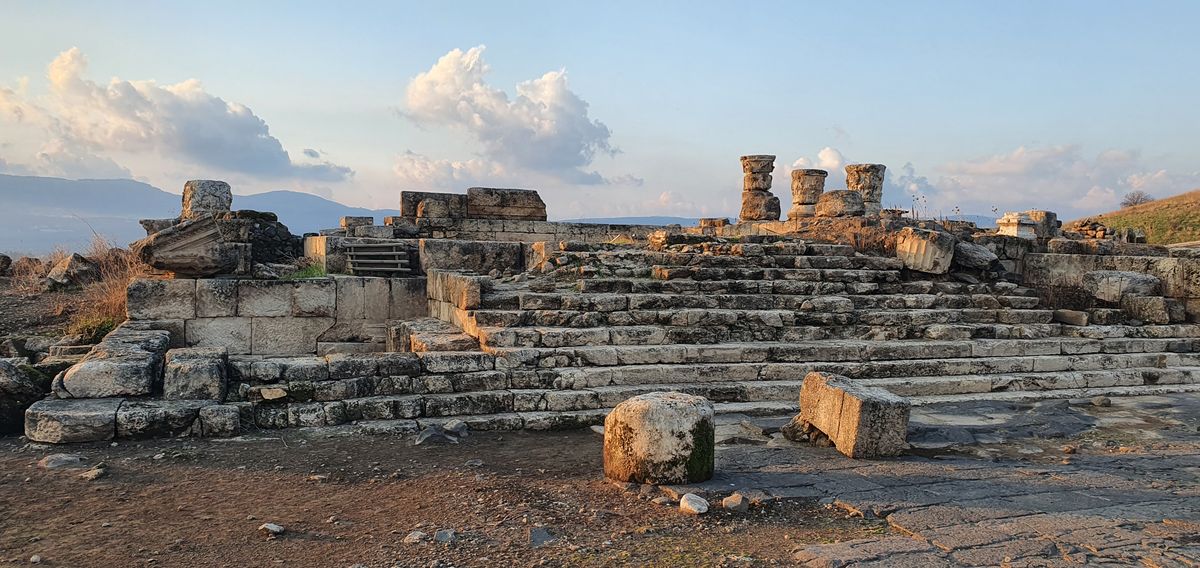
Khirbet Omrit (Horvat Omrit) is the ruins of a monumental Roman temple at the southwestern foot of the Golan Heights, near the ancient road from the Galilee to Banias (Caesarea Philippi). The temple, built by Herod the Great in the late 1st century BCE, was dedicated to the Roman Emperor Augustus and is one of the best examples of Herod’s program of building pagan temples to honor his Roman patron, a practice that made him hated by his own people but secured his position with Rome.
Herod and Augustus
Herod the Great owed his throne to Rome. Augustus (then Octavian) confirmed Herod as king of Judea, and Herod repaid the debt with a building program that honored the emperor across his kingdom. He built Caesarea Maritima and named it after Augustus. He rebuilt Samaria as Sebastia (the Greek equivalent of Augustus). And he built temples to Augustus at several locations, including Omrit, where a grand temple rose at the crossroads leading to the pagan sanctuary at Banias.
The irony was not lost on Herod’s Jewish subjects. The king who rebuilt the Temple in Jerusalem on a scale that amazed the ancient world was simultaneously building pagan temples to a living man who claimed to be divine. This contradiction, the ability to serve both God and Caesar, was Herod’s political genius and his moral failure.
Herod’s Temple to Augustus
Excavations at Omrit, led by J. Andrew Overman of Macalester College, uncovered a monumental temple complex built in three phases. The earliest phase, dating to Herod’s reign, was a substantial stone temple on a raised podium, oriented toward the south. A second, larger temple was built over the first, possibly by Herod’s son Philip (who ruled the region and built nearby Caesarea Philippi). A third phase added a large temenos (sacred courtyard) with colonnades. The architectural quality is high, with finely carved Corinthian capitals, molded cornices, and ashlar masonry that reflect the best Roman provincial architecture.
Identifying the Builder
The historian Josephus records that when Augustus visited Syria in 20 BCE, Herod “built him a very beautiful temple of white stone in the territory of Zenodorus, near the place called Paneion” (Antiquities 15.363). Paneion is Banias, and the territory of Zenodorus corresponds to the region where Omrit stands. The identification of Omrit with the temple Josephus describes is widely accepted, though not proven beyond doubt.
Christian Period
In the Byzantine period, the pagan temple was converted into a church, as happened at many pagan sites across the Roman world. The temple walls were reused, Christian symbols were added, and the building served a new faith. The transition from Augustus worship to Christian worship, visible in the archaeology, mirrors the larger transformation of the Roman Empire from paganism to Christianity.
Omrit sits at a strategic crossroads where the road from the Galilee climbs toward the Golan plateau, with views of the Hula Valley, Tel Dan, and the slopes of Mount Hermon. The site is unrestored and undeveloped, which gives it an atmospheric, off-the-beaten-path quality that contrasts with the more developed sites in the area.
Visit with Hoshen Tours
Omrit tells the story of Herod’s double life: Temple builder in Jerusalem, pagan temple builder everywhere else. Hoshen Tours visits the site on the way to Banias and connects the two Herodian sites into a single narrative of power, religion, and political survival.
Visitors exploring the Golan Heights often combine Omrit with nearby destinations such as Banias, Tel Saki, and Hula Valley, each offering its own distinctive perspective on the region’s layered history and landscape. A broader itinerary might also include Mount Hermon and Road to Damascus, both within easy reach and rich in their own right.
Every Hoshen Tours itinerary is private and fully customizable. Contact us to begin planning your journey through the Golan Heights.
Ready to experience Israel in true colors?
Plan Your TourPrivate tours designed around your interests, schedule, and pace.