



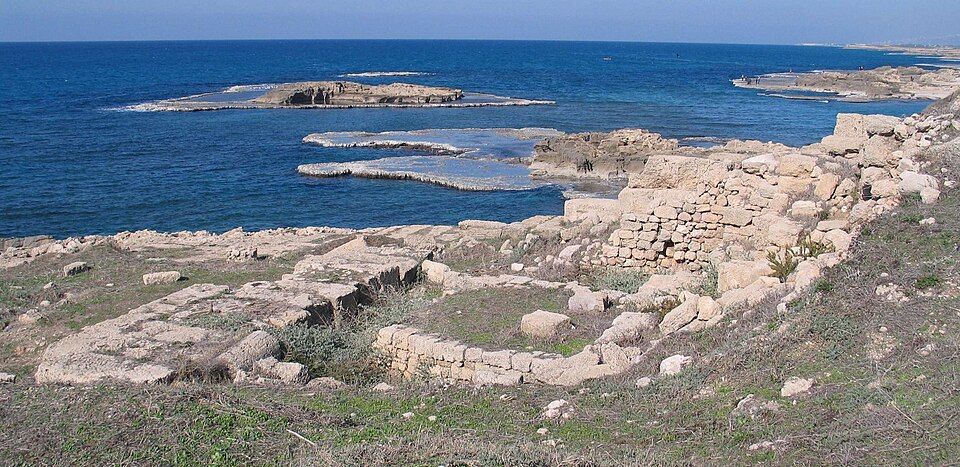
 Tel Dor is an ancient port city on the Mediterranean coast south of Haifa, one of the most important maritime sites in Israel. Occupied for over 3,000 years, from the Late Bronze Age through the Crusader period, its harbor served Canaanites, Sea Peoples, Phoenicians, Israelites, Greeks, and Romans. Set on a promontory with natural anchorages on both sides, Dor pairs deep archaeological significance with one of the most beautiful beaches on the Israeli coast.
The Sea Peoples and the Story of Wenamun
Dor was settled by the Tjeker, one of the Sea Peoples groups who swept through the eastern Mediterranean around 1200 BCE, toppling empires and reshaping the ancient world. The Tjeker held Dor well into the eleventh century BCE, and we know this not only from archaeology but from the Egyptian tale of Wenamun, one of the most vivid documents to survive from antiquity.
Wenamun was an Egyptian priest sent around 1076 BCE to buy cedar from Lebanon for the sacred barge of the god Amun. When his ship put in at Dor, one of his own sailors robbed him of his payment silver. He complained to Beder, the prince of Dor, but the prince was polite and unhelpful: the robber was Wenamun’s own crew, not a Tjeker citizen, so Dor bore no responsibility. The episode captures exactly how far Egyptian authority had collapsed. An official of a great temple could be robbed in a foreign port with no recourse whatsoever. Wenamun’s account is one of the most important texts for understanding the transition from the Bronze Age to the Iron Age, and Dor sits at its center.
Israelite Dor: Solomon, Manasseh, and Purple Dye
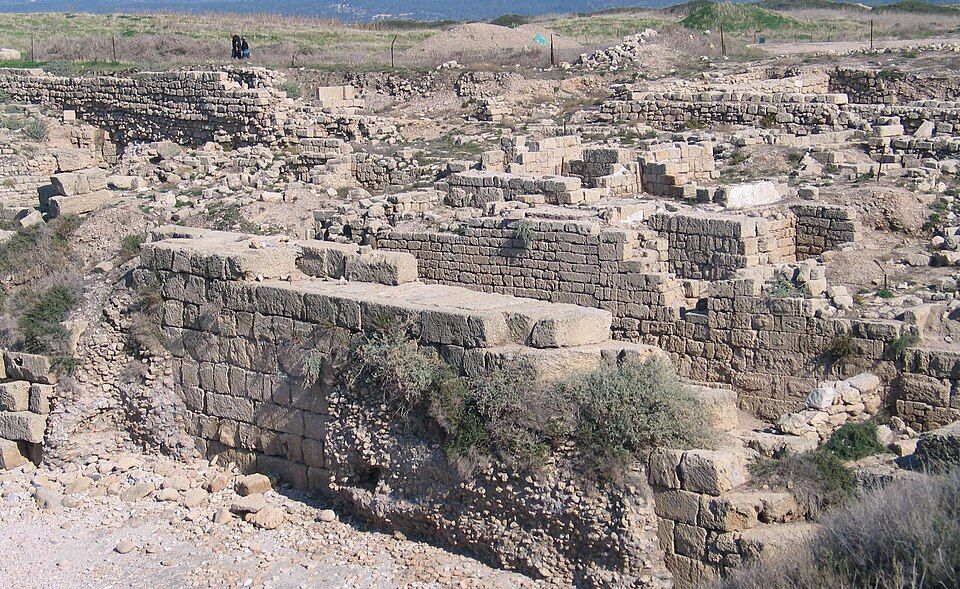 Dor passed into the Israelite orbit during the early Iron Age, though the city retained much of its Canaanite and Phoenician character. The Bible records that Dor was assigned to the tribe of Manasseh, but notes a telling qualification: the Israelites could not drive out the Canaanite inhabitants (Judges 1:27). Under King Solomon, Dor became an administrative hub and the capital of one of his twelve supply districts, and its governor, Ben-Abinadab, was married to Solomon’s daughter Taphath (1 Kings 4:11), a deliberate policy of tying important port cities to the royal family.
Dor was also a major production center for argaman, the precious purple dye extracted from murex sea snails. This dye, famous throughout the ancient Mediterranean as the royal purple of kings and priests, was produced at coastal sites like Dor and the Phoenician city of Tyre in Lebanon, from which it gets its common English name, Tyrian purple. A related dye, tekhelet, the sacred blue produced from the same family of sea snails, was used for the thread of blue (ptil tekhelet) on the fringes of the Jewish prayer shawl (tallit) and featured prominently in the vestments of the High Priest in the Temple in Jerusalem.
Dor is one of the sites most closely associated with the ancient production of both dyes. Excavations uncovered large deposits of crushed murex shells. In antiquity this dye was reserved for royal and priestly garments and was worth more than gold by weight. Its production fits Dor’s Phoenician identity well: the very name “Phoenician” may derive from the Greek word for purple (phoinix). Among the notable discoveries are gold and silver jewelry hoards, Egyptian-style figurines, Phoenician inscriptions, carved ivory objects, and an extensive ceramic collection spanning multiple cultures and centuries.
An Ancient Harbour City
The natural harbors at Dor, protected by offshore islands and reefs, made it one of the best anchorages on the Levantine coast. The geography created sheltered coves on both sides of the promontory, allowing ships to find safe anchorage regardless of wind direction. Underwater surveys by the University of Haifa’s Leon Recanati Institute for Maritime Studies have documented dozens of shipwrecks spanning the Bronze Age to the Ottoman period, along with submerged harbor infrastructure, stone anchors, and quay structures mapped using multi-beam sonar and 3D photogrammetry. When Herod built his artificial harbor at Caesarea 15 kilometers to the south, Dor’s importance declined, but for two thousand years before Caesarea existed, Dor was the dominant port on this stretch of coast.
Hellenistic and Roman Dora
Under the Hellenistic kingdoms that followed Alexander the Great, Dor was renamed Dora and refounded as a Greek-style polis, issuing its own coins. The Seleucid king Antiochus VII besieged Dora in 138 BCE during his campaign against the usurper Tryphon, who had taken refuge in the city, an episode recounted in the First Book of Maccabees. Under Roman rule the city functioned as a provincial town, gradually overshadowed by Caesarea. The Roman aqueduct that once carried fresh water from the Crocodile River south to Caesarea passed through the coastal lowlands just inland from Dor; its well-preserved channel can still be walked at Nahal Taninim. Roman-period finds include pottery, coins, and inscriptions documenting a lively if secondary settlement, and the tell remained occupied into the Crusader period.
Decades of Excavation
Tel Dor has been excavated continuously for decades, led largely by the Hebrew University of Jerusalem. The occupation sequence runs from the Middle Bronze Age through the Crusader period, and each layer preserves a different chapter: Canaanite city planning, Tjeker Iron Age occupation, Israelite administrative buildings, Phoenician harbor installations, Hellenistic urban structures, and Roman domestic and commercial remains. The depth and continuity of the sequence make Dor unusually valuable for understanding how coastal cities evolved across the great transitions of antiquity.
The Beach and Setting
The beach at Dor (Tantura) is one of the finest on the Israeli coast: a long crescent of sand with shallow, protected water, backed by archaeological remains and the kurkar (sandstone) ridge. The coves around the tel are sheltered and calm, with clear water excellent for snorkeling. You can spend the morning walking the tell and the afternoon in the water above the ancient harbor. Just to the north, the wild and largely undeveloped stretch of Habonim Beach extends along the same Carmel coastline, offering sea caves, tidal pools, and a nature reserve. The landscape makes the history legible. You can see immediately why people chose to settle here, and why they kept coming back.
Visit with Hoshen Tours
A visit to Tel Dor pairs beautifully with nearby destinations along your route. Consider combining it with a stop at Caesarea or Nahal Taninim, both just a short drive away. Many travelers also enjoy exploring Habonim Beach and Caesarea Aqueduct on the same day, while Ramat HaNadiv offers another worthwhile addition to your itinerary. Your Hoshen Tours guide will craft a seamless route that brings each destination to life with expert commentary and insider knowledge.
Explore Our Tour Collection
Ready to experience Israel in true colors?
Plan Your TourPrivate tours designed around your interests, schedule, and pace.