



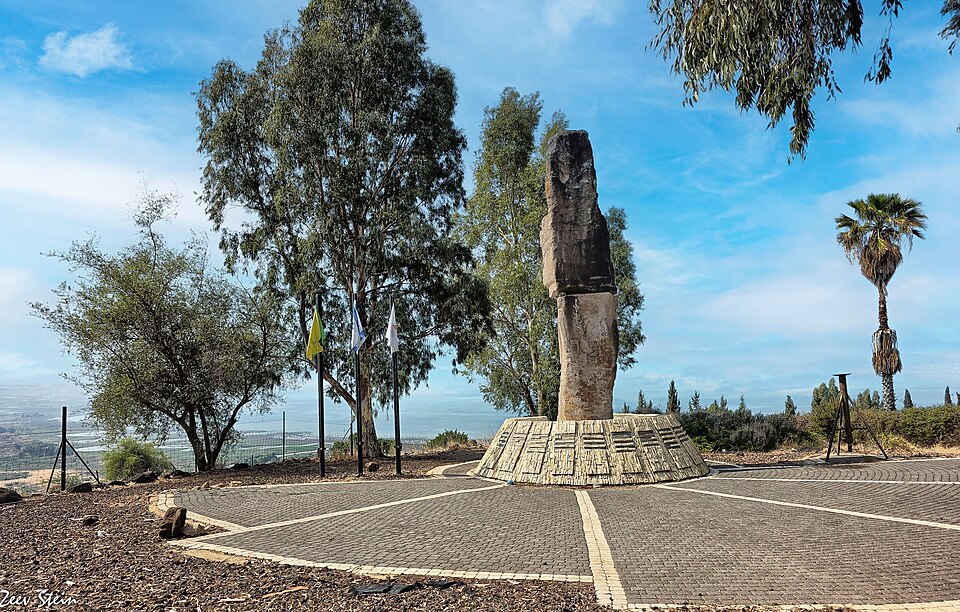
Standing on the basalt ridge north of the Sea of Galilee, Tel Motilla commands one of the most sweeping panoramas in the Upper Galilee. From this hilltop you can see the shimmering surface of the Kinneret far below, the winding course of the Jordan River, and the dramatic cliffs of the Golan Heights rising to the east. It is a place where landscape and memory intersect — a site that has served as a strategic lookout for millennia and, in modern times, became the stage for one of Israel’s most painful early battles. Today, Tel Motilla draws visitors who come for the breathtaking views, the moving memorial, and the chance to stand where history left an indelible mark on the young nation.
A Strategic Hilltop Through the Ages
Tel Motilla sits on the Korazim Plateau, a volcanic basalt tableland that stretches between the Upper Galilee highlands and the northern shore of the Sea of Galilee, near the moshav of Almagor. The name “tel” in Hebrew refers to an artificial mound formed by layers of accumulated settlement, and hills in this region have served as natural lookout points and defensive positions since antiquity. The Korazim Plateau itself is rich in archaeological heritage — the ancient village of Korazin, mentioned in the New Testament, lies just a few kilometers to the south. While Tel Motilla has not been the subject of major archaeological excavation, its commanding position above the Jordan Valley and the demilitarized zone that once separated Israel and Syria made it a site of enormous strategic importance in the modern era. The basalt terrain here is rugged and unforgiving, and anyone who walks among these dark volcanic rocks quickly understands why controlling these heights mattered so deeply.
The Battle of Tel Motilla, May 1951
In early May 1951, just three years after the founding of the State of Israel, a five-day battle erupted at Tel Motilla that would leave a lasting scar on the nation’s collective memory. Following the 1949 armistice agreements, the area east of the Jordan River and the Sea of Galilee was designated a demilitarized zone, where military activity was forbidden. In late April 1951, Syrian soldiers entered this zone in civilian clothing and seized three hilltop positions, including Tel Motilla, that overlooked the road connecting Tiberias to the north. The Israel Defense Forces launched a counterattack to dislodge them, but the fighting proved far more costly than anticipated.
Many of the Israeli soldiers were recent immigrants who had limited Hebrew proficiency and had not yet completed full military training. The harsh basalt terrain made rapid movement nearly impossible, and the troops faced severe shortages of ammunition and water. Over five grueling days — from May 2 to May 6 — forty-one Israeli soldiers lost their lives and more than seventy were wounded. The battle ended only after Israeli Air Force aircraft conducted low-altitude passes over the Syrian positions, prompting a withdrawal. The Battle of Tel Motilla is remembered as one of the most difficult engagements of Israel’s early years.
The Memorial at Moshav Almagor
In 1997, a striking memorial was dedicated at Tel Motilla to honor the forty-one soldiers who fell in the 1951 battle. Designed by architect Yehuda Yahav, the monument stands at the edge of Moshav Almagor and consists of two tall, dark basalt columns rising from a sloping circular base — an austere and powerful tribute that mirrors the rugged landscape around it. Metal plaques bear the names of each fallen soldier, and an eternal flame fashioned from the base of a mortar barrel burns at the site. Surrounding the memorial is a shaded eucalyptus grove with benches, creating a quiet space for reflection. A large interpretive panel tells the story of the battle and the broader history of the Golani Brigade’s operations in the region. The site is freely accessible and makes for a deeply moving stop, particularly for those interested in Israel’s modern history and the human cost of its earliest years.
Panoramic Views of the Galilee and Golan
Beyond its historical significance, Tel Motilla is simply one of the finest viewpoints in northern Israel. The hilltop offers an unobstructed 360-degree panorama that takes in the entire northern basin of the Sea of Galilee, the lush green carpet of the Bethsaida Valley, the Jordan River snaking southward, and the towering Golan Heights plateau to the east. On clear days, the view extends to Mount Hermon in the far north. The contrast between the dark volcanic basalt underfoot and the vivid blues and greens of the water and valley below is extraordinary. Photographers and nature lovers will find this an ideal spot, particularly in the early morning or late afternoon when the light paints the landscape in gold and amber. It is far less crowded than more famous overlooks in the area, making it a welcome retreat for those who prefer quiet contemplation over tourist bustle.
Visit Tel Motilla with Hoshen Tours
Tel Motilla is a hidden gem that most visitors to Israel never discover — and that is precisely what makes it special. On a private tour with Hoshen Tours, we weave sites like this into a richer, more personal exploration of the Galilee. From Tel Motilla, it is a short drive to other remarkable Upper Galilee destinations: the ancient synagogue ruins at Korazin, the springs and biblical history of Tel Dan, the stunning Banias waterfall, and the mystical alleyways of Safed (Tzfat). Whether you are tracing the footsteps of ancient civilizations or connecting with the stories of modern Israel, this hilltop offers an experience that stays with you long after you leave. Contact us to start planning your journey through the Upper Galilee.
Ready to experience Israel in true colors?
Plan Your TourPrivate tours designed around your interests, schedule, and pace.