



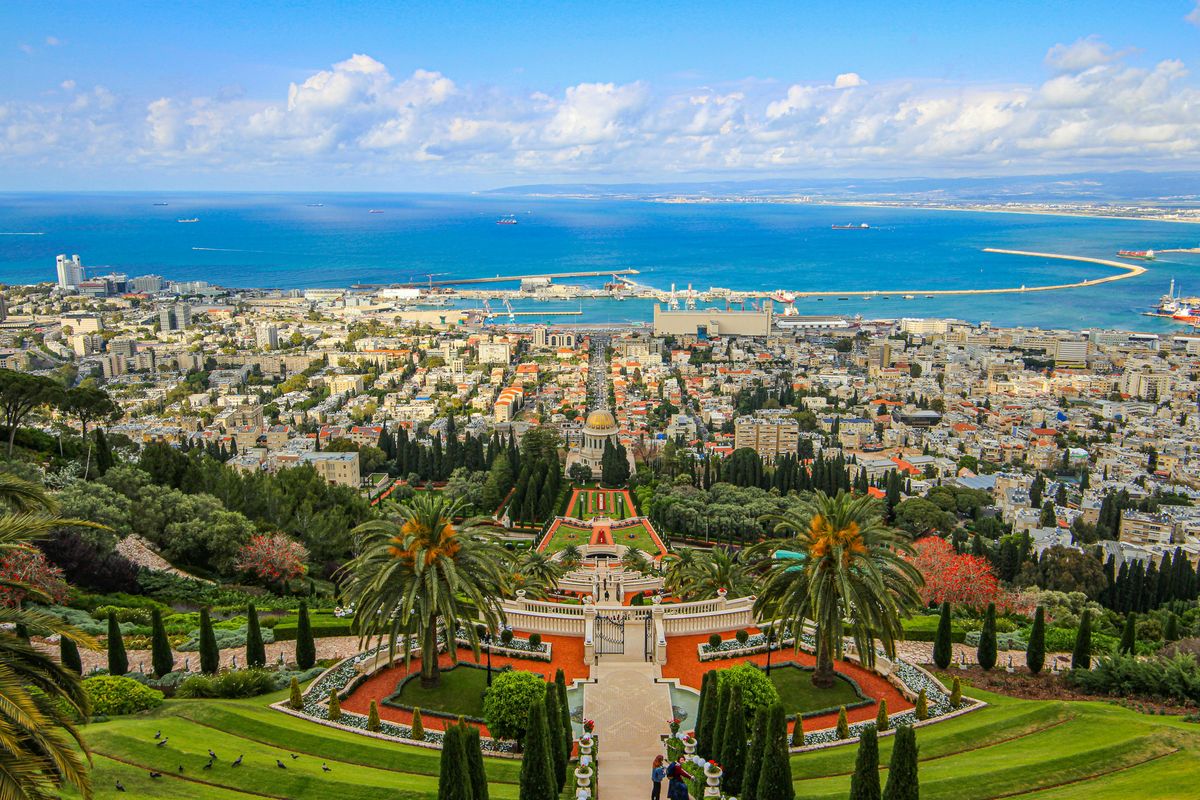
The Baha’i Gardens cascade down the northern slope of Mount Carmel in 19 terraces of manicured perfection, stretching from the crest of the mountain all the way to the German Colony at its foot. At the center of this extraordinary composition stands the golden-domed Shrine of the Bab, the burial place of the forerunner of the Baha’i faith. The gardens are a UNESCO World Heritage Site, inscribed in 2008, consistently ranked among the most beautiful gardens in the world, and for many visitors the single most visually stunning site in all of Israel. They are free to enter, open to all faiths, and maintained to a standard of horticultural precision that must be seen to be believed. For travelers who come expecting a pleasant park, the Baha’i Gardens routinely deliver something they were not prepared for: a place of such deliberate, almost overwhelming beauty that it reorders their sense of what is possible.
The Baha’i Faith – Baha’i Gardens in Haifa
The Baha’i faith was born in 19th-century Persia, in what is today Iran, and its origins lie in a time of profound religious ferment. In 1844, in the city of Shiraz, a young merchant known as the Bab, meaning “the Gate”, whose full name was Siyyid Ali Muhammad (1819–1850), declared himself to be the herald of a new messenger of God. His teachings drew thousands of followers and the fierce opposition of the Persian authorities and clergy. He was executed by firing squad in Tabriz in 1850, at the age of thirty, an event that his followers regard as a martyrdom. His follower Baha’u’llah (1817–1892), whose name means “Glory of God,” declared himself in 1863 to be the promised messenger the Bab had foretold, and became the founder of what is now the Baha’i faith.
The core teachings of the faith center on the unity of God, the unity of religion, the belief that all major world religions come from the same divine source, and the unity of humanity. The faith also teaches the elimination of all forms of prejudice, the equality of men and women, the harmony of science and religion, and the importance of universal education. Today there are an estimated five to eight million Baha’is in virtually every country on earth. The faith continues to face persecution in Iran, the land of its founding, where members of the community have been barred from higher education and imprisoned for their beliefs.
Why Haifa?
The connection between the Baha’i faith and the land of Israel was not a matter of choice, it was the consequence of exile and persecution. Baha’u’llah was expelled from Persia and exiled progressively further from his homeland: first to Baghdad, then to Constantinople, then to Adrianople, and finally in 1868 to the prison city of Akko (Acre), on the coast of what was then Ottoman Palestine. He arrived in Akko as a prisoner and spent his remaining years in the Akko area. He is buried at Bahji, near Akko, which is considered the holiest site in the Baha’i faith and the destination of Baha’i pilgrimage. Meanwhile, the remains of the Bab were hidden and transported secretly from Persia for decades after his execution, passing through many hands to protect them from destruction.
They were brought to Akko in 1899 and interred on Mount Carmel on March 21, 1909, under the direction of Abdu’l-Baha, the son of Baha’u’llah. It was Abdu’l-Baha who chose the specific site on Mount Carmel as the resting place of the Bab, following what believers hold to be instructions given by Baha’u’llah himself during a visit to the mountain in 1890. The accidents of 19th-century imperial politics thus gave the Baha’i faith its permanent world center in Israel, and gave Haifa one of its most remarkable and beautiful landmarks.
The Shrine of the Bab
At the heart of the terraces stands the Shrine of the Bab, one of the most architecturally distinctive religious buildings in the Middle East. The original structure was built in stages between 1909 and 1953, incorporating an earlier building that served as the Bab’s first resting place. The iconic golden dome that has become the emblem of Haifa was completed in 1953, designed by Canadian architect William Sutherland Maxwell, father-in-law of Shoghi Effendi, the Guardian of the Baha’i faith. The dome is clad in gilded tiles and rises above the mountainside in a manner that draws the eye from anywhere in Haifa Bay, at dawn, in midday sun, and especially at dusk, when it seems to hold the light long after the rest of the city has fallen into shadow.
Seen from the sea, the dome announces Haifa long before the city itself comes into view. The interior of the shrine is relatively simple: a central octagonal chamber containing the marble-faced tomb, decorated with Persian carpets and fresh flowers renewed regularly by devoted attendants. Visitors are asked to remove their shoes before entering and to observe silence within. The atmosphere inside is one of profound quiet, a stillness entirely separate from the busy city just beyond the garden walls. It is a space that many visitors, regardless of their own beliefs, describe as among the most moving they have encountered anywhere in the world.
The Nineteen Terraces
The nineteen terraces represent the nineteen disciples of the Bab. The terraces were designed by Iranian-Canadian architect Fariborz Sahba, whose earlier major work was the celebrated Lotus Temple in New Delhi. Construction began in 1987 and was completed in 2001. The design draws on Mughal, Persian, and European formal garden traditions, combining geometric precision with an extraordinary diversity of plant species suited to the Mediterranean climate of Mount Carmel. Nine terraces rise above the shrine and nine descend below it, framing the golden dome in a single breathtaking line from mountaintop to sea. Every hedge, every fountain, every flower bed is maintained to a standard of perfection by Baha’i volunteers who come to Haifa from countries around the world to serve at the World Centre. Maintenance is performed by volunteers, not paid gardeners, a point of which the Baha’i community is rightly proud, and one that explains the almost miraculous consistency of quality across every corner of the grounds.
The View Down the Nineteen Terraces to the Sea
There are remarkable views in Israel, and then there is the view from the top of the Baha’i terraces. Looking down the central axis, the eye travels from the precisely trimmed hedges of the upper terraces, past the golden dome of the Shrine of the Bab, continuing down through the lower gardens and the tree-lined boulevard of the German Colony all the way to the port of Haifa and the deep blue of the Mediterranean beyond. The visual composition is unlike anything else in the country, a single unbroken line of beauty descending from mountain to sea, framed on both sides by the symmetry of the terraces. The reverse view, looking up from the German Colony, is equally arresting: the terraces rise in perfect symmetry up the face of the mountain, framing the golden dome against the open sky.
At night the gardens are illuminated with carefully positioned lights, and the effect is otherworldly, the dome glowing gold above the lit terraces while the city lights of Haifa spread across the bay below and the lights of ships move slowly on the water. Sunrise and the early morning hours offer the finest natural light for photography and the quietest atmosphere for reflection. Both directions of view are essential; experienced visitors make a point of seeing the gardens from both the top and the bottom on the same visit.
The Baha’i World Centre
The terraced gardens are only one part of a larger complex that together constitutes the Baha’i World Centre on Mount Carmel. This administrative and spiritual campus includes the Universal House of Justice, the faith’s elected governing body, whose classical colonnaded headquarters sit at the top of the mountain and overlook the entire bay; the International Teaching Centre; the Centre for the Study of the Texts; and the International Archives Building, a neo-classical structure designed to evoke the Parthenon in Athens, housing the earliest sacred relics, original manuscripts, and personal artifacts connected to the founders of the faith. Together these buildings form the spiritual and administrative heart of a global religion, an unusual distinction for any city in the world, and one that has shaped Haifa’s character in ways both visible and subtle. The Baha’i World Centre employs hundreds of volunteers and staff from dozens of countries, making it a genuinely international presence in the city year-round. The Baha’i community observes strict political neutrality in all regional matters and has done so consistently since establishing its presence in the Holy Land.
Visiting the Gardens
Admission to the Baha’i Gardens is free of charge, and the gardens are open to visitors of all faiths and none. The lower terraces can be visited independently during opening hours, but the upper terraces, which offer the most dramatic downward views, require joining a guided tour, which departs at scheduled times during the morning. These tours are led by Baha’i volunteers who speak with genuine knowledge and personal conviction about what they are showing. Modest dress is required: shoulders and knees should be covered. Shoes must be removed before entering the shrine. The gardens are open daily except on Baha’i holy days, when they close entirely. Photography is warmly encouraged throughout the gardens and terraces. Comfortable shoes with good grip are advisable, as the terraces involve a considerable number of steps on a mountain slope. The gardens are at their busiest in the late morning; those who arrive at opening time are rewarded with quiet and exceptional light. The full experience, walking down through nineteen terraces of extraordinary beauty, entering the stillness of the shrine, and emerging into the panoramic view over the bay, typically takes between one and two hours, though many visitors find themselves lingering considerably longer.
Visit with Hoshen Tours
A visit to Bahai Gardens pairs beautifully with nearby destinations along your route. Consider combining it with a stop at Haifa or German Colony in Haifa, both just a short drive away. Many travelers also enjoy exploring Wadi Nisnas and Stella Maris on the same day, while Haifa Port offers another worthwhile addition to your itinerary. Your Hoshen Tours guide will craft a seamless route that brings each destination to life with expert commentary and insider knowledge.
Explore Our Tour Collection
Ready to experience Israel in true colors?
Plan Your TourPrivate tours designed around your interests, schedule, and pace.