



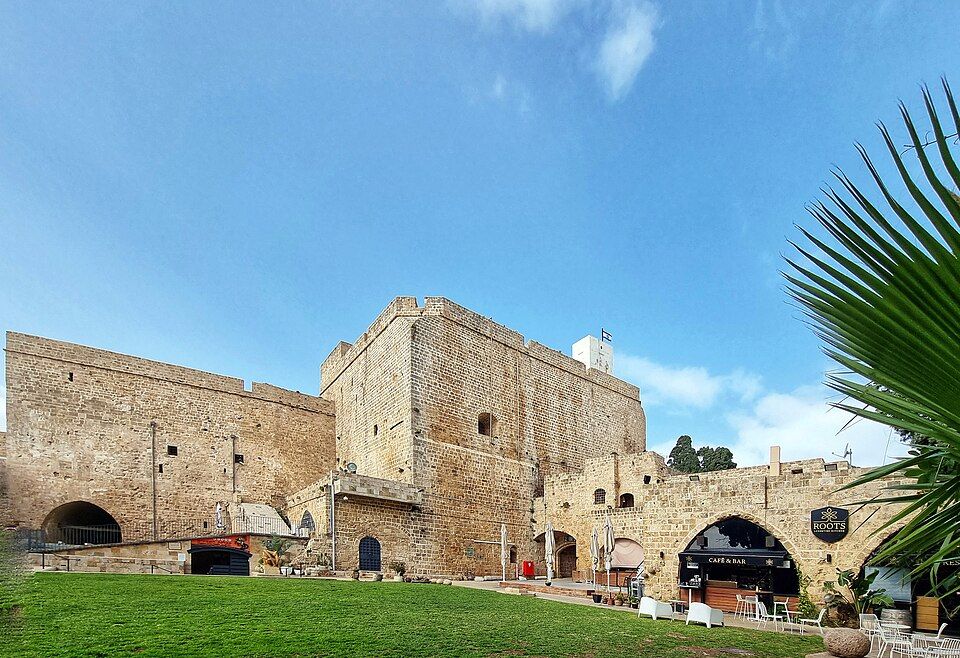
The Akko Citadel, in the heart of Akko’s Old City, served as a prison during the British Mandate (1920-1948) and became one of the most significant sites in the story of the Jewish underground’s struggle for independence. The prison held members of the Haganah, the Irgun, and the Lehi, and it was the place where Jewish fighters were executed by hanging, acts that became rallying cries for the Zionist cause and hastened the end of British rule.
From Fortress to Prison – Akko Citadel
The citadel was built in the late 18th century by Ahmad Pasha al-Jazzar, the Ottoman governor who also built Akko’s great mosque. Known in Arabic as Burj al-Khazna (Tower of the Treasury), it was constructed over the ruins of the Crusader fortress (the Knights’ Halls are directly beneath it) using massive cut stone that gives the structure its imposing, fortress-like character. When the British assumed control of Palestine after World War I, they converted the citadel into a central prison for the northern district, holding both criminal inmates and political prisoners, a population that grew increasingly charged as armed resistance intensified through the 1930s and 1940s. The cells, corridors, and execution chamber have been preserved, and the atmosphere, with its heavy iron doors, narrow windows, and stone walls, remains oppressive and authentic.
Prison Break
On May 4, 1947, the Irgun carried out one of the most daring operations of the pre-state underground: a military assault on the Akko prison to free Jewish fighters held inside. The operation, led by Dov Cohen (known as Shimshon), involved roughly 40 fighters supported by Lehi members attacking from outside while prisoners inside readied themselves to break out.
Explosives blew a hole through the outer wall. In the confusion that followed, 27 Irgun and Lehi prisoners escaped, along with more than 200 Arab prisoners who seized the opportunity. Nine Irgun fighters were killed, among them Dov Cohen himself, and several others were captured and later hanged. For the British, the break was a serious embarrassment. For the underground, it proved that no British fortress was impenetrable. The Acre prison break became one of the defining events of the independence struggle and was later depicted in the film “Exodus” (1960).
Ten Who Went to the Gallows
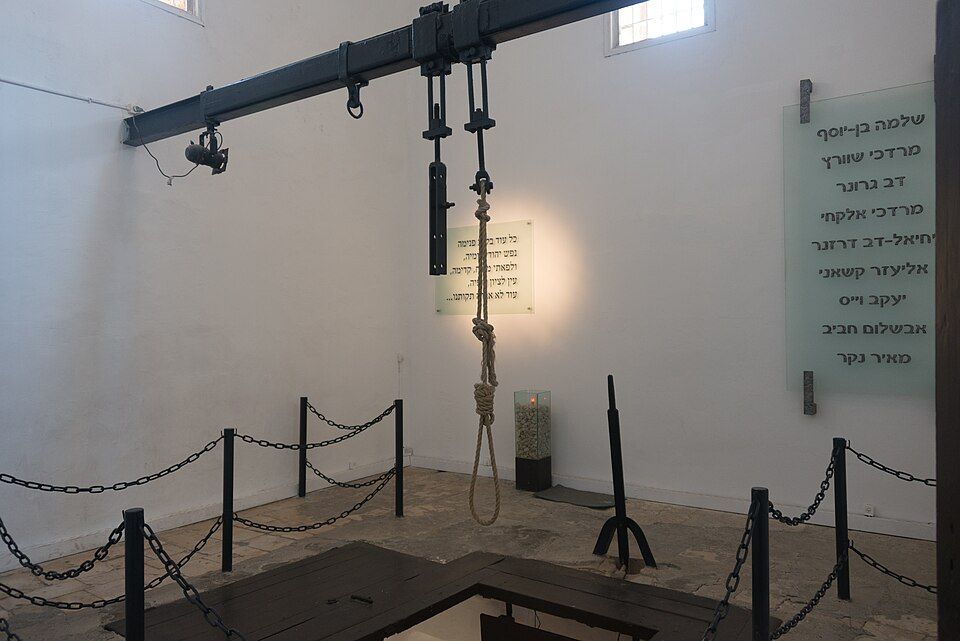 Between 1938 and 1947, the British executed Jewish underground fighters by hanging at the Akko prison. The prison is linked to the phrase “The Ten Who Went to the Gallows,” referring to ten fighters condemned to death by the British, eight of whom were hanged here at Akko. Conditions inside were harsh: overcrowding, punishment cells, limited food, and the constant awareness that a death sentence could be carried out at any time. Yet the condemned men went to their deaths with striking composure, singing Hatikvah, and became national heroes whose names were committed to memory by a generation fighting for statehood.
Among the most famous is Shlomo Ben-Yosef, the first Jew executed by the British (in 1938, for an attack on an Arab bus), and the three Irgun members, Avshalom Haviv, Meir Nakar, and Yaakov Weiss, hanged on July 29, 1947, for their role in the Acre prison break. The execution of these three men contributed directly to the British decision to withdraw from the land. The others executed at Akko include Dov Gruner, Yehiel Dresner, Mordechai Alkahi, and Eliezer Kashani, hanged on April 16, 1947, and Avshalom Haviv, Meir Nakar, and Yaakov Weiss on July 29, 1947.
Meir Feinstein and Moshe Barazani
Two of the most famous prisoners of the Mandate period were Meir Feinstein of the Irgun and Moshe Barazani of the Lehi. Although imprisoned in Jerusalem’s central prison rather than at Akko, their story is inseparable from the prison narrative of the underground. Both were sentenced to death. Two others condemned to death, Meir Feinstein of the Irgun and Moshe Barazani of Lehi, were held in the Jerusalem Central Prison. Rather than be transferred to Akko for hanging, they smuggled a grenade into their cell, hidden inside a hollowed-out orange. On the eve of their scheduled hanging, in April 1947, they embraced and detonated it together. Before they acted, they sang Hatikvah. Their graves on the Mount of Olives became a place of pilgrimage, and their story, the refusal to grant the enemy the dignity of the execution, stands as one of the most powerful accounts in the literature of the Jewish underground. The courage they embodied was the same spirit carried by those who went to the gallows at Akko.
The Underground Prisoners Museum and the Gallows Room
The Underground Prisoners Museum in the Citadel tells the story of the Jewish prisoners through personal items, photographs, documents, letters, and cell reconstructions. It documents the prison routine and the relationships between Jewish, Arab, and criminal prisoners. A memorial wall lists the names and faces of the executed fighters.
The execution chamber is preserved as it was: a trapdoor in the floor, the beam overhead, the noose mechanism, all left in place without dramatization. The names of those who died here are inscribed on the walls, and their last words, recorded by prison officials, are displayed nearby. Visitors often stand in silence. The simplicity of the space is precisely what presses hardest on the conscience: that ordinary rooms and ordinary bureaucracies carried out these executions, and that young men walked into this room and did not flinch.
Visit with Hoshen Tours
A visit to Akko Prison pairs beautifully with nearby destinations along your route. Consider combining it with a stop at Knights Halls in Akko or Tunisian Synagogue in Akko, both just a short drive away. Many travelers also enjoy exploring Templar Tunnel in Akko and Akko on the same day, while Yehiam Fortress offers another worthwhile addition to your itinerary. Your Hoshen Tours guide will craft a seamless route that brings each destination to life with expert commentary and insider knowledge.
Explore Our Tour Collection
Ready to experience Israel in true colors?
Plan Your TourPrivate tours designed around your interests, schedule, and pace.