



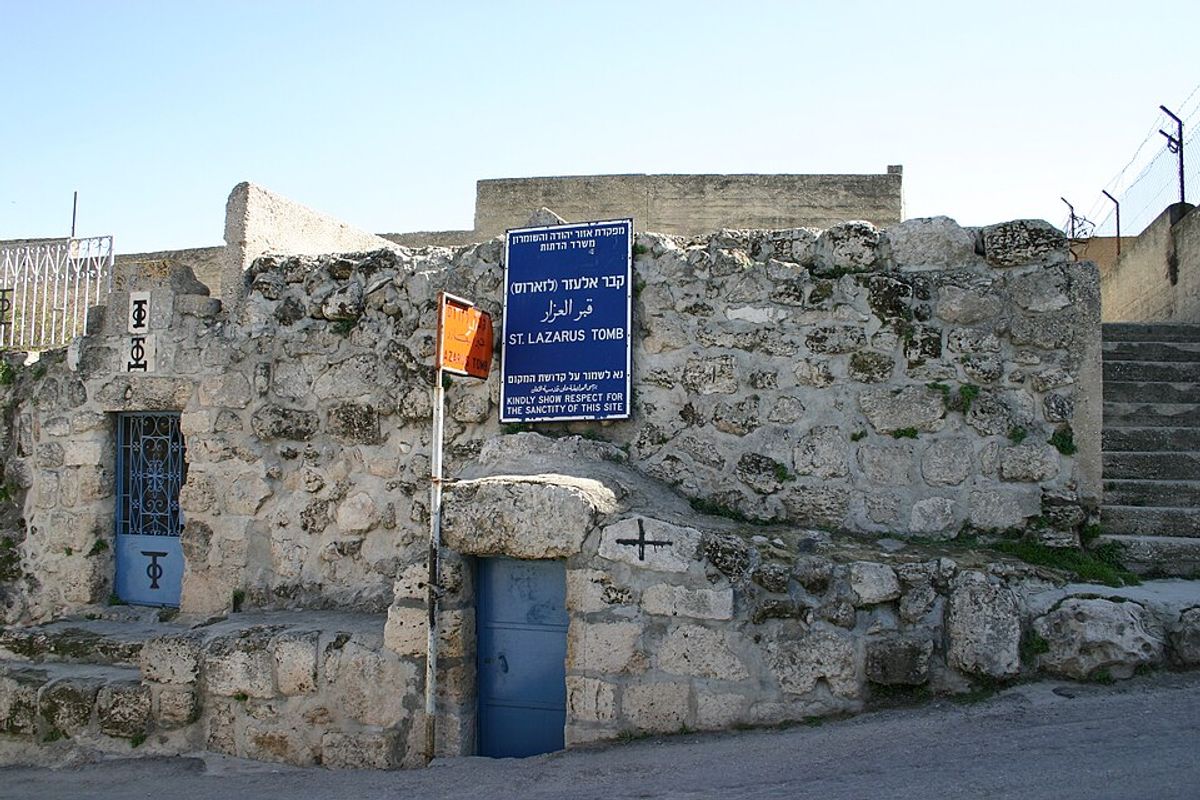
Bethany, known today as Al-Eizariya, a name derived from the ancient Lazarium, is a small village nestled on the eastern slope of the Mount of Olives, approximately three kilometers east of Jerusalem. Despite its modest size, Bethany occupies an outsized place in the Christian imagination, for it was here, according to the Gospel of John, that tradition holds that Jesus performed one of the most dramatic and theologically charged miracles recorded in the New Testament: the raising of his friend Lazarus from the dead. Pilgrims have been drawn to this hillside village for nearly seventeen centuries, descending into the rock-cut tomb believed to be that of Lazarus and standing in the same narrow lanes where Jesus is said to have wept before the sealed entrance. For visitors traveling with Hoshen Tours, Bethany offers one of the most moving and tangible encounters with the world of the Gospels.
Lazarus in the Gospels
The story of Lazarus is told in extraordinary detail in John 11:1–44, making it the longest miracle narrative in the Fourth Gospel. Lazarus, a resident of Bethany, falls gravely ill. His sisters Martha and Mary send word to Jesus, who is across the Jordan. Rather than departing immediately, Jesus delays two days, a detail that puzzles his disciples and deepens the theological drama. By the time Jesus arrives in Bethany, Lazarus has been in the tomb for four days. Martha meets Jesus on the road and declares her faith, “Lord, if you had been here, my brother would not have died”, and then makes her celebrated confession: “I believe that you are the Messiah, the Son of God.” Mary falls at Jesus’s feet weeping, and Jesus himself is moved to tears. “Jesus wept”, the two-word verse of John 11:35, is famously the shortest verse in the English Bible and one of the most theologically rich: it is understood as a revelation of divine compassion and shared human grief.
Jesus then commands the stone to be rolled away from the tomb, prays aloud, and calls out, “Lazarus, come forth!” Tradition holds that Lazarus emerged, still bound in his burial cloths, and was restored to life before the gathered crowd.
Bethany appears again in John 12:1–8, where six days before Passover Jesus returns for a dinner in his honor. Martha serves, Lazarus reclines at table with Jesus, and Mary anoints Jesus’s feet with expensive nard perfume and wipes them with her hair, an act that fills the house with fragrance and prompts Judas Iscariot’s objection about the cost. The scene is one of the most intimate in the entire Gospel narrative. Earlier, in Luke 10:38–42, a different visit to the home of Martha and Mary is recounted: Martha busies herself with preparations while Mary sits at Jesus’s feet listening to him teach. When Martha complains, Jesus gently defends Mary’s choice, “the good portion, which will not be taken from her.” Together these passages paint Bethany as a place of friendship, rest, and deep spiritual encounter for Jesus during his ministry around Jerusalem.
The Tomb of Lazarus
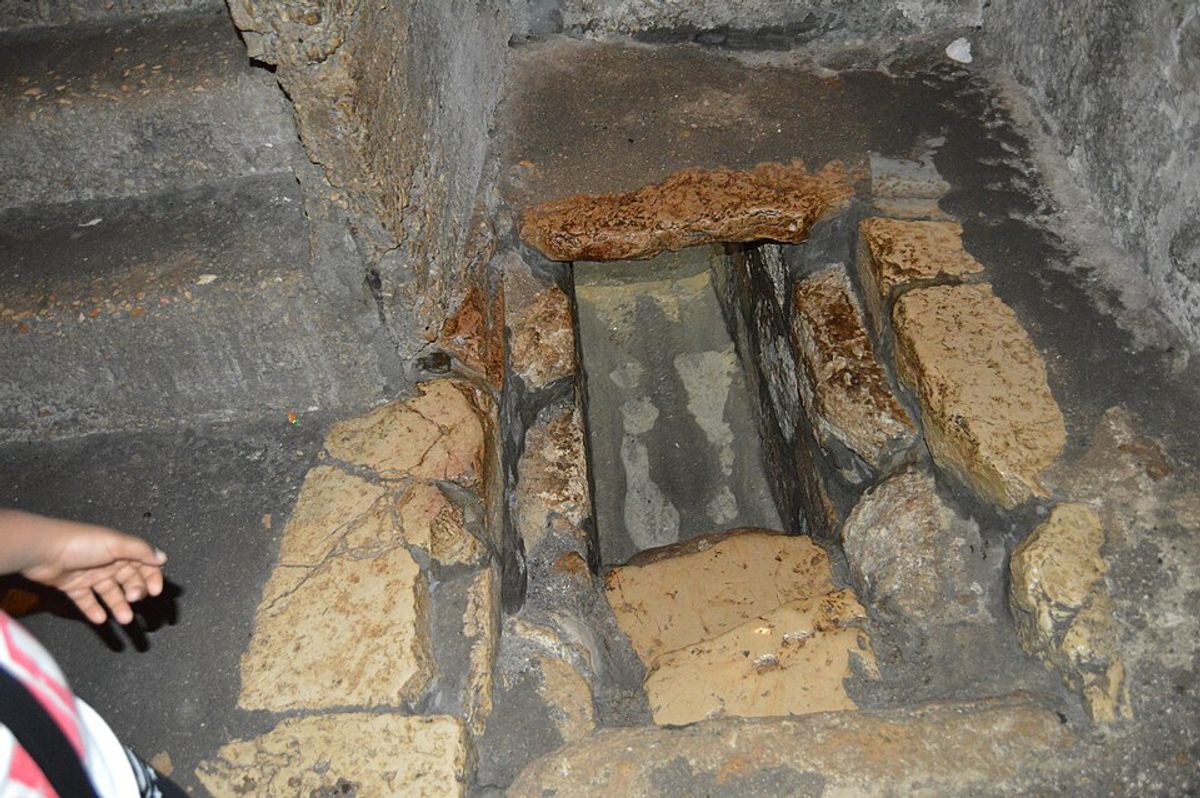
The tomb that visitors descend into today is a rock-cut burial chamber of the type common in first-century Judea. Reaching the burial chamber requires navigating 24 steep, narrow steps that were cut by Franciscan friars in 1566. The need for this new entrance arose because the original access to the tomb had been blocked when a mosque was constructed over the site, built atop the earlier Crusader-era church that had itself incorporated the tomb into its structure. The current entrance thus approaches the chamber from the side rather than from above, through a low passage that requires visitors to stoop as they descend.
Inside, the rock-cut chamber is simple and stark: rough limestone walls, uneven footing, and an atmosphere of great antiquity. Christian veneration of the site stretches back at least to the fourth century. The church historian Eusebius of Caesarea, writing around 330 CE, refers to the Lazarium at Bethany as a well-known landmark. The Bordeaux Pilgrim, writing in 333 CE, is among the earliest Western travelers to mention the tomb explicitly. By the Byzantine period the site had become an established destination on the pilgrimage circuit of the Holy Land, and the Arabic name Al-Eizariya, still the village’s official name today, is a direct linguistic echo of that ancient Lazarium, preserving the memory of Lazarus in the very topography of the land.
The Churches of Bethany
Bethany’s layered religious history is visible in its architecture. The most prominent structure for Christian visitors is the Church of St. Lazarus, a Franciscan church completed in 1954 and designed by the celebrated Italian architect Antonio Barluzzi, who also designed the Church of All Nations on the Mount of Olives and several other landmark churches in the Holy Land. Barluzzi designed the church to evoke the transition from death to life, with the interior moving from darkness at the entrance to light at the altar. The church stands on ground that has been a place of Christian worship for over sixteen centuries.
A Greek Orthodox church in the village also claims association with the Bethany narrative, reflecting the longstanding presence of Eastern Christianity in the region. The mosque adjacent to the tomb entrance was built over an earlier Crusader-period church, which was itself constructed over Byzantine-era remains. Beneath these successive layers of construction lies the memory of the fifth-century church commissioned around 450 CE during the time of Empress Eudocia, the Byzantine empress who was a generous patron of church construction throughout the Holy Land. Excavations and historical records suggest that this early basilica incorporated and honored the tomb of Lazarus as its centerpiece, establishing a pattern of veneration that subsequent centuries, Crusader, Franciscan, and Ottoman, would each continue in their own way.
Bethany in Christian Tradition
Beyond the raising of Lazarus, Bethany holds a broader significance in the Gospel narrative that is easy to overlook. For Jesus during the final week of his life, Bethany functioned as something of a base camp on the edge of Jerusalem, a place of rest, friendship, and safety outside the charged atmosphere of the city. The Synoptic Gospels indicate that Jesus lodged in Bethany each night during the days leading up to his arrest, walking the two-mile road over the Mount of Olives each morning into Jerusalem and returning each evening to the hospitality of Martha, Mary, and Lazarus.
It was from the vicinity of Bethany and the neighboring village of Bethphage that the Triumphal Entry into Jerusalem began. Mark 11:1 places the disciples’ procurement of the colt at Bethphage and Bethany, and it is from this eastern ridge of the Mount of Olives that the crowd spread cloaks and branches on the road, greeting Jesus with cries of “Hosanna” as he rode down toward the city. Luke’s Gospel also situates the Ascension in the neighborhood of Bethany: Luke 24:50–51 records that Jesus led his disciples “out as far as Bethany” before he was lifted up and carried into heaven. Tradition holds that the primary site of the Ascension is marked on the summit of the Mount of Olives, but the Lucan reference to Bethany reminds pilgrims that this entire ridge, from Bethany to the summit, is woven into the closing chapters of Jesus’s earthly story.
Visit with Hoshen Tours
The Tomb of Lazarus in Bethany marks the place where, according to the Gospel of John, Jesus raised his friend from the dead. Hoshen Tours pairs it with the Shepherds’ Fields, the palace-fortress of Herodium, Bethlehem’s olive wood workshops in Bethlehem, and the desert monasteries at the Judean Desert Monasteries.
Explore Our Tour Collection
Ready to experience Israel in true colors?
Plan Your TourPrivate tours designed around your interests, schedule, and pace.